Purdue HHS professor’s ample undergraduate research opportunities inspire, solidify future careers
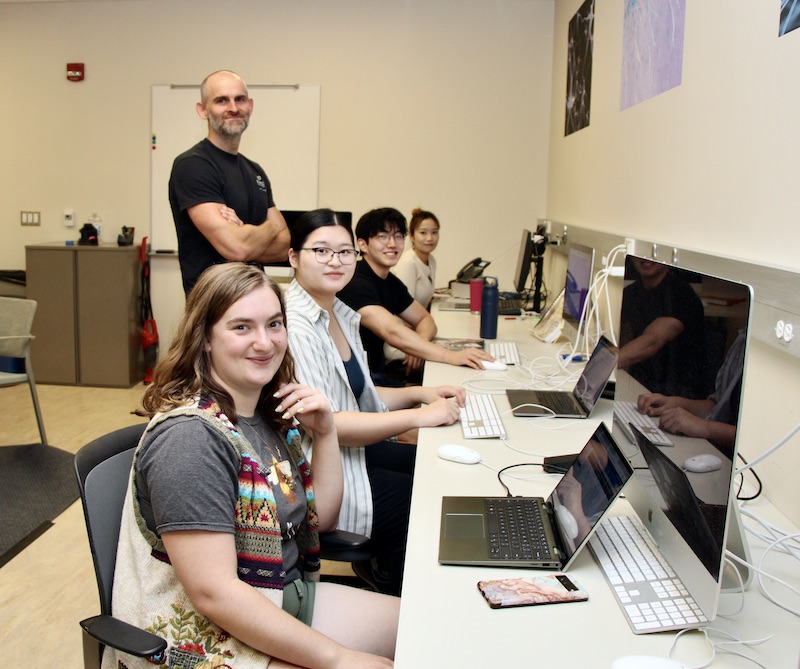
Brandon Keehn, associate professor in the departments of Speech, Language, and Hearing Sciences and Psychological Sciences, stands while his undergraduate student researchers, from front, Rachel Rieck, Iris Yao, and Sunny Yoon and his PhD candidate Yesol Kim take a break from crunching data.(Tim Brouk)
Written by: Tim Brouk, tbrouk@purdue.edu
Brandon Keehn, associate professor in the Purdue University departments of Speech, Language, and Hearing Sciences and Psychological Sciences, owes his career trajectory to a research opportunity he had as an undergraduate student at the University of Washington.
As a then psychology major, Keehn joined a lab that focused on autism, eye-tracking and electroencephalography (EEG). About 20 years later, Keehn’s academic research focus is on autism, and he uses eye-tracking technology and EEG to measure attention and sensory processing in toddlers and children with autism, with the goal of developing tools that can improve the access and accuracy to early autism diagnosis.
“I don’t think I’d be here if it wasn’t for that particular experience,” said Keehn, who is also a past director of the Purdue Autism Research Center. “That was my first exposure to autism, eye-tracking and EEG. It was a pretty formative experience in my whole research trajectory.”
For Keehn’s research within his Attention and Neurodevelopmental Disorders Lab, summer is pivotal for collecting data from school-age children. Despite being the traditional time for internships, family vacations and summer jobs for Purdue students, his lab is often full of Purdue College of Health and Human Sciences (HHS) undergraduate students gaining summer research experience. Most have had previous research opportunities during fall and spring semesters, but summer has its challenges — part-time work, living situations and summer courses. However, Keehn and other faculty proponents of summer undergrad research make it work by accommodating their schedules and offering them opportunities that will only enhance their HHS training and education.
Currently, numerous projects within Keehn’s lab have the undergrads busy — analysis of datasets collected from pediatrician offices around Indiana where toddlers have undergone an eye-tracking diagnostic test, work from Keehn’s PhD candidate Yesol Kim’s dissertation on behavioral flexibility in school-age children and adolescents with autism as well as their own personal projects. Allowing students to work on independent projects helps develop passions for conducting research, he believes.
“Many students that have come through the lab often take a piece of the data and then make it their own, or they have their own question that they may be interested in that they can ask with our data,” Keehn explained. “So, in addition to helping collect the data that we need for our studies, they are also in the process of developing their own studies.”
‘A no-brainer’
Like many incoming HHS students, Rachel Rieck, a senior in the Department of Psychological Sciences, arrived in West Lafayette with research as a goal. After a study abroad semester to cap off her sophomore year, Rieck sought an opportunity to research autism. She found her opportunity while talking Keehn’s SLHS 41800 (Understanding Autism) course.
“I was like, ‘If anyone here is researching autism, it’s going to be him,’” Rieck said with a laugh. “I’ve been very invested in this. This is where I want to be, so it’s kind of the best opportunity for me. So, it makes sense if you want to do research, you’re doing research over the summer. They’re really flexible with my schedule. It’s really a no-brainer for me to be here.”
Rieck is investigating females with autism and how the disorder is linked to anxiety and depression by using a dataset from a previous study.
Iris Yao, a junior studying psychological sciences, and Sunny Yoon, a junior in the Department of Biological Sciences, joined Keehn’s lab to expand their knowledge of EEG and eye-tracking methodology. While learning the technical sides of EEG as well as properly applying the snug cap of electrodes to participants’ scalps, Yoon became interested in the lab’s mission to recognize the early signs of autism.
“I just picture myself being in academic research in the future,” he said. “I felt like this summer I had a lot of time to invest and really gain experience in research. I think there’s a lot of things you just learn by doing them. So, I think that was the most logical step just using my time this summer to gain experience.”
Coming to Kenya
While his current crop of students is using previously acquired data from children here in Indiana, future student researchers will have fresh, international data to comb through. Keehn’s mission to help pediatricians and other health care professionals better diagnose children with autism has gone international thanks to a new five-year Research Project (R01) grant from the National Institutes of Health and funds from the Purdue Kinley Trust that will fund his research in Kenya. Keehn began traveling there in fall 2024 and has since made several other trips to get the project started.
The work introduces Keehn’s new eye-tracking tool that features a “battery” of biomarker videos for toddlers and very young children to watch that help indicate whether a child may have autism. Keehn and his team are working to create a device that is easily portable and could prove vital in low-resource areas in the U.S. (e.g., in rural areas) and across the globe that have few health care professionals trained in recognizing the early signs of autism. Keehn disclosed his tool to the Purdue Innovates Office of Technology Commercialization, which has applied for a patent to protect the intellectual property.
“Almost all the research that’s been done in autism has been done in the U.S. and the West — in industrialized, high-income countries, Keehn said. “The vast majority of the children in the world live in low- and middle-income countries, and thus the vast majority of the world’s autistic children live in low- and middle-income countries. Very little research on autism has been done in those countries.
“The Kenyan project is all about taking the tool that we developed here in Indiana and adapting it and validating it in a place like Kenya, so we can then say, ‘OK, now we know this tool also works in Kenya. Can we apply it more broadly to the rest of the world?’”
Keehn’s first trips to Kenya brought back data from 100 children. The goal of this five-year project will be to test 850 children total.
With all this vital work, Keehn places great value on the assistance of his undergraduate student researchers, especially in the summer. And not only do the students help with potentially life-changing work, but they may also be inspired to pursue such research as a career, just like Keehn did 20 years ago as an undergrad himself.
“For me, it’s definitely solidified my career goals,” Rieck said. “It’s kind of like a glimpse into the future of where I will hopefully be one day. So, this research opportunity really helped prepare me for what to expect going forward. Everyone kind of wonders what they’re going to be when they grow up. ‘What will my life look like when I have this job?’ It’s a really great opportunity to be like, ‘Oh, this is actually what people who are doing research, this is what their lives are like.’ So that’s been really helpful for me.”
Discover more from News | College of Health and Human Sciences
Subscribe to get the latest posts sent to your email.