Purdue Nutrition Science graduate student cracks into boosting adolescent nutrition through eggs
Written By: Rebecca Hoffa, rhoffa@purdue.edu

Anali Morales-Juarez (center) poses for a photo with her mentor, Heather Eicher-Miller (right), after receiving the Catherine L Justice Family Nutrition Grant from the Center for Families.(Photo provided)
Adolescents, which typically span ages 10-19, have the poorest nutrition quality among any age group in the United States, according to data presented in the 2020-25 Dietary Guidelines for Americans. In fact, a recent study comparing 21 micronutrients across both food secure and food insecure adolescents by Anali Morales-Juarez, a PhD student in the Purdue University Department of Nutrition Science (NUTR), found that regardless of food security status, adolescents have equally poor diets overall.
Because of the significant brain and physiological changes happening during this stage of life, diet is critical, which has led Morales-Juarez to pursue translational research to help adolescents and other vulnerable populations achieve healthier diet patterns.
“Just being an adolescent in this country, this group is at a higher risk of having a low micronutrient intake,” Morales-Juarez said. “This is very concerning because this means that just because they’re food secure doesn’t mean they are having a healthy food intake.”

Anali Morales-Juarez(Photo provided)
One potential solution Morales-Juarez has found in her work under the mentorship of Heather Eicher-Miller, NUTR professor in the College of Health and Human Sciences, is eggs.
“Thinking about that issue and how we can improve their nutrient intake, we think eggs can be a food that we can promote among adolescents because they are very easy to prepare and generally tend to be a cheaper protein source,” Morales-Juarez said. “I think we can use this information to inform nutrition education programs as well because this can be implemented not only to general adolescents but also low-income adolescents or adolescents who are facing food insecurity.”
In a theoretical statistical analysis published in Nutrients and funded by the American Egg Board, Morales-Juarez explored substituting an egg in place of a portion of the protein sources listed in four popular exemplary menus: the Healthy U.S.-Style Dietary Pattern; Harvard Medical School’s Heathy Eating Guide; the National Heart, Lung, and Blood Institute’s Dietary Approaches to Stop Hypertension diet; and the Healthy U.S.-Style Vegetarian Dietary Pattern. In doing so, she found this substitution led to improved diet quality for adolescents in relation to two critical micronutrients in brain and bone development.
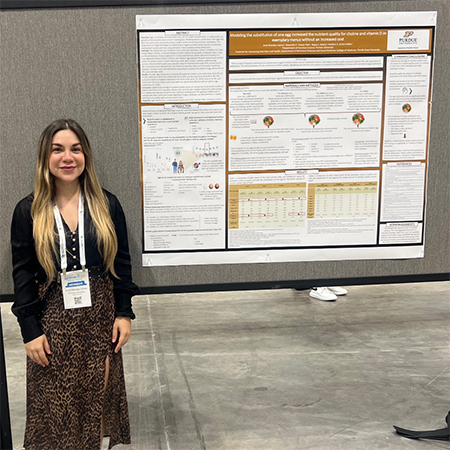
Morales-Juarez presents a research poster.(Photo provided)
“We took this approach because we wanted to maintain the flavors and nature of the original recipe,” Morales-Juarez said. “Then we compared outcomes before and after the egg substitution. We observed that (the nutrients) choline and vitamin D improved.”
Eicher-Miller noted Morales-Juarez’s high-impact research has direct implications for nutrition policies and programs that could help families improve their diet quality and overall health and well-being.
“Anali is an exceptional graduate student who has demonstrated outstanding leadership, productivity, imagination, originality and intellectual curiosity in her research,” Eicher-Miller said. “Her studies fill a critical gap in knowledge and have been addressed with the highest rigor, providing strong evidence to improve diets and household well-being.”
Morales-Juarez has been involved with research since she earned her bachelor’s degree in nutrition in Guatemala. While working as a research assistant, she enjoyed following the numbers and their patterns, but she often found herself asking about the analysis that came next in the process.
“I was always having this curiosity about what happened with the results,” Morales-Juarez said. “Did this intervention really help or work out?”
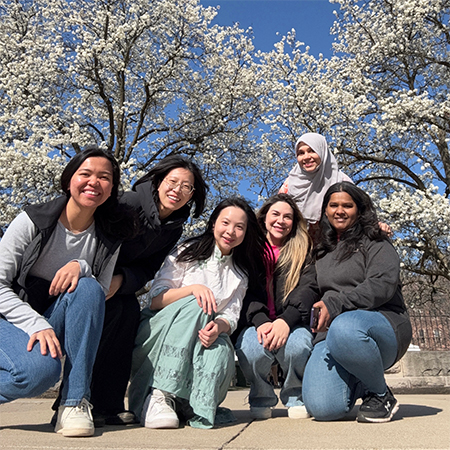
Morales-Juarez (third from right) poses with her Department of Nutrition Science cohort. (Photo provided)
For Morales-Juarez, who was connected to Purdue through her Fulbright scholarship, the university has offered the perfect home for her research, offering courses and opportunities that have given her a broader perspective toward the mechanisms that influence nutrition and diet.
“I love the Department of Nutrition Science,” Morales-Juarez said. “It’s a very diverse department in terms of the classes that we take. My background is in nutrition as a dietitian, but in my first semester, I took classes about molecular biology. That was very out of my comfort zone, but it has given me a different perspective as a scientist. It’s also very diverse in the different nationalities of students we have here. In my cohort, we represent six different countries, so I’ve had the opportunity to learn about different countries through the eyes of my friends.”
Ultimately, Morales-Juarez hopes to make a longstanding difference in dietary behavior and nutrition education through continued research in this area.
“Dietary behavior is very complex,” Morales-Juarez said. “I hope to translate my research into policies or interventions to inform and improve nutrition programs.”
Discover more from News | College of Health and Human Sciences
Subscribe to get the latest posts sent to your email.