Purdue Health and Kinesiology researchers explore possible link between air pollution and falls in college students
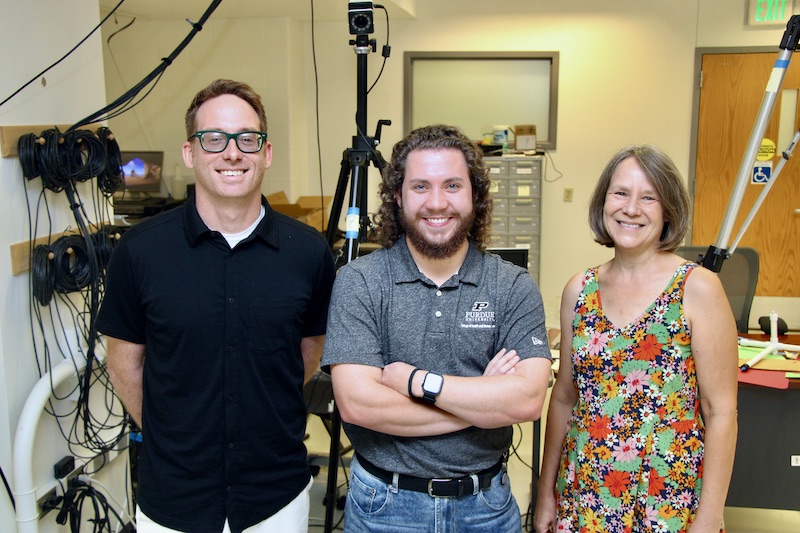
Steve Amireault, left and associate professor in the Purdue University Department of Health and Kinesiology, PhD student Riley Schellingerhout and Professor Shirley Rietdyk investigated correlations between air pollution levels and falls in Purdue students.(Tim Brouk)
Written by: Tim Brouk, tbrouk@purdue.edu
For more than a decade, Shirley Rietdyk and her fellow researchers in the Purdue University Human Motor Behavior Group have analyzed falls and loss of balance in an understudied, but abundant, demographic — college students.
The group has published papers from a large dataset of more than 300 Purdue students ranging from mainly ages 19-22 — with some outliers in their mid-to-late 20s. The information was collected from hundreds of self-report surveys given to eight different student cohorts for eight weeks from 2014-19. More than 400 falls were recorded.
Riley Schellingerhout, a PhD student in the Purdue Department of Health and Kinesiology, took a fresh look at the data. While there were fewer falls among the college students than in the commonly studied demographics of older adults and toddlers, the data revealed interesting trends.
“The general idea was over the course of a semester, they would get a question every single day saying, ‘Did you fall, trip or slip in the last 24 hours?’” Schellingerhout explained. “If they hadn’t, they said ‘no.’ End of survey. Really fast and simple. If they did fall, trip or slip or any of that, it would ask a few follow-up questions.”
Those questions included: What time of day was it? Was it outside or inside? Did they trip, slip, or was it a full fall? Were they talking to a friend at the time of the fall? Were sports involved?
With weather playing a major role in falls in winter — ice, snow and wind, Schellingerhout wondered what other environmental factors could lead to falls. While digging around with air quality index (AQI) measurements from the U.S. Environmental Protection Agency (EPA), he looked at the air pollution levels on days that had the most reported falls from young Boilermakers. He found air pollution levels were higher than average for West Lafayette when many of the falls occur.
Levels reached as high as 110 AQI. The EPA suggests as AQI goes up and moves into higher risk categories, more people are likely to be affected. Some days were less than five AQI.
“The actual finding was for every 10-point increase in AQI, it was a 44% increase in fall incidence,” Schellingerhout said. “The baseline fall rate for young adults is quite low, but it’s notable that the correlation existed even in a population that most people would consider to be at the lowest risk for falling.”
A bouquet of pollutants
AQI measures ground-level ozone, particle pollution, carbon monoxide, sulfur dioxide and nitrogen dioxide in our air. Rietdyk cited international studies that look at how pollution affects the mobility of middle-age and older adults. While the air pollution levels in West Lafayette pale in comparison to major cities such as Beijing, Los Angeles or Mexico City, the air pollution can still be harmful to Boilermakers walking around outside.
“These young people are compromised by poor air quality index, and it’s affecting their sleep and their motor control,” Rietdyk said. “Researchers who study AQI use the word ‘neurotoxic’ to describe the effects. Pollution affects the sensory system, the cognitive system, the cardiovascular system. All of those are important for falls.”
Schellingerhout concurred, “Slightly larger particles that we breathe in on a regular basis will often stick to the inner lung surface and eventually get transported out by small structures called cilia that move mucus — and all the stuff trapped in it — out of your lungs. When that mucus builds up too much, we just cough or clear our throats to get it out.
“In contrast, really tiny particles can actually get into the lung cells instead of just sticking to the surface. At that point, the normal mucus and cilia cleaning system doesn’t apply, and the pollutants that are now in your cells can potentially move to other parts of the body.”
Distraction in the air too
Many students chalked up their falls or slips to distractions. What distracted them is surprising, especially in the digital age.
“We did actually find that walking and talking to a friend was pretty strongly associated with falls,” Schellingerhout reported. “We had few falls associated with a device. My rationale is if you see someone texting while they’re walking, they’re walking really slowly. So, if they do bump into something or trip, they’re probably going to recover. They might be more likely to get hit by a car, but we’re not codifying that.”
Keeping Boilermakers upright
With only an average of a little over one fall per student in the dataset, Boilermakers are walking tall most of the time. When digging deeper, some students who accounted for multiple falls participated in sports, such as soccer, cross country running and basketball, where falling can occur.
This detail opened another research question from this large data pool: What role does physical activity play in the falls of college students? Not surprisingly, higher levels of physical activity were associated with a higher number of falls. During sports, fall-risk is higher because people tend to move faster and the environment is less predictable, including the movement of opponents. However, most falls in this group did not occur during sports, most falls occurred during a very common activity: walking. Rietdyk and Steve Amireault, associate professor of health and kinesiology, plan on investigating if the lack of physical fitness means more falling for students. Do sedentary people have a higher risk of falls than physically fit folks?
“Physical activity has many benefits. One of them is you push your balance with physical activity. If you only participate in activities that are not physically demanding, your balance will not improve,” Rietdyk said.
Amireault supported the physical activity and balance link too.
“The most recent worldwide guidelines for fall prevention and management in older adults recommends a multicomponent physical activity modality,” he said. “Going to the gym, for example, may include aerobic, strength and balance training. Also, tai chi. Multicomponent physical activity will help improve aerobic fitness, muscular fitness, flexibility and balance as well.”
Discover more from News | College of Health and Human Sciences
Subscribe to get the latest posts sent to your email.