Purdue students take multidisciplinary approach to address public health issue in national case competition
Written By: Rebecca Hoffa, rhoffa@purdue.edu
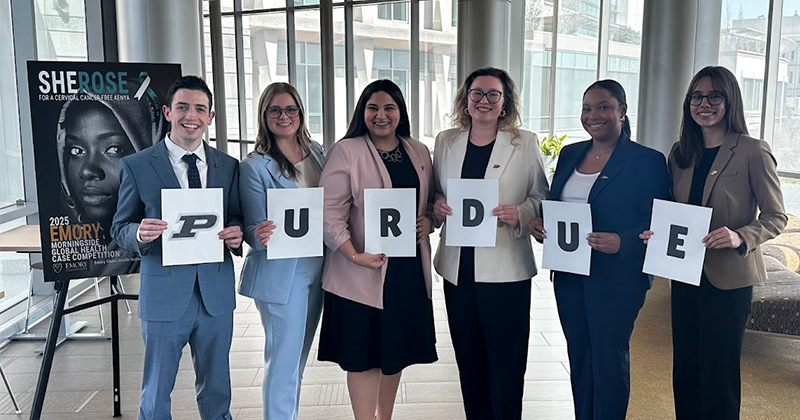
The six-student team consisting of Russell Kleiner, Ashley Fitzpatrick, Simran Vedvyas, Yvonne Ritsema, Christelle Altidor and Hannah Hampson poses for photo at the Emory Morningside Global Health Case Competition.(Photo by Jorge Banda)
Cervical cancer is deadliest among lower-income countries and is the leading cause of cancer deaths in Kenya, according to 2024 data from the World Economic Forum. This is a public health issue six Purdue University students were ready to tackle at March’s Emory Morningside Global Health Case Competition.
“Worldwide, about four per 100,000 women die of cervical cancer,” said Russell Kleiner, a Master of Public Health (MPH) student in the Department of Public Health and captain of Purdue’s case competition team. “In Kenya, it’s about 10 times the world statistic. Cervical cancer is entirely preventable. It’s a disease of inequity.”
Although it was Purdue’s first year competing in the competition, led by Jorge Banda, clinical assistant professor of public health, the team got to compete alongside some of the top schools in the country. The six-person team of Boilermakers spanned across areas of study in public health, nursing, anthropology and pharmacy.
“It’s really cool because Purdue’s Department of Public Health is still rather new, only being around for six years, so being invited so early was really neat,” Kleiner said. “This experience definitely is the cornerstone of my MPH. I think far too often we as students get stuck in a cycle of waking up, going to class and doing homework. Remembering what we’re learning and what we’re doing is real and affects people is huge — you can’t get that anywhere else.”
The idea for getting involved in the competition originated with first-year public health undergraduate student Hannah Hampson, who participated on the national competition team. She brought the idea to Boiler Advocates for Student Empowerment, a club for which Banda is the faculty advisor. She noted the support of the department and colleges of Health and Human Sciences, Liberal Arts and Pharmacy led to the idea’s success.
“It was something I had seen other universities participate in and thought it was a really great opportunity,” Hampson said. “The department and colleges ended up picking it up and expanding it beyond what I had imagined. That was really neat to see happen.”
While the Emory competition was the goal, after Banda submitted the Emory application on behalf of Purdue, he organized an internal Purdue event. In the smaller-scale competition, students looked at the topic of violence against women in Southeast Asia and competed to be selected to participate in the national competition.
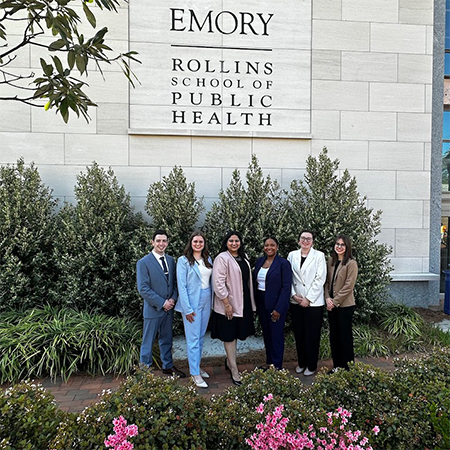
Russell Kleiner, Ashley Fitzpatrick, Simran Vedvyas, Yvonne Ritsema, Christelle Altidor and Hannah Hampson pose in front of the Rollins School of Public Health at Emory University.(Photo by Jorge Banda)
“I thought no matter whether we were or were not selected to compete at Emory, it would still be a great opportunity for students from different disciplines to come together and learn from each other around a very important public health topic,” Banda said.
The students who advanced to the Emory competition tackled the issue of cervical cancer screening and treatment in Kenya. Their solution looked to establish an ambassador program to encourage testing and care, deploy mobile clinics, develop an app for health care providers, and create bridges to care for follow-up and treatment.
While 28 teams competed in the Emory competition, only five moved on to the final round to determine the winner. While Purdue did not advance, Banda and the students were proud of their performance and received praise from many in attendance.
“The little things still matter,” Kleiner said. “We’re talking about people’s problems — that’s a sister, a daughter, a mom. The Emory program director, who was in our presentation, mentioned to us afterward that the line I had the honor of closing with was hugely impactful to her. It basically said, ‘In the last 20 minutes that we’ve been here, 40 baby girls were born in Kenya, and this solution will make it so cervical cancer is never an issue in their mind.’”
For Christelle Altidor, a nursing PhD student, participating in the competition gave her an entirely new perspective toward the public health and business angles of health care delivery.
“I think in health care we often just focus on the patients and their care, but we don’t necessarily think about how to get other people to buy into what we’re selling,” Altidor said.
The Emory competition required a multidisciplinary team from three or more colleges to qualify, and the team members saw the coming together of six distinct perspectives as a strength in their solution.
“Everything about public health is so multifaceted,” Hampson said. “In order to create a solution that is viable and has a chance at working, you have to have people from different backgrounds who have different ideas and philosophies about the solution we can come up with. So having people from a wide variety of disciplines representing multiple colleges helped us bring that additional layer of complexity and depth to our solution.”
From the Department of Public Health to each of the three colleges involved, Kleiner noted the support within Purdue is what made participation in the competition possible.
“I think that shows a lot to Purdue’s desire to get their students to the best places they can,” Kleiner said. “That’s those giant leaps — that’s what makes Purdue Purdue.”
While each student walked away from the competition with new perspectives and lessons, Banda and the students are reflecting on their experiences and looking ahead to future competitions.
“It kind of reinforces your love for the field, seeing people try to come up with solutions to problems that you know are out there and other people aren’t necessarily paying attention to,” Altidor said.
Discover more from News | College of Health and Human Sciences
Subscribe to get the latest posts sent to your email.