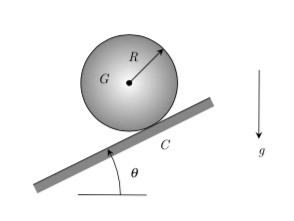
Any questions??
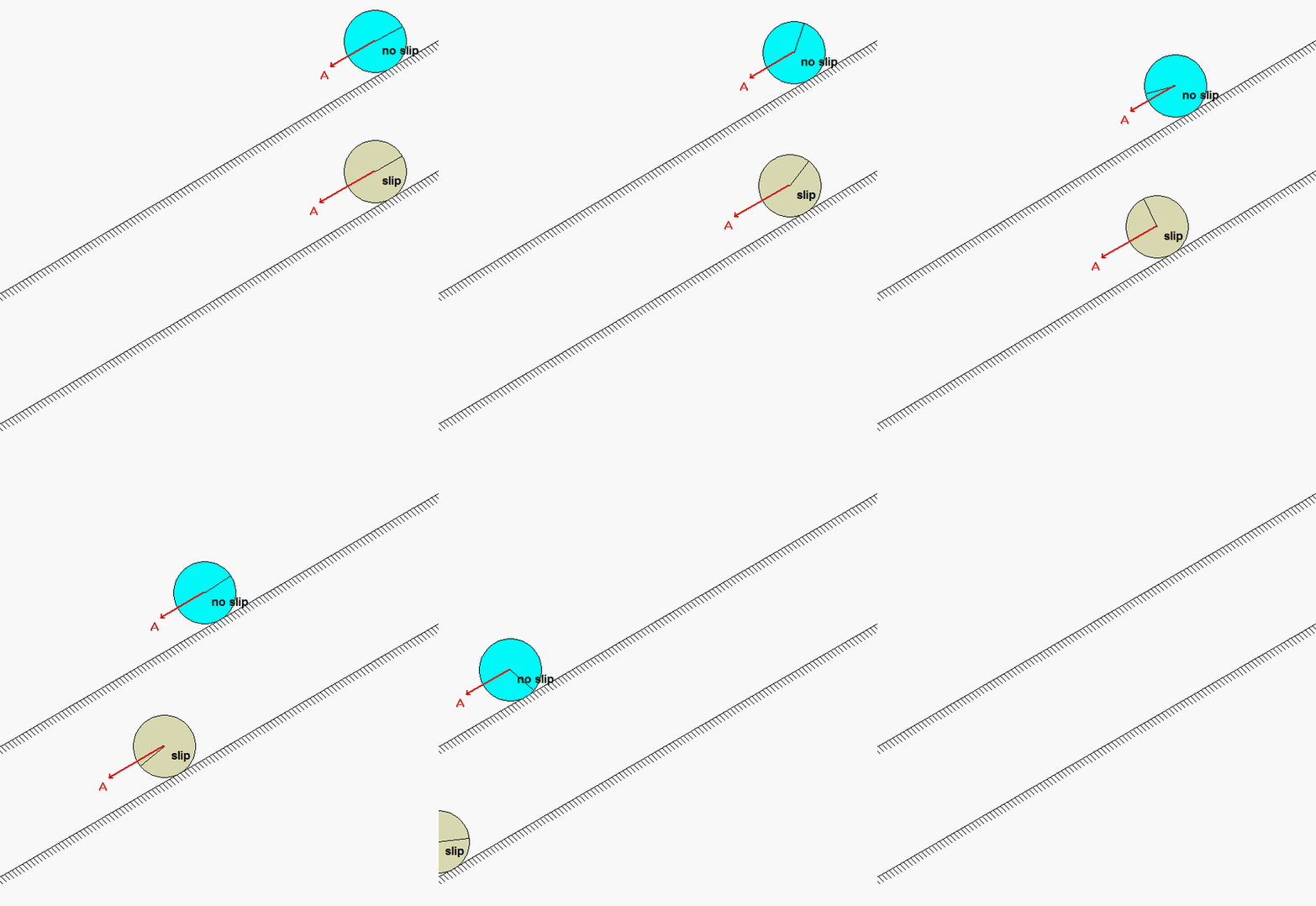
For Part (a), the coefficient of static friction between the sphere and the ramp is sufficiently large that the sphere does not slip as it rolls. Here f ≠ μkN.
For Part (b), the coefficient of friction is reduced such that slipping does occur. Here f = μkN.
Can you see the difference in rotational motion of the sphere between the no-slip and slipping cases?
Four-step plan:
Step 1 – FBD: Draw a free body diagram of the sphere. Take care in getting the direction of the friction force on the sphere correct.
Step 2 – Kinetics: Write down the Newton/Euler equations for the sphere. Be careful with your moment equation – it is recommended that you use a moment equation about the center of mass of the sphere.
Step 3 – Kinematics: For Part (a), C is a no-slip point. Relate the angular acceleration of the sphere to the acceleration of G. For part (b), C is NOT a no-slip point. You cannot relate the angular acceleration back to the acceleration of G through kinematics. Instead you need to use: f = μkN.
Step 4 – Solve