
You can ask questions or answer questions of others here. You can learn from either.
DISCUSSION
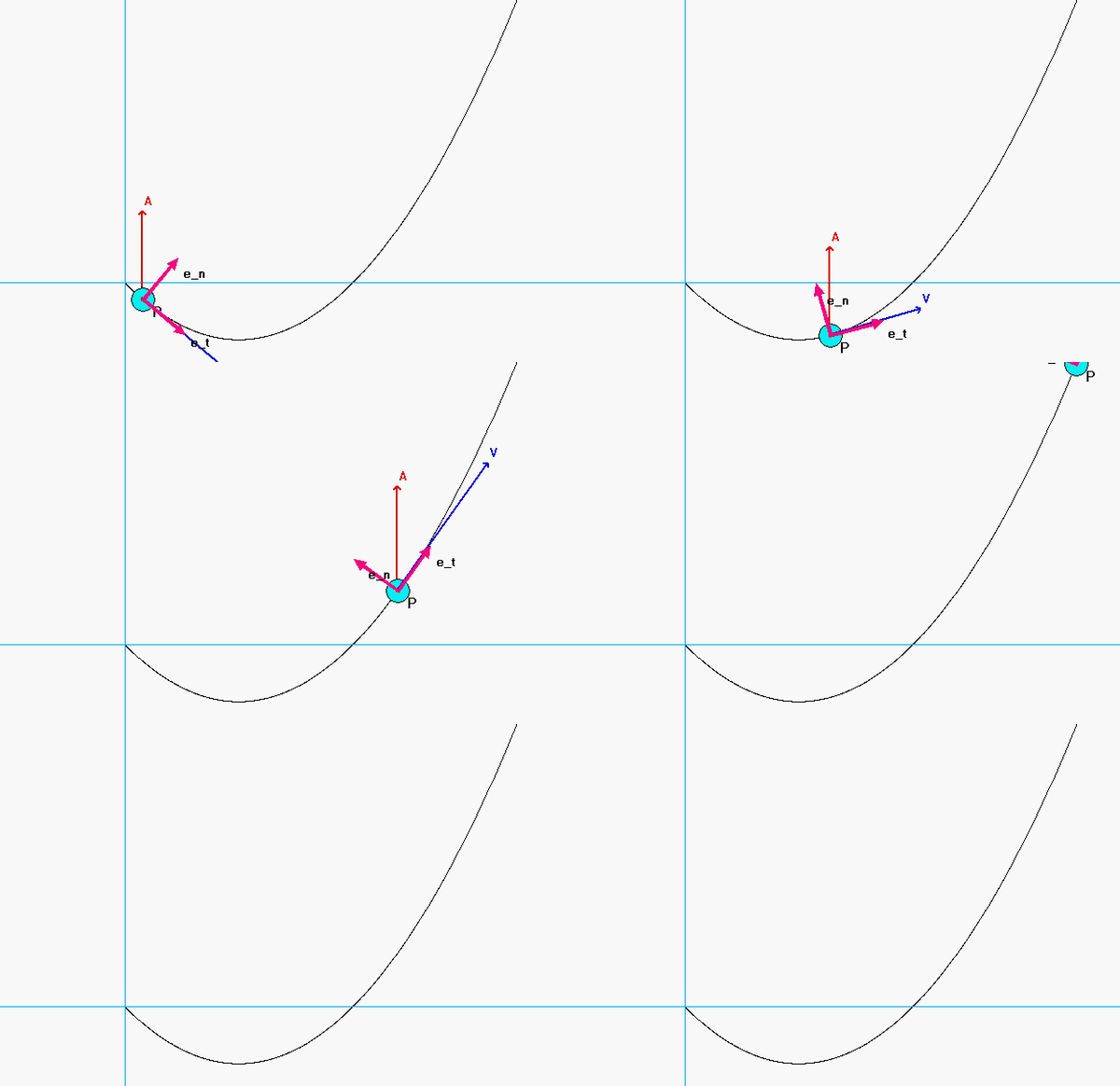
Shown in the animation below is the path taken by Particle P.
- As expected the unit vectors et and en are tangent and normal to the path of P, repectively.
- Also seen there is that the velocity vector is always aligned with the tangent unit vector, et, since v = v et.
- The acceleration vector, in general, has both tangential and normal components of acceleration. The normal component always points in the same direction as the unit normal vector, en. The acceleration vector either points “forward” of the motion (for which the rate of change of speed is positive; i.e., increasing is speed), or points “backward” of the motion (for which the rate of change of speed is negative; i.e., slowing down).
HINTS
Recall that since you do not know the y-component of motion of P explicitly in terms of time, you will need to use the chain rule to find dy/dt.
It is most convenient to determine the rate of change of speed through the vector projection of the acceleration vector, a, onto the unit tangent vector, et. How do you find the tangent unit vector? Simply divide the velocity vector by its magnitude! et = v/v .
Once you know the rate of change of speed, you can find the radius of curvature ρ through the magnitude of the acceleration.