| Problem statement Solution video |
DISCUSSION THREAD
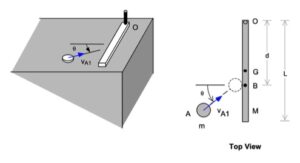
Any questions?? Please ask/answer questions regarding this homework problem through the “Leave a Comment” link above.
| Problem statement Solution video |
DISCUSSION THREAD
Any questions?? Please ask/answer questions regarding this homework problem through the “Leave a Comment” link above.
Comments are closed.
To solve this problem it is important to note that there are no external moments between the puck and bar therefore angular momentum is conserved. From this you can just use the AIM equations along with PAT to determine the moment of inertia about point O to calculate w2.
Could we utilize rigid body kinematics to relate va2 and w2? I found it simple to do since the two objects stick, meaning that the velocity of the particle (va2) is the same as the velocity of the bar at point b (vb2), but I was unsure if this was the correct approach.
Yes, I believe relating va2 and w2 using kinematics equations would work. I’m pretty sure you could also account for the bullet by taking the moment of inertia about O for the entire system (meaning there would be a component for the bar and one for the puck). If you do it this way, then I believe your angular momentum for state 2 ends up just being equal to Io(w2).
I found Example 5.C.3 from the textbook that we went over in class very helpful in assisting me to solve this problem.
What if there wasn’t a pin at O and instead it was pinned some arbitrary distance farther down? How would that affect the bar’s angular velocity? For some reason I can’t think of it in terms of the equations, and I was kind of confused.
If pinned at G, I imagine the angular velocity would be less because the particle wouldn’t cause as much moment than if it collided further down
What helped mefor this problem was treating it as an impact problem and taking angular momentum about O, since the pin forces at O do not create a moment about that point during the impact.
I found that an important thing to remember for this problem is using the parallel axis theorem for both the rod and puck attached at point B to compute the total moment of inertia about point O, which can then be used with the angular momentum equation to complete the rest of the problem.
For this problem, when using rotational momentum, how do we get the inertia of the disk since we don’t know the radius?
Please note that the problem statement says that P should be treated as a particle.