| Problem statement Solution video |
DISCUSSION THREAD

Any questions?? Please ask/answer questions regarding this homework problem through the “Leave a Comment” link above.
In the animation of the simulation shown below, the RED vectors shown are the forces of reaction acting on particles A and B (such as the force on each particle by member AB, and the normal forces of reaction by the floor and wall).
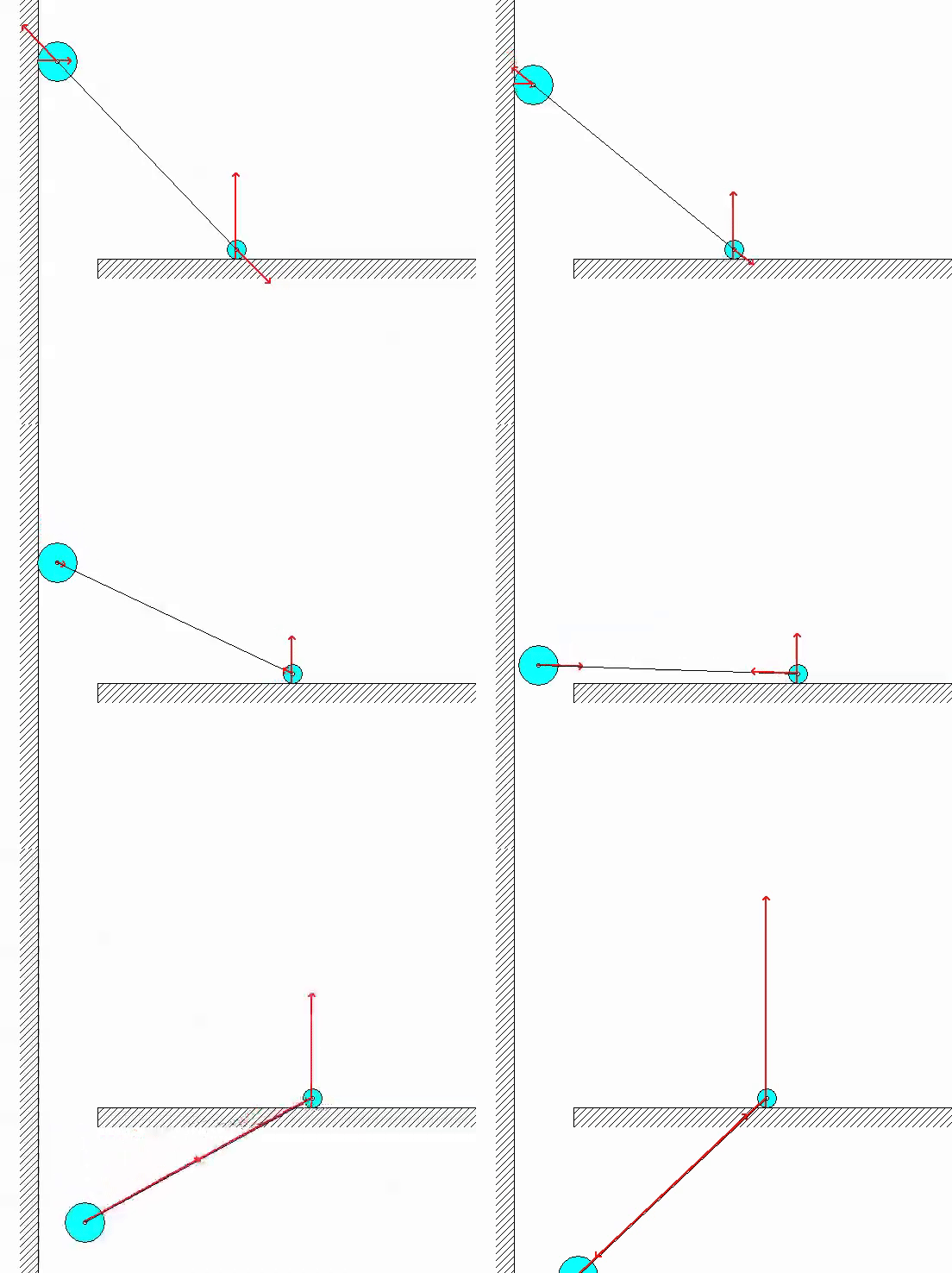
What terms should our final solution be in?
At the most, the answers will depend on the parameters defined in the problem: m and R, along with g. It may not depend on all three.
Can we assume velocity of A and B is 0 at release?
Yes, the problem statement says that the system is released from rest.
Am I correct in assuming that the blocks are pinned to the member?
Yes, pinned.
Would the forces on A and B from the two-force member be horizontal and vertical because of its shape and orientation?
There is a observation in the problem statement that says member AB is a two-force member (forces acting at only two points). As you might recall from ME 270, this means that the reactions on AB must align with the line connecting points A and B. The actual shape of member AB is immaterial; it is only the line connecting the two points that tells you how the forces act on AB.
Does this help?
I’m a little confused on how to relate the two accelerations together. A only accelerates horizontally and B only accelerates vertically.
Note that points A and B are connected by a rigid body. You can use the rigid body kinematics equation to relate the accelerations of A and B. As you say, the acceleration of A is strictly in the horizontal direction and the acceleration of B has only vertical component.
Take a look at the solution video for Example 4.A.8 from the lecture book. That problem is nearly identical to your homework problem here. Your problem is released from rest, whereas 4.A.8 has initial velocities for points A and B. Your problem is simpler because of that.
Let me know if this does not help.
The kinematics equation will be a path constraint AB^2 = x^2 + y^2 which is the shortest distance from A to B, not the arc.