| Problem statement Solution video |
DISCUSSION THREAD
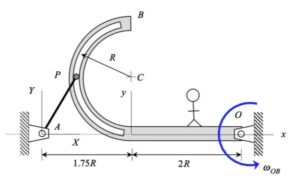
Discussion
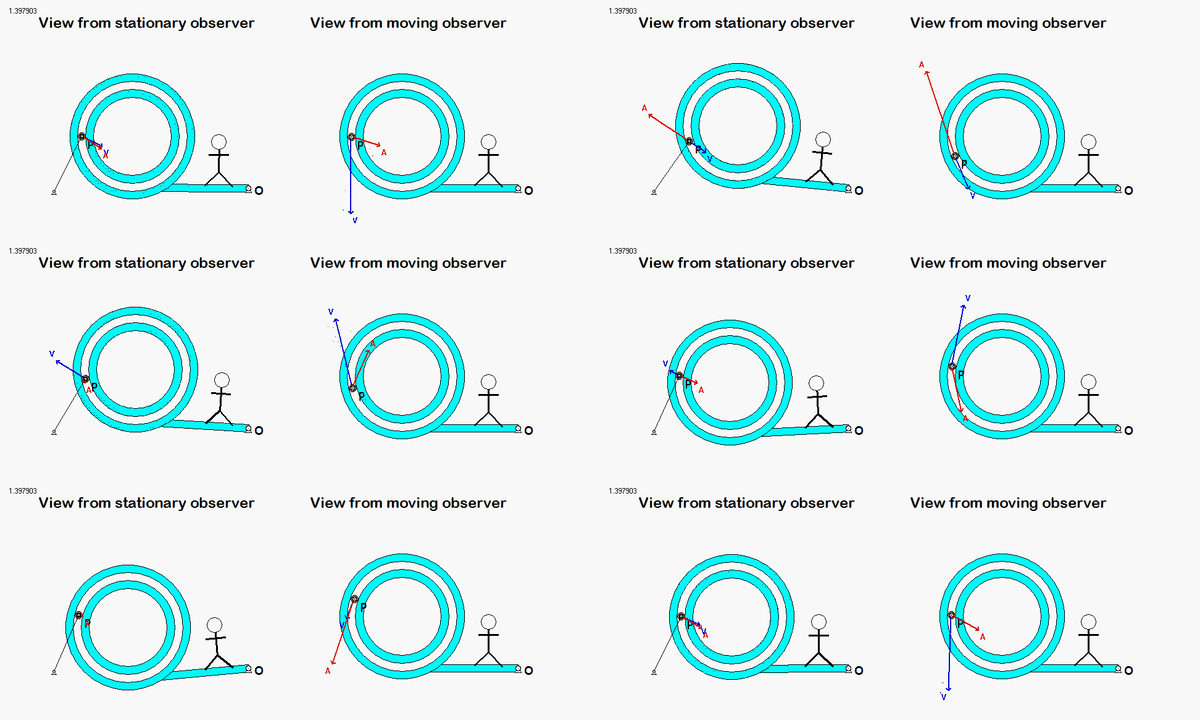
- Shown above left is the motion of the mechanism as seen by a fixed observer. Note that the stationary observer sees P moving on a circular path centered at point A.
- And, shown above right is the motion of P as seen by an observer attached to the slotted arm. Note that the moving observer sees P moving on a circular path centered at point C.
It is suggested that you employ the view of the observer on the slotted arm in your analysis.
Any questions?? Please ask/answer questions regarding this homework problem through the “Leave a Comment” link above.
How do we solve for the tangential part of acceleration? It appears to be pointing inwards, perpendicular to velocity, but I don’t want to make an assumptions.
To clarify, I mean relative acceleration
Keep in mind that a point going around a curved path has two components of acceleration: one tangential component and one normal component.
The normal component of the relative acceleration of the point will be the relative speed squared divided by the radius of curvature of the observed path. These will be known once you get to this acceleration part. The tangential component of acceleration is an unknown, and you will be solving for that unknown in the problem.
Note that you can see these tangential and normal components of relative acceleration in the animation shown above right.
Does this help?
When asking for relative speed of the particle P, when doing the kinematics equations, what would (v_op)rel be equal to? Should we find the velocity of P in terms of path equations (e_t & e_n) from the observers POV, or would relative velocity at that point just be “-v j” from the observers POV?
The velocity of P as seen by the observer is only in the y-direction. Write down that term as (v_P/O)_rel = v_rel*j_hat, where v_rel is an unknown.
So for the relative acceleration of P, there would also be a centripetal acceleration as well as tangential?
Yep.
Can we treat the velocity of P as “connected” to the other ridged body? As in, if its not slipping, would its velocity just match the whatever the magnitude of the velocity is as it moves downwards?
Clarification, with similar problems with a disk instead of a pin connection we can sort of “attach” that disk at a given point to figure out its velocity using the rigid body equations, can we do something similar here?
Point P is attached to the rigid link AP. Use the rigid body kinematics equations to relate the motion of P to the angular motion of AP.