| Problem statement Solution video |
DISCUSSION THREAD
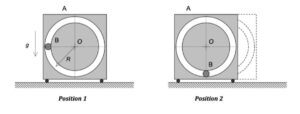
Discussion and hints:
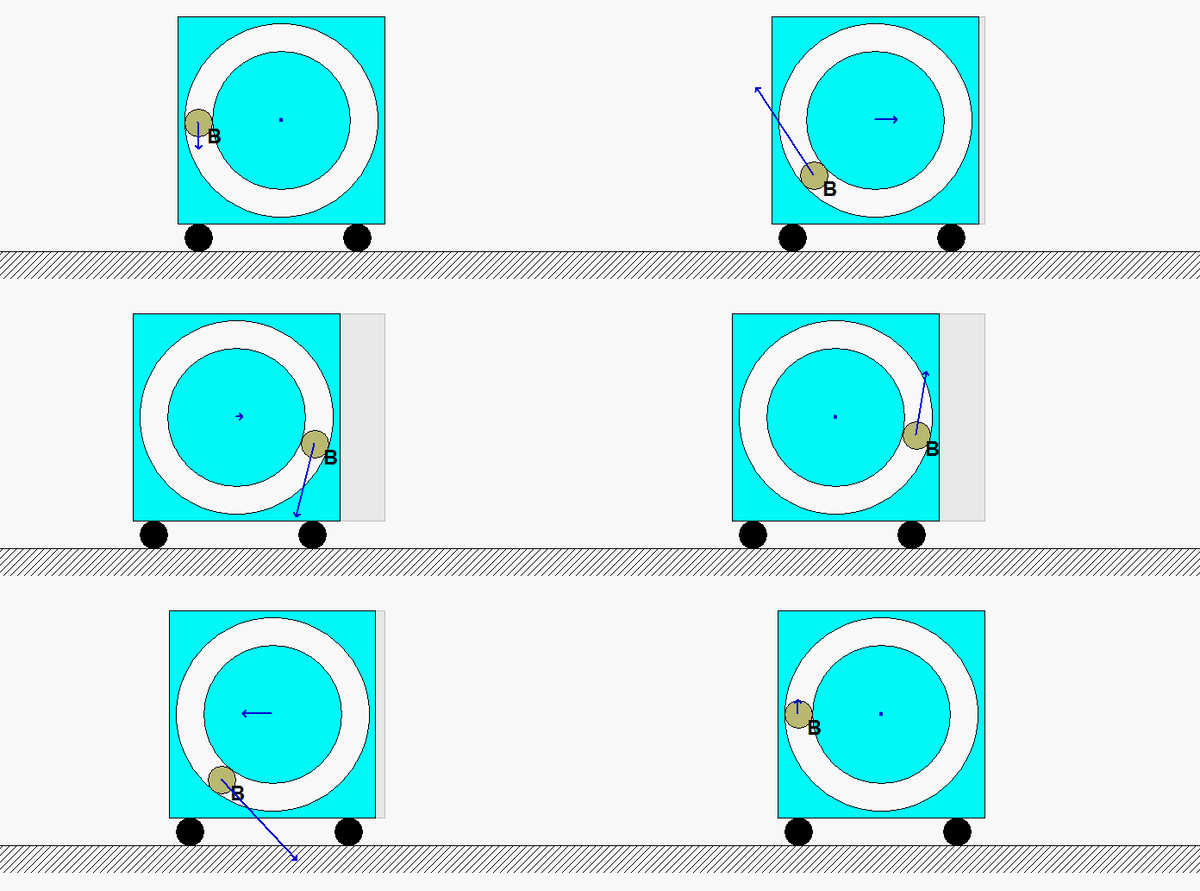
Recall the following four-step plan outline in the lecture book and discussed in lecture:
Step 1: FBD
Draw a free body diagram of the system made up of A+B.
Step 2: Kinetics (linear impulse/momentum and work/energy)
From your FBD above, what is the external force acting on the system of A+B in the horizontal direction? What does this say about the linear momentum of this system in that direction? Also, are there any non-conservative forces acting on the system of A+B? What does this say about the mechanical energy of the system?
Step 3: Kinematics
At position 2, B is moving only in the horizontal direction. There is no vertical component of velocity of B at position 2.
Step 4: Solve
Solve for the speeds of A and B from the above equations.
Any questions?
To find the work done on Block A, should I make another FBD with A and B separate? Or use the FBD of A + B together and analyze it from there?
It is recommended above in the Discussion that you work with a system made up of A and B together. If you follow that recommendation, then you need to work with that system throughout.
So, for the W/E equation, include both A and B. This means that the KE will include both bodies, and the PE will include both bodies. For that system, there is no non-conservative work being done.
And, for the LIM equation, include both A and B. For momentum, include both bodies. With A and B together, there are no external forces acting in the horizontal direction, leaving the impulse in that direction equal to zero.
Does this help?
Since we are analyzing the system A+B together, if I choose the datum (vg = 0) at the center O going horizontally, would the potential energy, V1 and V2, both be zero as the entire system has no displacement relative to the datum, or should I account for the vertical displacement of particle B when writing the work-energy equation? Thank you for the clarification.
If you choose the gravitational datum line at O for the system made up of A and B together, then:
* V_1 = 0, since the centers of mass of A and B are both on the datum line
* V_2 = -mgR since the center of mass of A is at the datum line and B is a distance of R BELOW the datum
This may be a silly question but is a datum line required for this problem?
The answer is: You ALWAYS need to define a datum line when you write down the potential due to the gravitational force. Otherwise, you cannot write down the potential.
I got my V_A in position 2 as a positive value, however, the block is moving left so this answer does not make sense to me. But it seems as there is no way I get a negative value from the WE equation because the V_A will be squared no matter what so should I just stick a negative sign on my answer or maybe mention its ___ m/s in the negative I_hat direction?
Take a look at the animation above. There are two instances when B is at the bottom of the slot:
* One has B moving to the right and A moving to the left.
* The other has B moving to the left and B moving to the right.
Note that when you take the square root of a number, there are two roots: one positive and one negative. These two roots account to the two instances described above for the velocity of A.
Does this help?
Oh I see, so that would mean V_A in this instance where the cart is moving left, would be negative?
Yes, if you choose the negative root, you are selecting the answer for A moving to the left. And, choosing the positive root gives you A moving to the right. Both are solutions to your equations and represent the motion at two different times.