| Problem statement Solution video |
DISCUSSION THREAD
Ask and answer questions here. You learn both ways.
DISCUSSION and HINTS
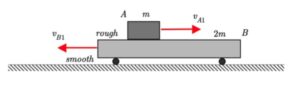
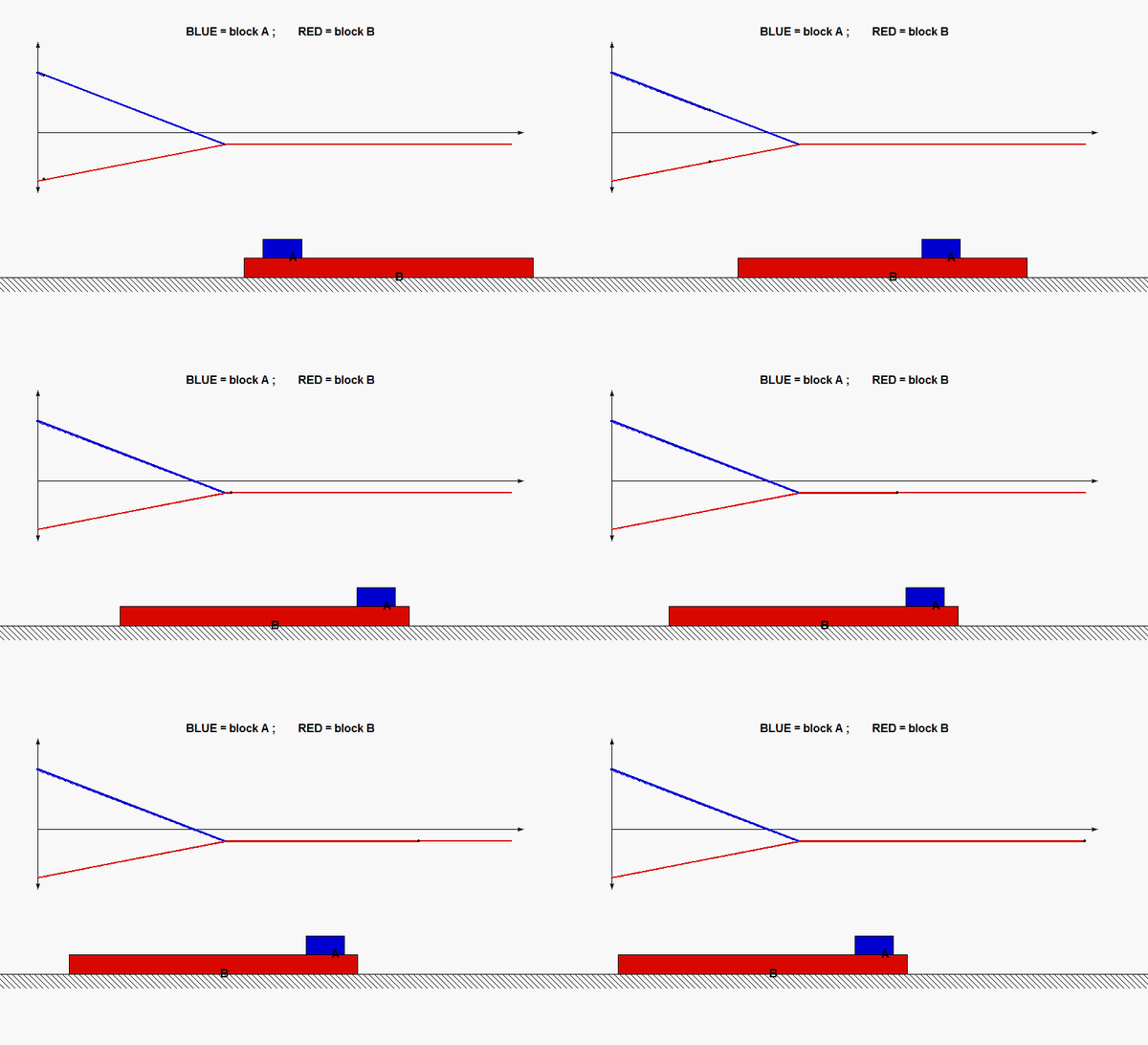
Initially Block A slides to the right along Block B which is traveling to the right. However, with friction acting between A and B, both A and B slow down. At some point, A instantaneously comes to rest, and the starts to move to the left. Once the speed of A to the left matches that of the speed of B to the left, the two stick and move together. You can see this in the animation that follows.
Recall the following four-step plan outline in the lecture book and discussed in lecture:
Step 1: FBDs
Draw single free body diagram (FBD) for the entire system (A+B). Do NOT consider A and B in separate FBDs because you will need to deal with the friction force acting between A and B (which you do not know).
Step 2: Kinetics (linear impulse/momentum)
Consider all of the external forces that you included in your FBD above. If there are no external forces acting in the horizontal direction (x-direction) on your system, the linear momentum in the x-direction is conserved.
Step 3: Kinematics
As described above, A comes to rest with respect to B when vA = vB.
Step 4: Solve
Combine your kinetics equation from Step 2 with your kinematics that you found in Step 3, and solve for the velocity of B.
QUESTION: Are you surprised that your answer for the final speed of B (and A) does not depend on the coefficient of friction acting between A and B? I was the first time that I worked the problem. 🙂
Do we count gravity as an external force?
I am assuming that you will be drawing a single FBD of A and B together, is that correct? If so, you will have the weights of A and B appearing in the vertical direction in your FBD. There will also be a normal force acting on B due to the ground. The normal forces of A on B and of B on A will NOT appear in this FBD as these are internal forces.
Does this help?
I understand. Thanks
Will our final answer be in terms of vA1 and vB1?
Yes, those two given pieces of information.
It shouldn’t effect problem. I just ignored it
In this case, because we include the whole thing in the FBD, do we add the momentums of block A and B together to calculate both mv_2 and mv_1?
If you use a system of A and B together, then your linear momentum for the system is the vector sum of the linear momentum of A with the linear momentum of B.
Will a friction force have any effect on the momentum of the system?
It depends on your choice of system.
* If you choose both A and B in your system, then the friction between A and B is an INTERNAL force. Because of this it does not affect the momentum of that system.
* If you look at A and B individually, then friction affects the linear momentum of each individually.
Conceptually, why doesn’t this friction change the total horizontal momentum or the final velocity when the blocks move together?
Friction does not come into play when looking at A and B together since the FBD of A+B has friction as an internal force. Because it does not appear in the LIM equation for the system, it cannot affect the final velocities.
The size of the friction force will influence the time that is required to stop the slipping since when looking at A or B individually, the friction does play factor and influences the impulse (the integral of the friction force over time).
When utilizing the momentum conserved equation, mva1 – 2mVb1 = mV2 + 2mV2, does it matter how we define the direction of V2? Should we include negatives in front of the two V2 terms in the equation above?
Not needed. In general, you do not know the final direction of motion for the two blocks moving together. The math will tell you in the end in which direction that they are moving.
So my first instinct was to set up the work energy equation with the BIG FBD (including both block A and B). Since there are no non-conservative forces on the system the work is 0, and since gravity does not change the block’s potential energy, we are left with initial and final kinetic energy. There is surely something wrong with my logic as I see a lot of folks are using the momentum equations.
This is one case for which the method that one uses depends on the information provided and the results that are sought.
In this problem, we do not know information about the friction acting between A and B. In order to calculate the final speed using the work/energy equation, you would need to know about friction in order to calculate the work being done.
On the other hand, with friction being an internal force for A+B together, we do not need to deal with friction in the LIM equation.
Does this help in understanding why LIM is a better method than W/E for this problem?
Ah since the friction force from B-A is absolutley making A slow down we cannot assume it cancels with the friction force from A – B?
The friction force on A by B does cancel with the friction force on B by A. (That is why we are able to use the LIM equation of A+B with such ease.) With the W/E equation, however, it is not the forces directly that influence the motion – it is, instead, the work done by the forces. Although the friction forces are the same, the work done on A and the work done on B will be different in both sign and magnitude. The total work on A+B will end up being negative, meaning that mechanical energy is lost.
Q: Since the mechanical energy is lost, where does it go? Think about what you learned in thermo to answer this.
Good question and point of discussion. Thanks for asking. 🙂
When combining the two blocks into one FBD, how would I go about drawing the normal force? Would it just be the normal force from B being in contact with the floor?
When drawing an FBD of A and B together, there will be a normal force at each wheel on B.
If you were to draw an FBD of B alone, you would still have a normal force at each wheel on B, in addition to a normal force from block A.
The former is recommended, for reasons described above.
Because we aren’t given the coefficient of friction, does that mean the final speed of block B is irrelevant to how much force friction actually exerts on B and A?
You are correct – if we had given you information on the friction between A and B, you would find that the information would not influence the answer for the final velocity of B when it sticks to A.
Look at the LIM for A+B. That equation arises from an FBD where friction is internal and does not influence the relationship between the velocities of A and B. On the other hand, if you had been asked about how much time elapses while A slides on B, then that would be influenced by the amount of friction.