| Problem statement Solution video |
DISCUSSION THREAD
Any questions?? Please ask/answer questions regarding this homework problem through the “Leave a Comment” link above.
HINTS
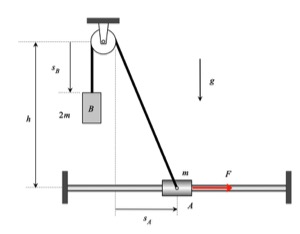
STEP 1 – FBD: Draw a SINGLE free body diagram (FBD) of the system including Block A, Block B and the cable. From this, determine which forces do work on this system.
STEP 2 – Kinetics: Write down the work/energy equation. Determine the work done by the forces that you identified above in STEP 1.
STEP 3 – Kinematics: Review the constrained motion kinematics from Section 1.D of the course lecture book. To this end, you will write down an expression for the length of the cable in terms of sA, sB and constants. Differentiate this expression to relate the speeds of A and B.
STEP 4 – Solve
__________________________
Is there supposed to be a HW 4.I?
I found it helpful to review the in-class example 4.2 for this problem since it had a similar geometry and setup. However, it is important to consider the key difference in that this problem has a force contributing to the work while 4.2 did not, as all forces were either internal or accounted for in V.
At the initial point (1), how could we calculate sB? Can we assume block B is at the top of the pulley at height h? Using the constant length equation, I can calculate sB at the end point and also relate the two sBs, but without at least one of the values, I am stuck in my solving process with an extra variable.
Since block B has potential energy terms on both sides, the constant length variable (“L”) ends up cancelling out of the calculation.
To answer the original question: you do not ever actually calculate sB for initial or final values (in fact you can’t as far as I can tell). Rather you use the relationship of sB to sA to find the change in sB from state 1 to state 2. Change in sB is what matters for change in PE, which is why the constant length cancels out in our work-energy equation.
If you wanted to visualize this you could always use the kinematics of the system to find a value for sB1 – sB2. Note what happens to the constant length term.
Regarding solving for Sb, I was able to get Sb1 to cancel out when plugging Sb2 into the work/energy equation
Is it okay to use T1 + Wext = T2?
What is “Wext”?
In the FBD, should there be a tension force pointing upward from block B? The example we did in lecture (4.B.6) was similar to this problem, and we didn’t include tension in that example, but I don’t understand why
If you do an FBD of the system as a whole (blocks and pulley), then the internal force (tension force) can be ignored
What have you chosen for your “system”? If your system is A, B, cable and pulley, then NO, all tension forces in that system are INTERNAL. Include only external forces in your FBD.
Can you assume that vb1 = 0? If so, why?
You do not need to make any assumptions. For a given value of v_A, you can always calculate the speed v_B. Recall our cable-pulley system kinematics work from Friday of the second week of class.
so is it safe to say that va1 = vb1
That would not be a good idea.
Recall from our work on Friday of the second week of class where we related the speeds of two particles connected by a cable-pulley system. Use that approach to find v_B1.
Should we indicate any directionality via vectors or otherwise for the speed, or is the magnitude just fine.
Since speed is a scalar magnitude, there is no need to write your answer as a vector.
One thing that really helped me solve this problem is that you don’t necessarily need the initial and final states for the potential energy, but rather the difference in the states.
Since we are converting to numbers for the final answer, is it okay to use g = 9.81 m/s^2? Or, do we leave it as g, since it is not given?
Either works.