| Problem statement Solution video |
DISCUSSION THREAD
NOTE: Consider all surfaces to be smooth. Leave g as part of your answer.
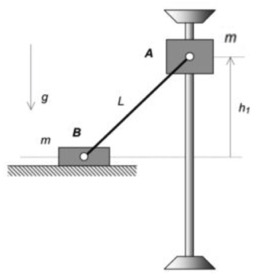
Discussion and hints:
Let’s first take a look at the motion of the mechanism, as shown in the simulation results below.

Recall the following four-step plan outline in the lecture book and discussed in lecture:
Step 1: FBD
Draw a free body diagram for the entire system of A+B+bar. Which, if any, forces do non-conservative work on this system? Can you justify this from the FBD?
Step 2: Kinetics (work/energy equation)
Write down the work energy equation for the system of A+B+bar. The KE will be the sum of the KEs of A and B. The PE will be the sum of the PEs for A and B.
Step 3: Kinematics
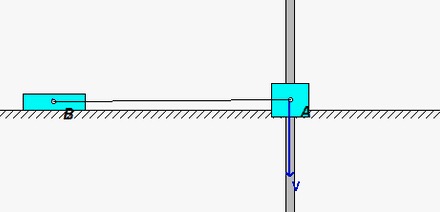
Shown below is a freeze frame of the system at position 2. Where do you see the IC for AB to be located? Use the location of the instant center of AB at Position 2 to simplify your kinematics for that position.
Step 4: Solve
Solve your work/energy equation for the speed of block A.
Any questions??
The instant center approach for the kinematics part of this problem proved to be really helpful in simplifying the work/energy equation.
While solving the problem, I noticed that image presented in the problem statement download is different than that on this website. However, the problem can be solved identically, as long as the givens and finds of the problem statement are correct. When I solved the problem, I also found it useful to remember that perpendicular forces to movement do no work.
when block A reaches the bottom of the vertical slot, should we assume the bar is still connected and moving, meaning block B has a nonzero speed too? Or can we treat it like A just stops at the bottom and that’s the final state?
The animation suggests that block B has zero velocity when block A reaches the bottom of the slot.
You are asked for the speed of A when it has reached a position that is on the same horizontal plane as is B. It has not yet impacted the floor.
If we were asking about after it impacts the floor, then you would need to know something about the impact properties of A and the floor. This is something that we will cover in class on Monday.
I think using the instant center method once A is at the bottom would also demonstrate that B has no velocity at the final state
How come V2 is 0? If block A can go below where block b is, wouldn’t it still have some gravitational potential energy at that point where y=0?
The value for V_2 (the gravitational potential at position 2) depends on where the datum line is placed. If you place the datum line at the same horizontal plane as block B, then V_2 = 0. If you place it at any other location, then V_2 ≠ 0.
Does this help?
Would you be able to explain why this is the case?
The background on this is that the W/E equation depends on the difference between the gravitational potential at the initial and final states: V_2 – V_1. The gravitational potential at any state is itself proportional to the height h of the body above an arbitrarily-chosen horizontal line: V = m*g*h. From this we have: V_2 – V_1 = m*g*(h_2 – h_1). What this says is that you can measure h from ANY horizontal plane of your choice. This choice affects both h_2 and h_1 in the same way, with this constant cancelling out on the subtraction h_2 – h_1.
For this particular problem, I would choose the same datum for both A and B, and choose this datum to pass through the horizontal plane within which B moves. That way the gravitational potential for B is zero for ALL motion, and the gravitational potential for A is zero for position 2. This simplifies things a little. Keep in mind, however, that this choice is TOTALLY up to you.
Does this help?
When I solved the question, the gravity constant from the initial potential energy didn’t cancel out. Is it ok to leave it in the final answer?
Please read the note at the top of the Discussion thread advising you that “g” will be part of your answer.
Is a good way to think about why Vb = 0 that if there was no ground and A kept going down then B would be forced to go the other way, therefore changing the sign of velocity?
That’s how I did it.
Should internal forces be included in FBD?
If you do an FBD of the whole system of both blocks , internal forces can be ignored
Never.
I believe those only come under consideration if the components of the system have individual FBDs.