| Problem statement Solution video |
DISCUSSION THREAD
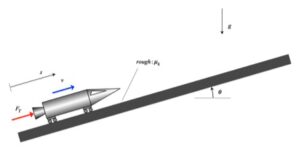
NOTE: This problem is asking for the distance that the rocket travels between when the speed is v1 and when the speed is zero (“at rest”).
Any questions?? Please ask/answer questions regarding this homework problem through the “Leave a Comment” link above.
Since the problem states the sled is under-powered and comes to rest, do we just set the final kinetic energy to zero and let the negative work from friction and gravity balance the positive work from the thrust?
I think that makes sense, if the rocket cart comes to a rest, it’s velocity should be zero, which would mean that the final kinetic energy would be zero. Your reasoning also follows along with example 4.B.2 from the lecture book, which is similar but flipped; it has a block released from rest sliding down a ramp and compressing spring. In that one, the initial kinetic energy is zero since it starts at rest. For the homework, we start at an initial velocity and then end at rest. We would still need to account for the change in potential energy, which you are by acknowledging gravity, as well as the negative work from friction, which are as well.
What should we leave our answer in terms of?
The given parameters are m, F_T, v_1, mu_k, theta and g.
what does F_T represent?
F_T is the thrust force on the sled due to the firing of the rocket engine.
For this problem, I found writing the kinetic equations for the sum of forces in the x and y directions (I found placing the x axis along the length of the incline to be helpful) before moving into the work-energy equation to be a useful strategy.
I did this as well but I used polar equations. Path components could be used as well since we never have to relate anything back to the acceleration.
Are there any kinematic equations that are necessary to use here? I believe after you solve step 2 (work/energy) and do the trigonometry needed to solve for “h,” we can move to step 4 to solve, as there are no kinematics necessary for further analysis.
For this problem, datum line choice simplified the problem, in addition to that drawing the Free Body Diagram and using the fricton force formula helped in solving the problem for me. Additionally another helpful tip was orienting the x and y coordinate system in a way that simplifies the problem is also helpful.