| Problem statement Solution video |
DISCUSSION THREAD
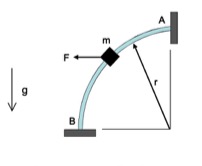
HINT: It is recommended that you review page 211 of the lecture book regarding the determination of the work due to an applied force using Cartesian coordinates. Using this can greatly simplify your analysis.
Any questions?? Please ask/answer questions regarding this homework problem through the “Leave a Comment” link above.
Should we consider the block having a normal force pointing in the same direction as (er) from the quarter circle on which it rides on?
You are correct – the normal force on the particle from the guide is along a radial line for the quarter circle.
For an FBD I believe we would show all forces, but for answering a W/E question we would only need forces tangent to the slope of the path in our equation right?
And if this is true, is that because when working within W/E were only using information on velocity and location such that anything not effecting velocity simply does not matter in the W/E approach?
You are correct. Your FBD should show all forces. Only forces that do work will appear in the W/E equation. And, yes, only forces that do work end up affecting the speeds of the particles in the system.
Would it be best to use path or polar coordinates for this question? The particle is moving radially however many of the examples in the lecture book use path for this type of analysis
In this case of a circular path, there is little difference between the polar and path descriptions. The two sets of units are aligned with each other. There no obvious advantage to using one or the other.
Although the path is circular, would cartesian coordinates be the best to use for this problem? How does the chosen coordinate system impact the question when using the work/energy equation?
I agree with your decision that Cartesian is the appropriate coordinate system to use.
Please refer to page 211 of the lecture book on “How to Compute Work Using Cartesian Components”. On this page you see that the path integral for work can be broken down into contributions due the x-component of forces and the y-component of forces. Since in this problem the constant applied force has only a horizontal component you will have only the contribution of F*Delta_x, where Delta_x is the HORIZONTAL distance that is traveled by the particle. Note that this does NOT require the detailed knowledge of the path taken by the particle.
Would the normal force not affect the work equation since the surface is smooth?
As we have seen in class, the work/energy equation is derived to eliminate all force components that are perpendicular to the path of the point at which the force acts. So, yes, the normal force can be ignored when calculating work. As you suggest, if the surface were not smooth, then the frictional component of the contact force would do work on the block. The frictional work would be negative.
In a previous comment thread, it was mentioned that Cartesian coordinates are the correct coordinate system to use. However, when determining the kinematic equations, are we supposed to use polar/path because of the circular path or continue with Cartesian because of the direction of force F? I’m assuming we still have to fill out the 4-step solution process and then afterwards solve for the speed of the collar at B.
Just to clarify, you are able to use any of the kinematic descriptions for a particle that you want. Based on the comment to which you refer, it turns out that the Cartesian description is the simplest.
Note that the work-energy equation uses the speed of the particle, where speed is the magnitude of the particle’s velocity. Since it is the magnitude, the choice of kinematics is completely up to you. In this particular case, just use the speed “v” when writing the KE. There is no coordinate system needed in that case.
Yes, you should continue using the four-step plan with the work-energy equation. For this particular problem, there is nothing to be done in Step 3 since the KE is naturally appearing in terms of speed v.
As long as we arrive at the correct answer, are we allowed to use any description we want?. In the case a vector answer is requested, can we write that vector in terms of the coordinate system we chose?
Unless otherwise specified, the choice of coordinates is yours.
The insight of choosing the correct datum line helped significantly simplify this problem. Choosing the cartesian coordinate system specially to find the work done proved to also help me simplify the problem significantly.
There really is no one “correct” choice for datum lines. Sometimes one choice may be a little simpler than others. In this case, there is little difference among a number of possibilities.