| Problem statement Solution video |
DISCUSSION THREAD
DISCUSSION
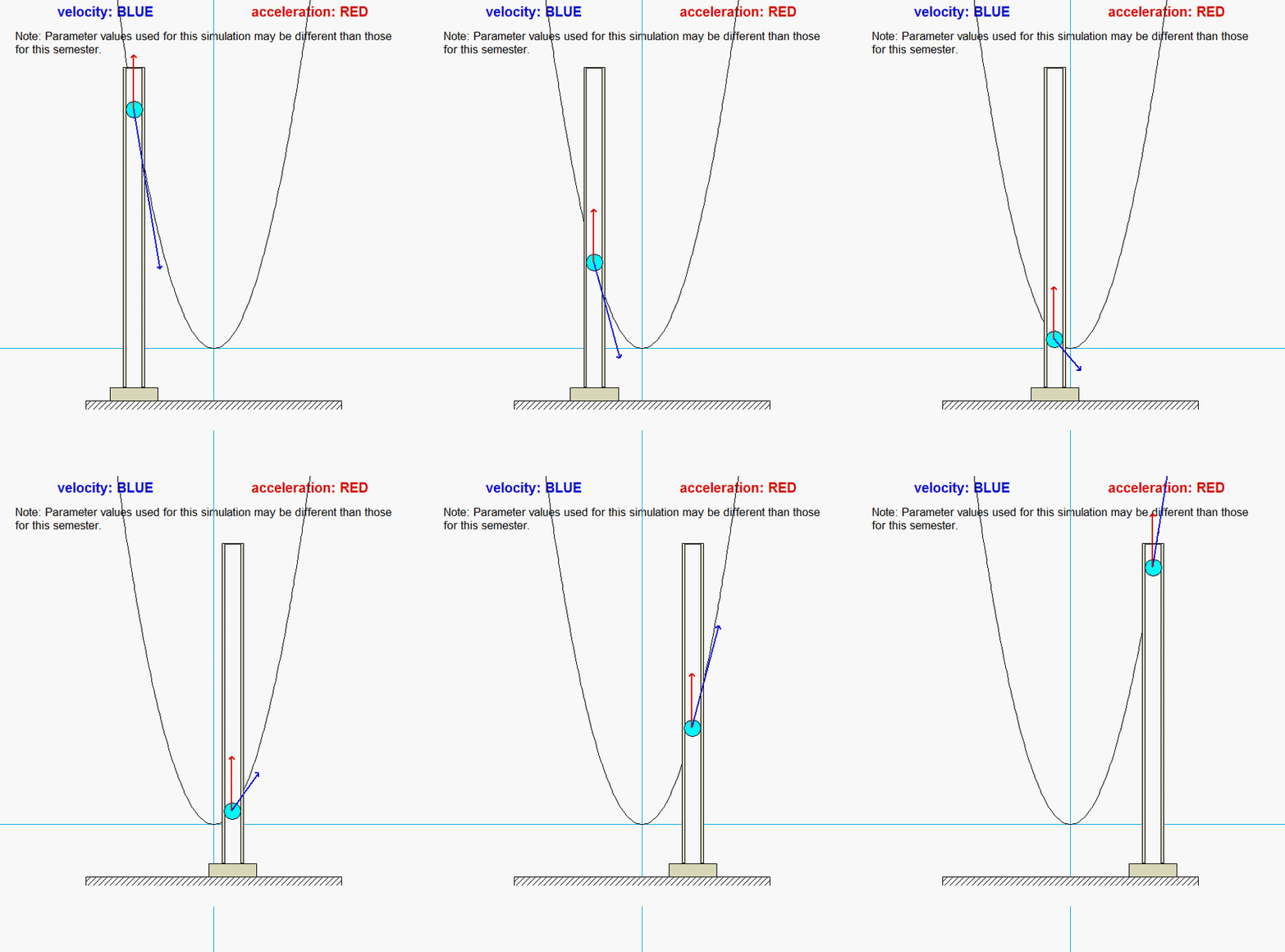
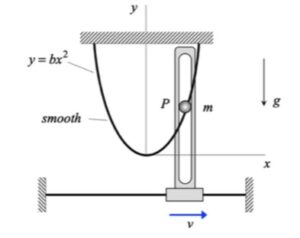
Particle P moves in a way that it is constrained to move along the parabolic-shaped guide, as well as within the vertical slot. Your task here is to determine the reaction forces acting on P by the guide and the slot that are needed to enforce these motion constraints.
As you watch the animation above for the motion of P, why is the acceleration of P always pointing in the y-direction?
Hints:
You should follow the four-step solution plan described in the lecture book, and as discussed in lecture:
Step 1: Free body diagram (FBD) – Draw an FBD of P alone.
Step 2: Kinetics – Write down the Cartesian components of Newton’s 2nd law for P.
Step 3: Kinetics – You need kinematics here to related the known x-components of velocity and acceleration of P to its y-components.
Step 4: Solve – You will have two equations and two unknowns. Solve these for the two reaction forces.
Ask and answer questions below. You will learn from both asking and answering.
How do you solve for the angle that the normal force that the curved guide is acting at?
Please use calculus. You know that the angle made by the tangent to the curve measured from the positive x-axis is given by: tan(theta) = dy/dx.
In the kinematics section, I was able to utilize the shape of guide equation twice – 1. differentiated with respect to time to find accelerations – 2. differentiated with respect to x to help solve for theta
Can we assume that the ball that is in the vertical slot doesn’t feel a reaction force from the other side of the slot when feeling the normal? Because if we didn’t then wouldn’t the normal cancel
If body P is rigid (does not deform), then P can be in contact with only one side of slot, not both simultaneously.
On the other hand, if the body is compliant, then it would be possible to fit an oversized body into the slot so it would be squeezed by the slot and therefore in contact with both sides.
In this course, we will deal only with rigid bodies, leaving them in contact with only one side of a slot.
The problem does not give us a value for g, yet it asks for the numerical value of Fslot and N. Are we supposed to assume g = 9.8? Or do we just leave it in terms of g?
Since the problem asks for a numerical solution, using the numerical value for g would make sense. If you leave it in terms of g, that would be OK also.
how do you go about determining the direction in which the guide force acts if you’ve already found the angle
You should use calculus to find the angle theta between the x-axis and the tangent of the curve: tan(theta) = dy/dx.
The angle made by the inward normal is theta + 90°.
Can we leave our answers as the value of the normal forces, or do we need to break it up into vector components?
It is always a good idea to write the final answers as vectors.
We have to use the derivative/slope of the parabola to find the angle right?
Yes, theta = angle between the tangent to the path and the x-axis is found from tan(theta) = dy/dx. The angle for the normal unit vector is theta + 90°.
Looking back at this HW I am confused on why dy/dx is used for the tangent instead of opp/adj as seen in normal tangents.
dy/dx provides you with the slope of the function y(x), where the slope is equal to the tangent of the angle that defines the orientation of the tangent vector. I am not sure what you mean by the “normal tangent” – that sounds contradictory (being both tangent and normal). Could you clarify your question?