Research
Climate Change and Forest Dynamics
Our work examines how forest ecosystems respond to climate change, including shifts in species distributions, biodiversity–productivity relationships, and drought resilience. By combining long-term data with modeling approaches, we aim to predict how climate change will reshape forest communities and ecosystem function.
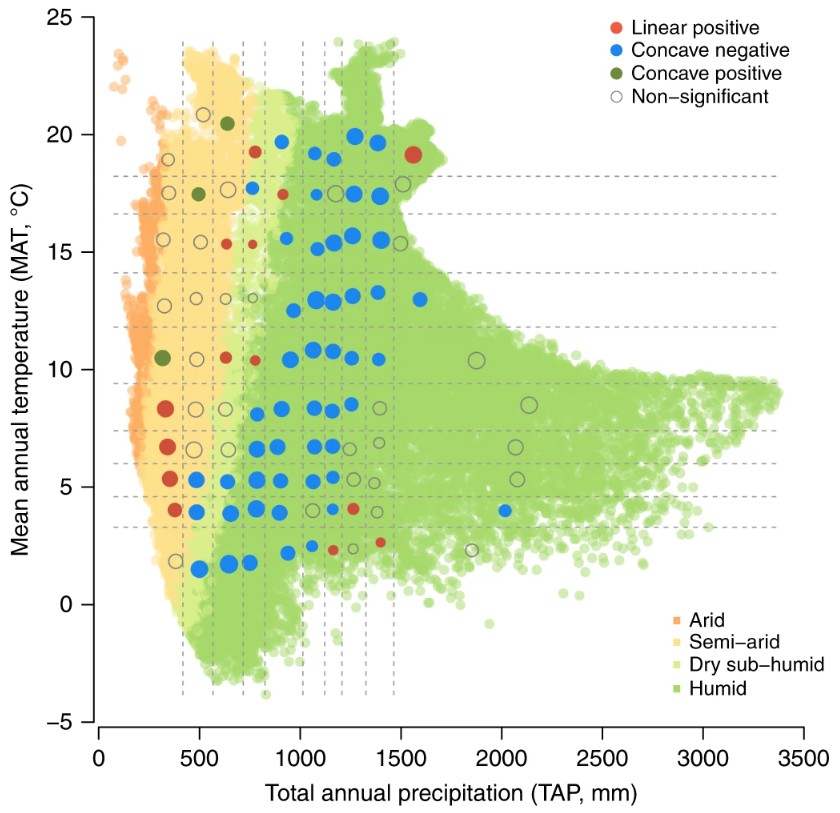
Relationship between tree richness and productivity in different climatic units (Jo et al. 2018)
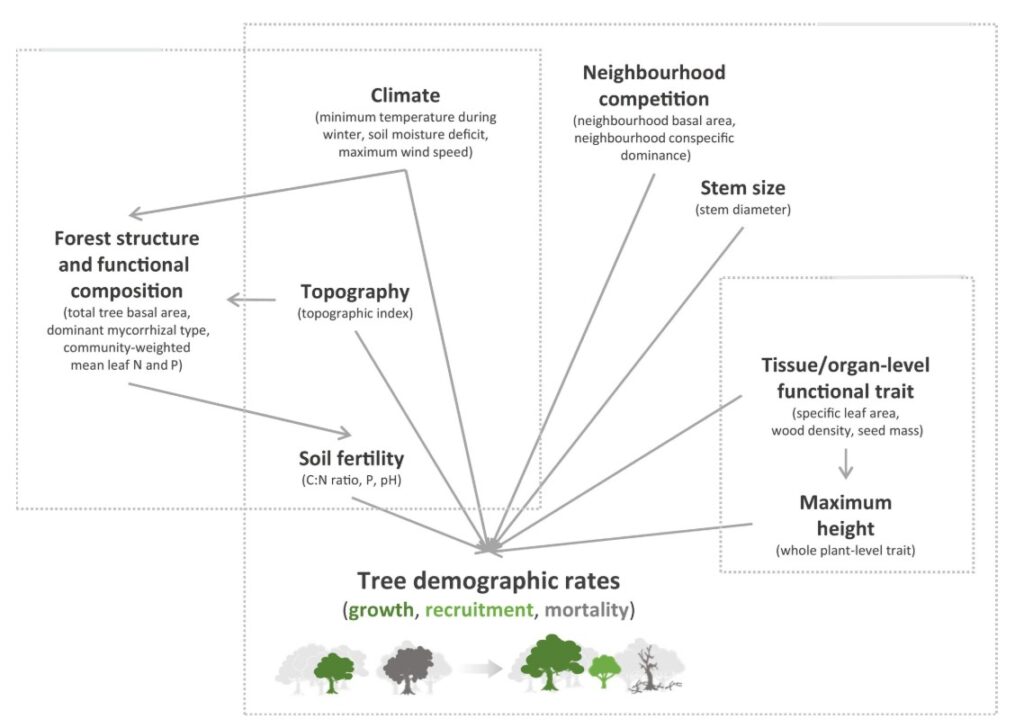
Potential biotic and abiotic drivers of tree demographic rates and their inter-relationships (Jo et al. 2025)
Aboveground–Belowground Interactions
We link aboveground plant traits with belowground microbial and mycorrhizal communities to understand how their interactions shape biodiversity, productivity, nutrient cycling, and invasion success. Our research has shown that shifts in dominant tree mycorrhizal associations under anthropogenic pressures strongly influence forest function and resilience.
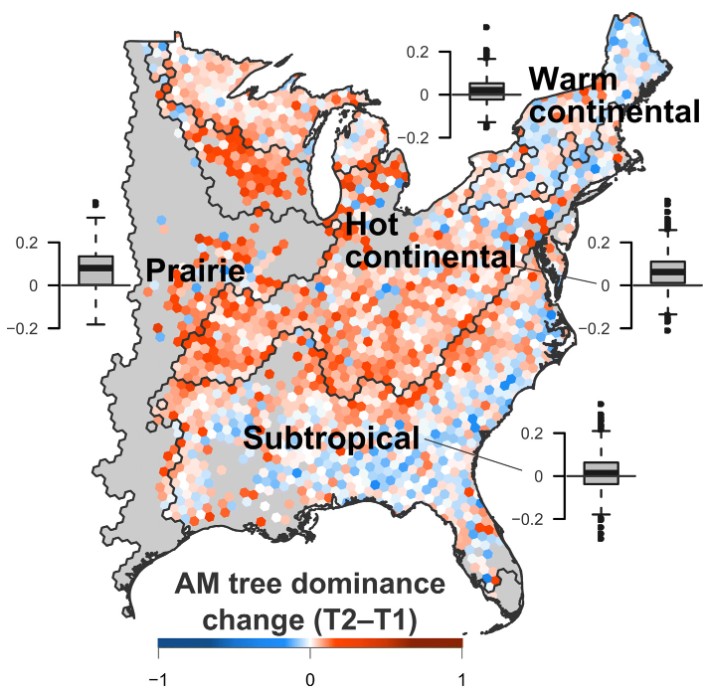
Changes in forest AM tree dominance during the past three decades (Jo et al. 2019)
Plant Invasions and Ecosystem Impacts
We investigate the ecology and impacts of invasive plants using field experiments and global syntheses. Our studies reveal how invasions alter nutrient cycling, decomposition, and community functional composition. We also explore how competition, disturbance, and biotic resistance interact to determine invasion outcomes, with implications for managing multi-species invasions in forests and grasslands.
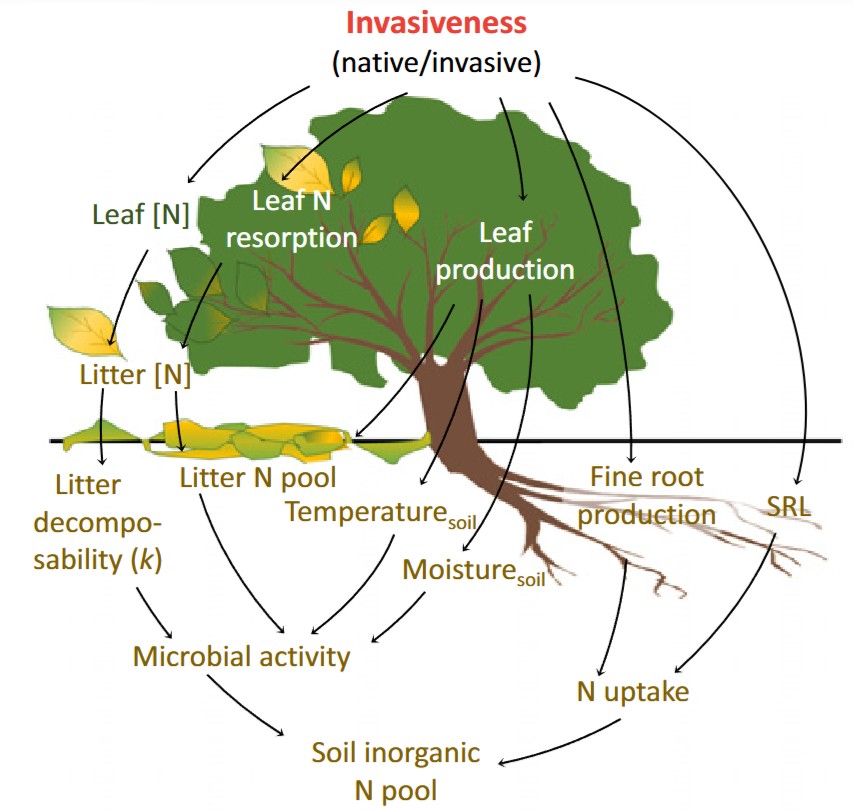
Hypothesized relationships between the soil inorganic N pool and potential invasive species-induced changes in plant and soil attributes (Jo et al. 2017)
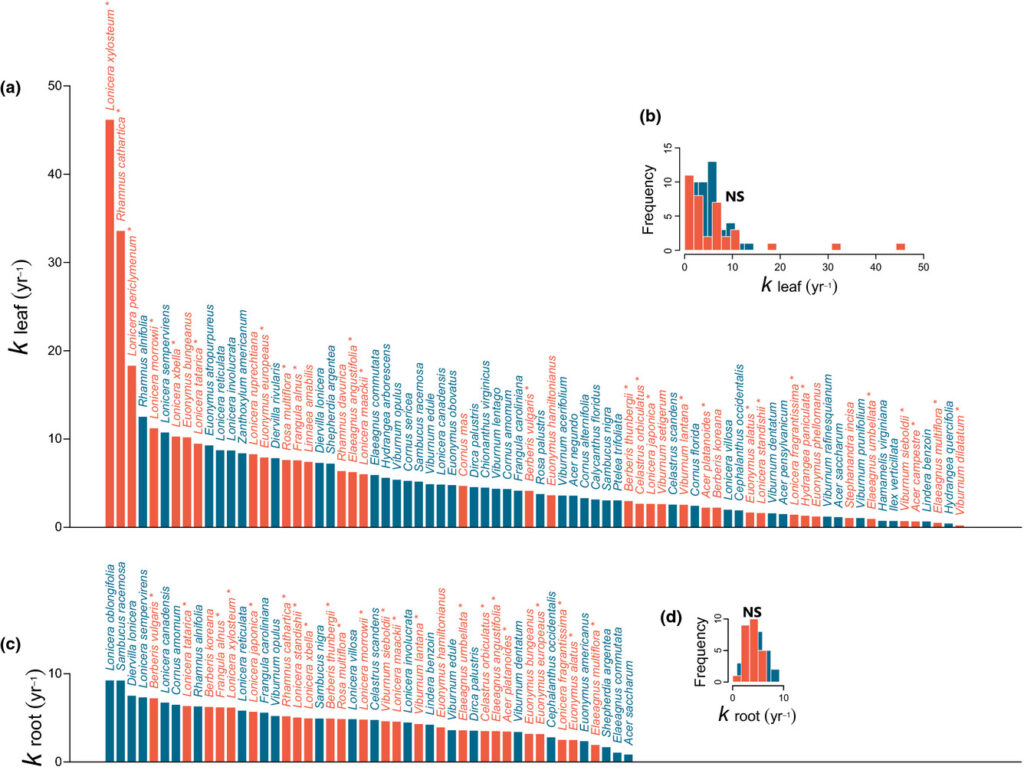
Litter decomposition rates for leaf (a) and root (c) for native and nonnative species. Natives are labeled blue and nonnatives red. Nonnative invasives are denoted with asterisks (*). Histograms show distributions of leaf and root decomposition rates for native and nonnative species (b, d) (Jo et al. 2016)
Integrative Forest Ecology
Together, our research advances an integrative understanding of forest ecology, bridging above- and belowground processes at scales ranging from local plots to continental forests. Our goal is to generate insights that help predict and manage ecosystem responses to global change, supporting the conservation of forest biodiversity and function.