Research – AI-Driven Commercial Building Operation
Advanced building data analytics, such as fault detection and diagnostics (FDD) and advanced controls, have witnessed rapid advancements in the past two decades. However, field deployments have been limited. The major barrier is the high upfront cost of accessing and interpreting the building monitoring data. Point tagging and mapping to physical equipment are critical first but also the most time-consuming step of any analytics project. This is mainly caused by the heterogeneity of mechanical equipment and different naming conventions across buildings and technology providers. The current practice mainly relies on manual data tagging and mapping, leading to high upfront costs. Semantic data models, such as Haystack/Brick/ASHRAE 223P, are gaining momentum in the building automation industry to address this issue by standardizing the data flow and structure. However, these semantic models mainly target new construction while their implementation for existing buildings is still cost-prohibitive.
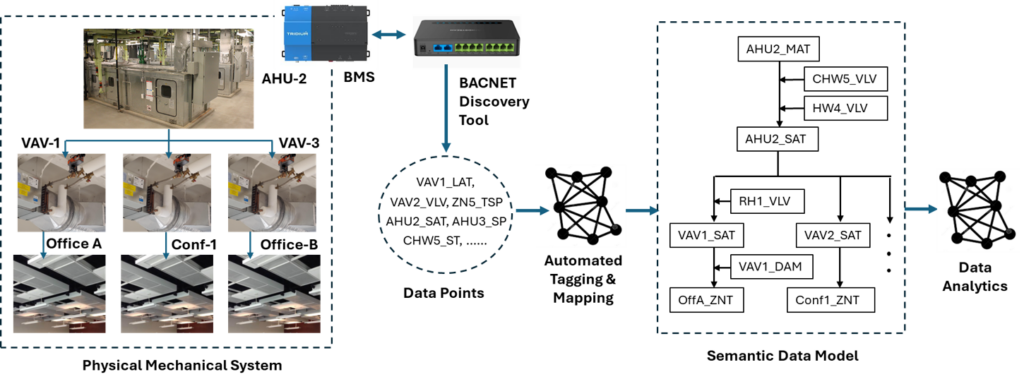
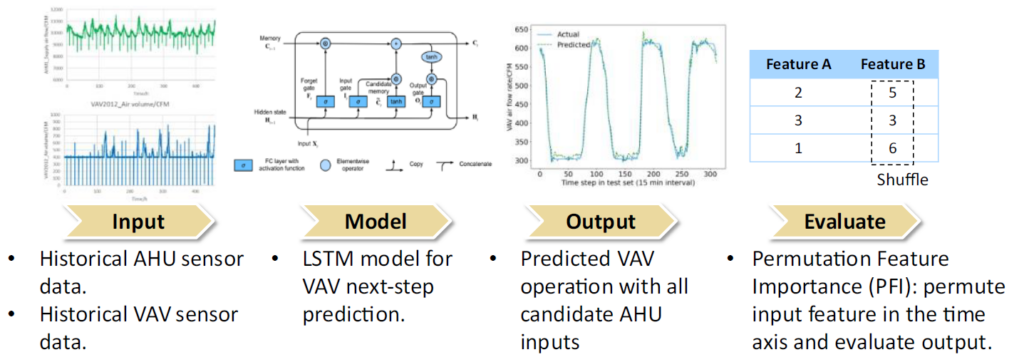
We proposed an automated semantic model creation workflow for building automation systems. The proposed workflow can (1) automatically interpret and group the data points by the physical measurement and equipment type through text feature extraction from point names, and (2) identify the causal relationships among the data points from time series data. The constructed semantic model can facilitate no-touch deployments of advanced analytics such as FDD and control. Its efficacy has been demonstrated through automated deployments of ASHRAE Guideline 36 fault detection rules in a medium-sized commercial building in Indiana.
References:
- Wang, Z., Ma, J., Cai, J., Qu, M., Unsupervised Inference of Equipment Relationships in Building Automation Systems Using LSTM-Based Feature Importance. 12th ACM International Conference on Systems for Energy-Efficient Buildings, Cities, and Transportation, 2025.
- Wang, Z., Ma, J., Qu, M., and Cai, J., Point2Brick: Automating building semantic model creation via multi-stage confidence-aware Large Language Model agents, Energy and Buildings, 2026, submitted.