Research – Heat Pump Load-Based Testing
Load-based testing for heat pumps is an emerging experimental methodology designed to capture realistic, dynamic equipment performance by allowing the system to operate under its native controls—including the integrated thermostat and embedded logic—rather than using fixed-speed overrides common in traditional steady-state ratings (like AHRI 210/240). In this approach, a physical heat pump is installed in side-by-side psychrometric chambers, where the indoor room conditions are dynamically adjusted in real-time according to a virtual building model to emulate the thermal dynamic response of a real building. This closed-loop interaction enables OEMs, researchers, and regulators to evaluate how variable-speed components and control algorithms respond to transient building loads, accurately characterizing phenomena such as cycling losses, control instabilities, and performance degradation that are often missed by steady-state test procedures.
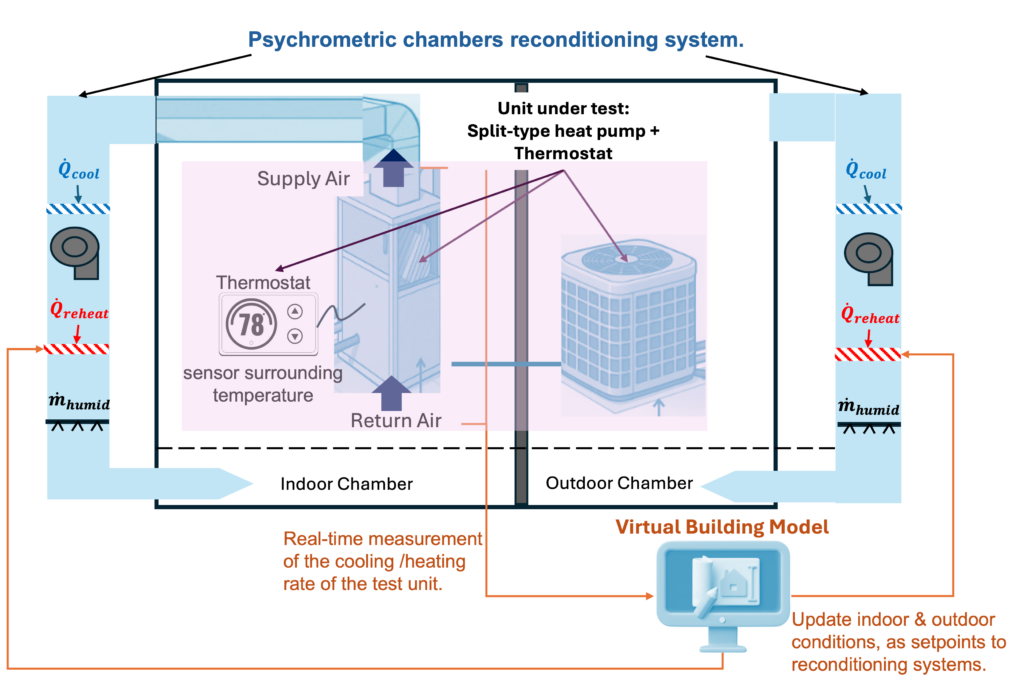
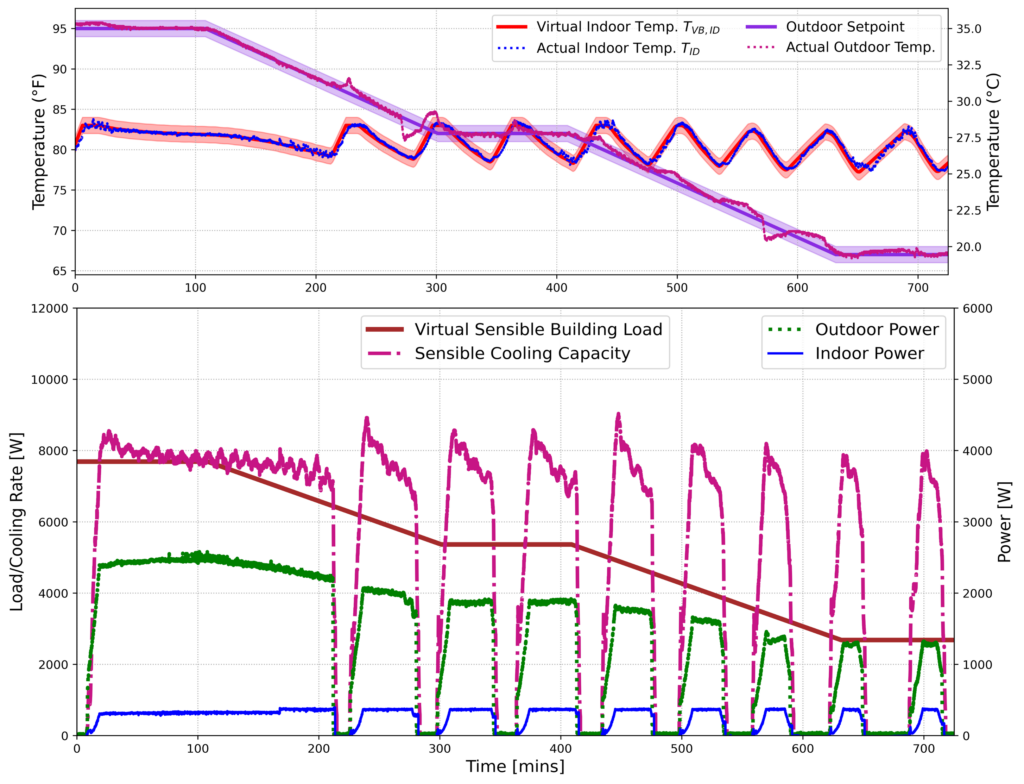
Purdue team conducted load-based tests of multiple units from different manufacturers and results reveal that modern variable-speed heat pumps often deviate from their theoretical peak efficiency due to complex interactions between a building’s dynamics and the thermostat’s control logic. Under intermediate- to low-load conditions, the testing captured significant cycling behavior and control oscillations as the system struggled to find a stable compressor frequency to meet the building load. The oscillatory and/or cycling behaviors can lead to failures in earning variable-speed certification, reduced equipment life spans, and efficiency degradation in the field. The team has conducted control stability and performance analyses to investigate the root causes of control chattering of heat pumps during load-based testing. Results show a variety of factors, including slow testing chamber dynamics, interactions between the building dynamics and on-board controllers, and thermostat sensing delays, could all result in control instability. A PI plus lead controller was proposed to boost phase margins while accelerating temperature control responses.
References:
- Eneh, C., Ma, J., Braun, J.E., Horton, W.T., and Cai, J., Control Performance Analysis of Load-Based Testing for Air-Conditioning and Heat Pump Systems: Control Analysis, Design, and Validation, Energy and Buildings, 2026, preprint. DOI: 10.1016/j.enbuild.2026.117193.
- Ma, J., Eneh, C., Xi, D., Braun, J.E., Horton, W.T., and Cai, J., Control Performance Analysis of Load-Based Testing for Air-Conditioning and Heat Pump Systems: Control Oriented Simulation Model Development, Energy and Buildings, 2025, preprint, submitted.