

Connector Ecosystem: Fireflies, Drone Shows, and Community Engagement
Written by Roberto Gallardo
Reflections on three years as Vice President for Engagement at Purdue University
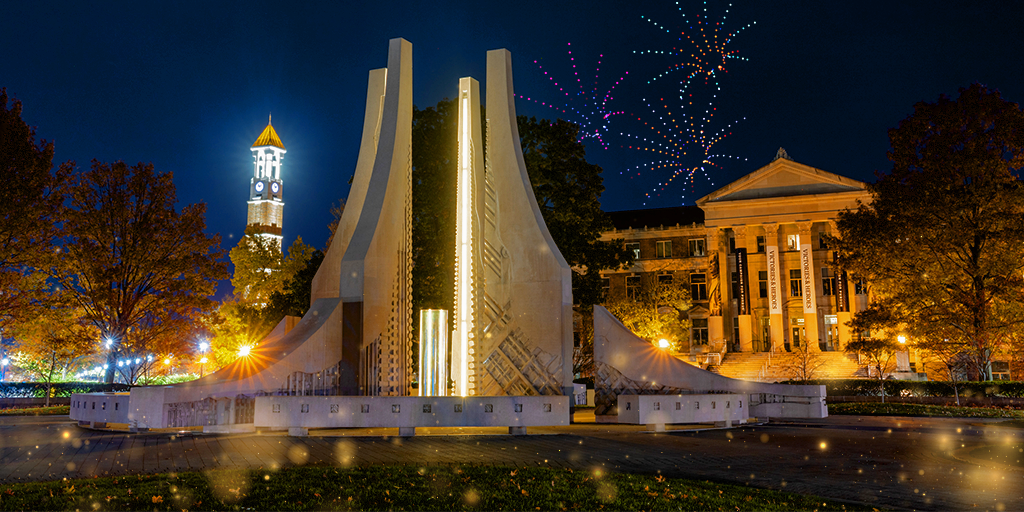
On a warm summer night in Indiana, you can watch fireflies flicker across a field. They’re beautiful. They’re visible. But they light up on their own schedule — no coordination, no pattern, no shared story. For much of the past three years, this is the image I’ve used to describe Purdue University’s community engagement work: highly engaged, but visible in scattered flashes rather than as a coordinated whole.
This July of 2026 marked my third anniversary as Vice President for Engagement at Purdue. It has been so much fun with much work to do. This post is a reflection on what our office has built over these three years, what we’ve unveiled, and where we’re headed.
When I stepped into the role, we set out to reflect on what we do, how we do it, and most importantly, how we can continue to more meaningfully engage and leverage Purdue’s resources to create community impact, while also creating community opportunities for our faculty, students, and staff. Our core value has not changed: we engage reciprocally and genuinely.
We must actively uphold this value and hold ourselves accountable to it. Often—unfortunately—we hear from community partners that faculty conduct research, publish, and disappear. Or that they are contacted last-minute for grant purposes for which they had no say or do not understand the purpose. Or receive requests from multiple faculty/units asking them to work with their students. Through this all, many community partners do not see the benefit—and above all—are hesitant to say ‘No’ to an organization the size of Purdue.
Two problems became clear within the first few months.
First, although Purdue is a highly engaged institution, our engagement happens in silos. This is not a criticism, Purdue is a large, complex organization with different cultures, expectations, and interests across units, faculty, and staff. The challenge is that as an institution, we do not yet share a common community engagement language. A shared language matters. It builds trust with community partners. It supports transparent communication. It enables consistent rewarding and documenting of the work. And critically, it makes storytelling possible.
Second, and directly related to the first, a coherent university-wide engagement story is missing. This becomes a real problem when we try to demonstrate our value as a partner and resource, beyond a degree-granting, patent-producing research institution. Our impact deserves to be told in ways that go beyond traditional academic indicators, and to do that, we need a way to tell it as one story rather than many disconnected ones. That’s what the fireflies image captured for me: real, visible, valuable work, but scattered.
Over the past three years, our office has repositioned itself to address both problems. What follows is how we did it, and how the pieces come together in what we’re now calling the Connector Ecosystem — the scaffold I’ll unveil later in this post.
We started with the language issue, because until an institution talks the same community engagement language, communication, goal achievement, and measurement are difficult.
The first step was drafting a university engagement framework and expectations statement. This was shared with deans and other administrators to make sure they agreed with its principles. The Framework laid out the university’s community engagement principles — the shared definitions and terms that make a common language possible. It doesn’t dictate how any given college engages; it establishes the terms of the conversation.
Next, we drafted the engagement protocol. If the Framework established the principles, the Protocol provides faculty and units the practical tools. It outlines the types of engagement that can take place (inform, consult, involve, collaborate, co-create), the on-ramps for engaging (research, K-12 outreach, Purdue Extension, and others), and the outcomes.
Purdue conducts community engagement to produce four things: research with broader impacts, the scholarship of teaching and learning, the scholarship of engagement, and dynamic empowerment. The first three yield traditional academic outputs; dynamic empowerment—the purposeful leveraging of university knowledge, expertise, and resources to build community capacity, facilitate strategic planning, and address complex community issues mostly through non-academic avenues that are rigorously evaluated and documented for impact—allows Purdue’s expertise and resources to create real community impact, resulting in and beyond academic metrics. Together, all four build value and trust with partners.
But how can this framework and protocol be implemented across a diverse organization? We needed a way to bring both into the daily work of a large, decentralized institution.
For that, we launched the innovative Engaged College Program (ECP). The ECP invites colleges and schools to reflect on the quality and depth of their engagement practices in ways customized to their own cultures. A structured self-assessment across 25 indicators and five dimensions produces two things: a college that is more aware of its own engagement practices, and an action plan the college develops and implements. Along the way, a data-sharing agreement is discussed and agreed upon (more on data shortly), and colleges begin speaking roughly the same community engagement language.
To date, eight out of the 10 academic colleges are implementing their ECP action plans. The first to complete the program was the College of Veterinary Medicine. Along with the ECP, professional development and capacity building are also offered. This effort revolves around three pillars: broader impact + scholarship of engagement fellows’ program; an engagement community of practice; and custom presentations, workshops, and consultations. In addition, the community engagement, research, and impact grant was launched.
It will take time for this language to be adopted across the university, but the process has begun.
Now that a similar community engagement language has been identified and continues to be disseminated across the university and professional development and capacity building are in place, we turned our attention to the second issue: the lack of a university-wide community engagement story.
Our hope is that a common engagement vocabulary produces more accurate data on the work being done, which in turn allows a coherent university-wide story to be told while also improving how we reward and document that work. Early on, we decided not to build another reporting instrument to capture these “fireflies.” Instead, we chose to leverage what already existed.
First, we launched the Engaging Case Studies series. Each case study implements the Framework and Protocol while highlighting units and faculty doing exceptional engagement work. They demonstrate how the shared language becomes real stories. Currently, there are six case studies with more to come soon. These include case studies from the College of Agriculture, College of Engineering, College of Health and Human Sciences, College of Education, College of Pharmacy, and the Center for Career Opportunities federal work study program.
Whenever a faculty member or unit asks, “what do you actually mean?” — we point them to the case studies. In addition, we revamped our Office of Engagement awards and community impact summit to provide more ways to disseminate this language.
Around this same time, the university was revamping its reporting platform for faculty. We were able to include community engagement metrics and during our ECP meetings with departments, we spoke about these metrics and shared a decision tree resource to better guide faculty as they reported on them. In addition, the Office of Research was also revamping their grant and contract intake form; we added two community engagement questions there as well. Because of this, I can share that between January and July of 2026, close to $280 million grants and contracts were submitted that involved a community partner, of which $173 million included co-creation with community partners, the community engagement gold standard.
Those two streams capture new activity going forward. But what about the existing fireflies — the years of work already glowing across the institution?
For that, we developed the B+I methodology—a novel qualitative data analysis methodology. B+I brings together two critical components. BRIDGE — Building Reciprocal Impact through Data-Guided Engagement — is our office’s internal tracking system, where we log opportunities, connections, and engagement activities and, over time, categorize them into one or more of the four Protocol outcomes. IMPART — Integrated Measurement of Partnerships, Activities, Research and Teaching — is the broader methodology that runs existing data (annual reports, grant reports, and other archival sources) through the same categorization, surfacing engagement stories from work that was previously buried in silos.
Our B+I methodology goes beyond simple administrative tracking; it serves as a rigorous qualitative framework for the scholarship of engagement by systematically analyzing and documenting the ‘ingredients’ of our community partnerships.
The easiest way to explain B+I is that it works like a blender. Existing data goes in; it gets categorized against the four outcomes; what comes out is what we call an engagement smoothie — a rendered story of a faculty member’s, unit’s, department’s, or college’s community engagement work, tagged in the university’s shared language. Those smoothies go back to the people who did the work, so they can not only tell their story but continue learning the language. A useful side effect: this same process produces a phenomenal inventory of Purdue resources and community partners.
By this point our office restructured to better accomplish our mission and had built the language infrastructure, the story infrastructure, and a growing list of programs that include the College & Community Collaboration initiative, the Purdue Community Table events, the Purdue Partnership Pathways (P3), the annual Purdue United Way Campaign, the Nonprofit Executive Leadership Forum, and the long-standing partnership with Purdue Extension, to name a few.
The pieces work. But they needed a scaffold that made sense of them together: for faculty trying to find an on-ramp, for community partners trying to connect, for peer institutions trying to understand the model, and (candidly) for grant applications that need a coherent frame.
That scaffold is what we call the Connector Ecosystem.
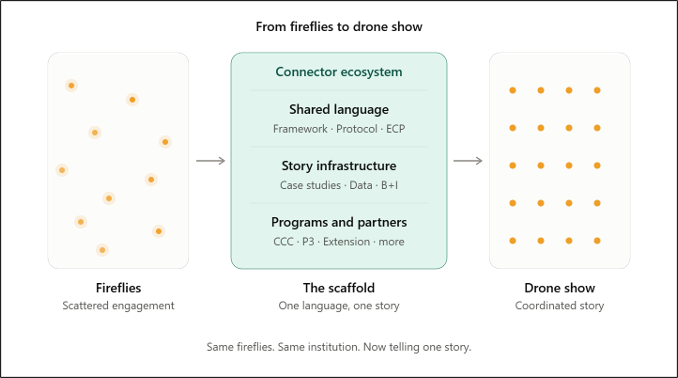
The Connector Ecosystem is not a new program layered on top of the others. It is the integrating architecture. It brings the language work (Framework, Protocol, ECP, professional development) together with the story infrastructure (Case Studies, faculty and grant reporting, B+I methodology) and connects both to the university’s active engagement programs and resources. It also creates a clear entry point for external partners: a single, responsive pathway from community need to Purdue expertise as well as multiple mechanisms for Purdue faculty/students/staff to meaningfully engage with the community.
Crucially, this Connector Ecosystem is not just about institutional alignment; it actively fuels the scholarship of engagement. By establishing a shared language and the Engaged College Program (ECP) framework, we have given our faculty the structural tools to rigorously document their community impact. When engagement is no longer a set of isolated ‘fireflies’ but part of a recognized, measurable ‘drone show,’ faculty are better equipped to translate their community-based work into compelling dossiers for promotion and tenure.
From a research perspective, the Connector Ecosystem provides a powerful competitive advantage. When our faculty apply for federal grants, they no longer must invent community engagement plans from scratch. Instead, they can plug into our existing story infrastructure and the B+I methodology, demonstrating to funders like the National Science Foundation (NSF) that their ‘Broader Impacts’ are supported by a coordinated, university-wide network.
Lastly, the scholarship of engagement thrives on interdisciplinary collaboration. By mapping our engagement footprint and creating a responsive pathway from community need to university expertise and vice versa, the Connector Ecosystem breaks down traditional silos. It allows an engineering researcher and a rural sociologist to find each other, align their efforts, and produce richer, co-authored scholarship that neither could have achieved alone.
For our community partners, navigating a large land-grant university used to feel like trying to find a needle in a haystack. The Connector Ecosystem fundamentally changes this experience. By building a shared internal language and cohesive structure, we have effectively created a dedicated front door. When a community leader brings forward a complex challenge, they no longer must guess which college or department to call; our ecosystem is designed to catch that need and seamlessly route it to the right interdisciplinary expertise.
The ‘firefly’ approach to engagement often inadvertently causes partner fatigue—multiple researchers knocking on the same community door for separate, uncoordinated projects. Our ‘drone show’ approach respects our partners’ time and resources. Through the Engaged College Program and our tracking infrastructure, we now map our footprint. This internal coordination means we can build upon established relationships and trust, ensuring our partnerships are additive rather than extractive.
Most importantly, the Connector Ecosystem shifts our community relationships from transactional interactions to true co-creation. Using our B+I methodology, we aren’t simply deploying university expertise in a community. Instead, we are blending local, lived experience with university resources that build capacity and addresses complex issues on the community’s terms, not just the university’s.
Finally, the story infrastructure we’ve built signals to our partners that we are in this for the long haul. By systematically capturing and elevating these stories, community successes are woven directly into the institutional narrative of the university. Our community partners are recognized and celebrated as vital co-authors of our land-grant mission.

For peer institutions going through a similar process, the specific programs here are Purdue’s, but the underlying pattern is one any land-grant office could adapt: establish a shared language, build story infrastructure that leverages what already exists, then create the scaffold that ties both to the work and to external partners.
The road ahead is exciting. Going from fireflies to a drone show, where the ability to flip a switch and tell the university’s engagement story — or the College of Agriculture’s, or Professor Jane Doe’s — as a coordinated, coherent, transparent picture is possible (see graphic above). That is how Purdue and our partners come to share the same language. That is how mutual benefit becomes visible. That is how a land-grant university lives its mission in the modern era. If you are at a peer institution, I would welcome additional ideas, suggestions, or just talk. If you are a Purdue faculty member looking for an on-ramp, or a community organization looking for a Purdue collaborator, reach out. We will make sure you join the drone show.