
| RELATED INFO |
| * Office of the Provost |
| * Office of Engagement |


July 16, 2007
Córdova names Lechtenberg as Purdue's interim provost
WEST LAFAYETTE, Ind. -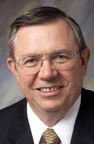 |
Lechtenberg, who has served as Purdue's vice provost for engagement since 2004, will start his new duties immediately. He will succeed Sally Mason, who is leaving Purdue to become president of the University of Iowa.
"I consulted with many Purdue faculty members and administrators before deciding on this appointment," said Córdova in announcing the appointment on her first day as Purdue president. "Dr. Lechtenberg is deeply respected by these people and by alumni and community leaders throughout the state. His administrative skill and his extensive experience as Purdue dean of agriculture from 1994 to 2004 and as vice provost make him the ideal person to lead the academic mission of the university."
Córdova said she will move quickly to initiate a national search for a new provost. Lechtenberg said he will appoint an interim vice provost to lead Purdue's engagement programs during the search process.
As interim provost, Lechtenberg will be responsible for oversight of campus management in research, engagement, teaching and related academic activities in coordination with the Office of the President. His office will oversee academic systems such as the libraries, computing center and student services (admissions, registrar, financial aid, health facilities), along with the Black Cultural Center, Latino Cultural Center and the new Native American Educational and Cultural Center.
The provost's office, in coordination with the president, also will be directly involved in developing support from federal agencies, corporations and foundations and will be responsible for issues of academic concern for the university's four regional campuses and Extension sites.
As vice provost for engagement, Lechtenberg has led Purdue's expanded effort to use university resources to address economic development and other issues affecting the state's prosperity and quality of life. He worked directly with Indiana's leaders, the business community and citizens to find ways for Purdue to advance that mission.
Lechtenberg helped communities throughout the state develop technology parks and promote the growth of high-paying jobs. He also advanced initiatives such as the Technical Assistance Program, which last year helped 536 Indiana companies implement new technologies.
Additional programs under Lechtenberg's supervision included the Office for Continuing Education and Conferences; Opportunity for Indiana, a statewide initiative to counter the brain drain; and Science Bound, which assists Indianapolis Public Schools students in preparing for a science-related degree at Purdue.
Lechtenberg said he is looking forward to the challenge.
"Provost Mason has left us with a solid foundation," Lechtenberg said. "I look forward to continuing those efforts and to working with the deans, faculty, chancellors and public officials to enhance Purdue's position as a leader in academic excellence."
Lechtenberg joined the Purdue faculty in 1971 and became a professor of agronomy in 1979. He then served as associate director of the Indiana Agriculture Experiment Station (now the Office of Agricultural Research Programs) from 1982-89. That job entailed serving as liaison between agricultural researchers and funding sources, as well as reviewing research proposals from academic departments.
Lechtenberg was named executive associate dean of agriculture in 1989. In that position, he made recommendations to the dean about research, teaching and Cooperative Extension Service programs, and he assisted in facilities planning as well as budget and personnel decisions.
The dean of agriculture administers the Purdue Cooperative Extension Service and the Office of Academic Programs, Office of Agricultural Research Programs and International Programs in Agriculture.
Lechtenberg is a member of several academic, professional and scholarly societies and has written nearly 150 technical papers, approximately 50 abstracts and six chapters in books. He served as chair of the U.S. Department of Agriculture's national Agricultural Research, Extension, Education and Economics Advisory Board from 1996 through 2002. In that capacity, he provided written testimony on biosecurity for the U.S. Senate.
Lechtenberg is a native of Butte, Neb., where he grew up on a general livestock farm. He received his bachelor's degree from the University of Nebraska in 1967 and earned a doctorate in agronomy from Purdue in 1971.
Writer: Marydell Forbes (765) 496-7704, mforbes@purdue.edu
Source: Victor L. Lechtenberg, (765) 494-9095, vll@purdue.edu
Purdue News Service: (765) 494-2096; purduenews@purdue.edu
To the News Service home page