DISCUSSION
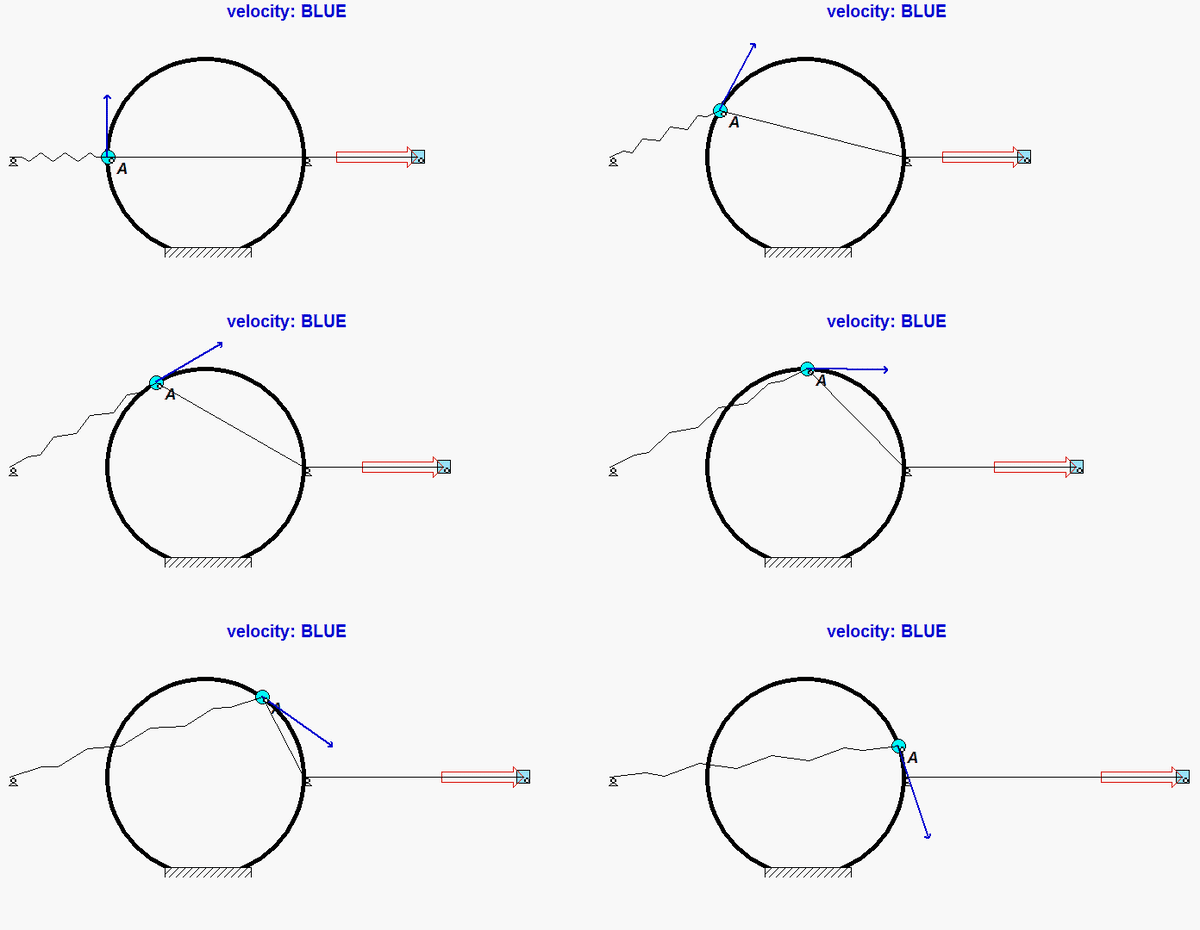
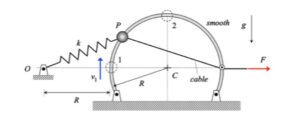
Since the problem asks for a relationship between the change of speed of P and the distance traveled by P, the work/energy equation is a natural method of choice. Recall that with the work/energy equation, we typically want to include as much in the system in order so that we can make as many forces to be workless, internal forces within the system. To this end, consider a system made up of P and the cable connected to P.
Hints:
You should follow the four-step solution plan described in the lecture book:
Step 1: Free body diagram (FBD) – Draw an FBD of the system made up of P and the cable. Which forces in your FBD do work on the system?
Step 2: Kinetics – Write down the work/energy equation for P, and the terms included in this equation.
Step 3: Kinetics – In order to determine the work done on the system by the applied force F, you need to find the distance traveled by the end of the cable as P moves from position 1 to position 2. HINT: This distance is equal to the amount of cable that is pulled over the pulley as P moves from position 1 to position 2.
Step 4: Solve – Solve for the final speed of P at position 2.
Ask and answer questions below. You will learn from both asking and answering.