Ask and answer questions here. You learn both ways.
DISCUSSION and HINTS
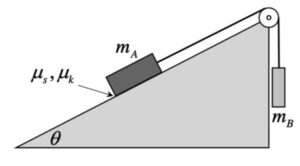
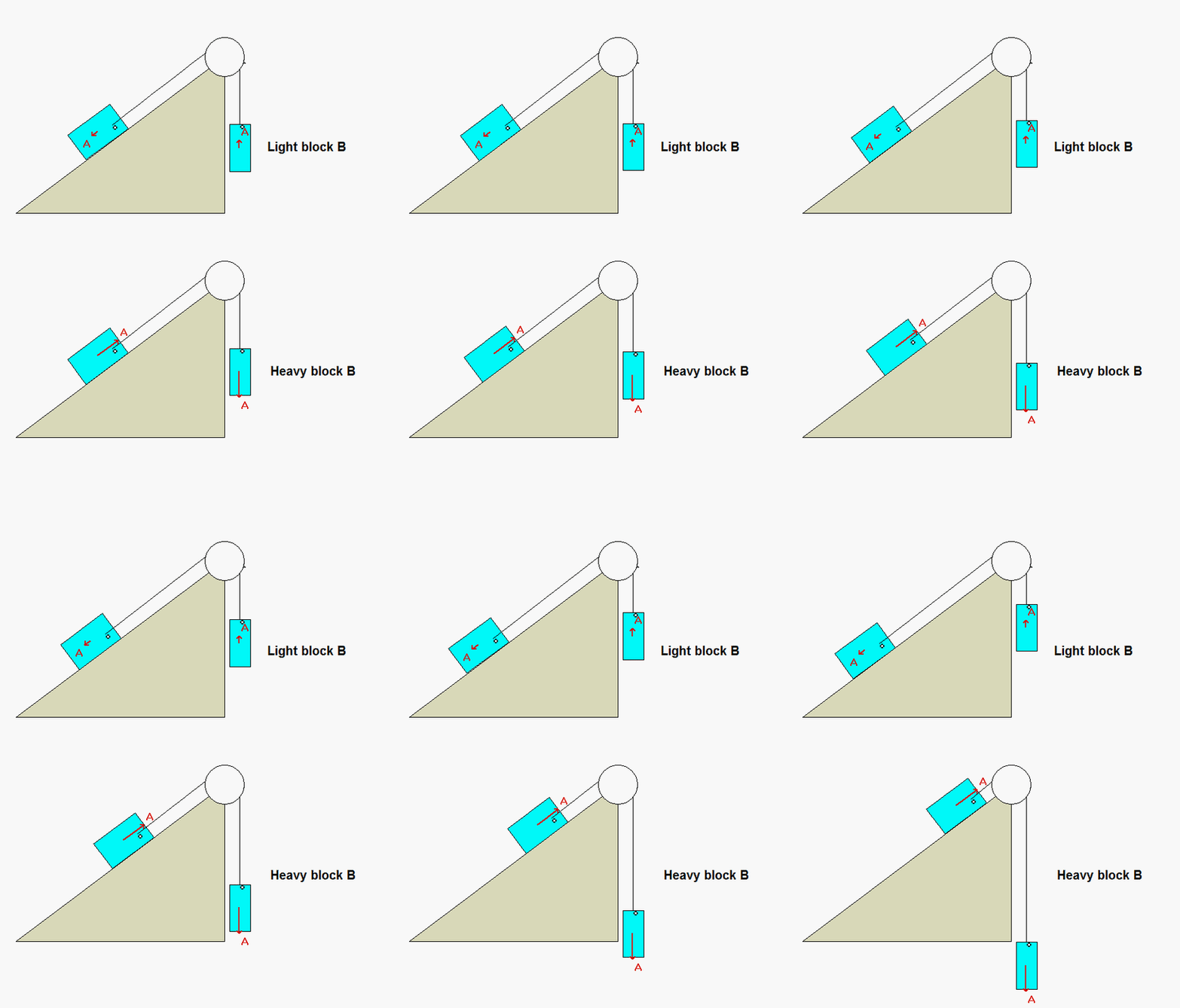
Recall when drawing a free body diagram for a system that slips when need to know the correct direction of the friction force. Consider two cases for the system shown where we change the mass of block B. In the top animation below, block B is “light”, whereas for the bottom animation, block B is heavy. The motion of the system is as expected. However, how do we know which situation that we have for the mass values given in this problem: is our block B heavy or light? Importantly, does the friction force on block A point up the incline or down the incline?
Recall the following four-step plan outline in the lecture book and discussed in lecture:
Step 1: FBDs
Draw individual free body diagrams for each block. When drawing the FBD for block A, you need to know the direction of the friction force on A (either up the ramp or down the ramp). How did you determine that?
Step 2: Kinetics (Newton’s 2nd Law)
It is recommended that you use an xy-coordinate system aligned with the slope of the ramp for block A. Sum forces in the x- and y-directions, and use Newton’s 2nd law. Use a typical xy-coordinate system for block B. Sum forces in the y-direction.
Step 3: Kinematics
What kinematics do you need here for solving the problem? Be sure that your sign conventions for forces and accelerations are compatible.
Step 4: Solve
At this point you will have two scalar equations to solve.