Ask your questions here. Or, answer questions of others here. Either way, you can learn.
DISCUSSION and HINTS
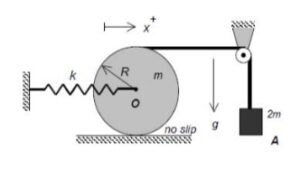
The animation below shows the vibrational motion of this system. Take note of the relationship between the acceleration of block A and the acceleration of the disk’s center O. Note that the magnitudes of these accelerations are not the same. We will focus on this in Step 3 of deriving the equation of motion.

Recall the following four-step plan outline in the lecture book and discussed in lecture:
Step 1: FBDs
Draw individual free body diagrams (FBDs) of the disk and Block A.
Step 2: Kinetics (Newton/Euler)
Write down the Euler equation for the disk and the Newton equation for Block A. The the disk rolls without slipping, it is recommended that you write your Euler equation for the disk in terms of the no-slip contact point (let’s call that point C).
Step 3: Kinematics
Since the disk rolls without slipping at the contact point with ground (let’s call that point C), we can write:
aE = aC + αdisk x rE/C – ωdisk2 rE/C
where E is the top point on the disk.
What is the relationship between the acceleration of point E and Block A?
Step 4: EOM
From your equations in Steps 2 and 3, derive the equation of motion (EOM) of the system in terms of x.