
Insect Migration and Conservation
Each year, quadrillions of insects migrate across continents and oceans — some as pollinators and ecosystem regulators, others as pests or disease vectors. Because they are small, numerous, and short lived, their movements have long been almost impossible to track. We have shown that isotope geolocation is uniquely suited to this challenge, revealing that insect migration is not chaotic but governed by predictable environmental cues. Our work on the painted lady butterfly (Vanessa cardui) uncovered continental-scale connectivity linking Europe, tropical Africa, and even South America via extraordinary transatlantic flights, and showed how rainfall anomalies drive multigenerational outbreaks across continents. This work is essential to predict insect migration and to manage and anticipate the change of migration for insects.
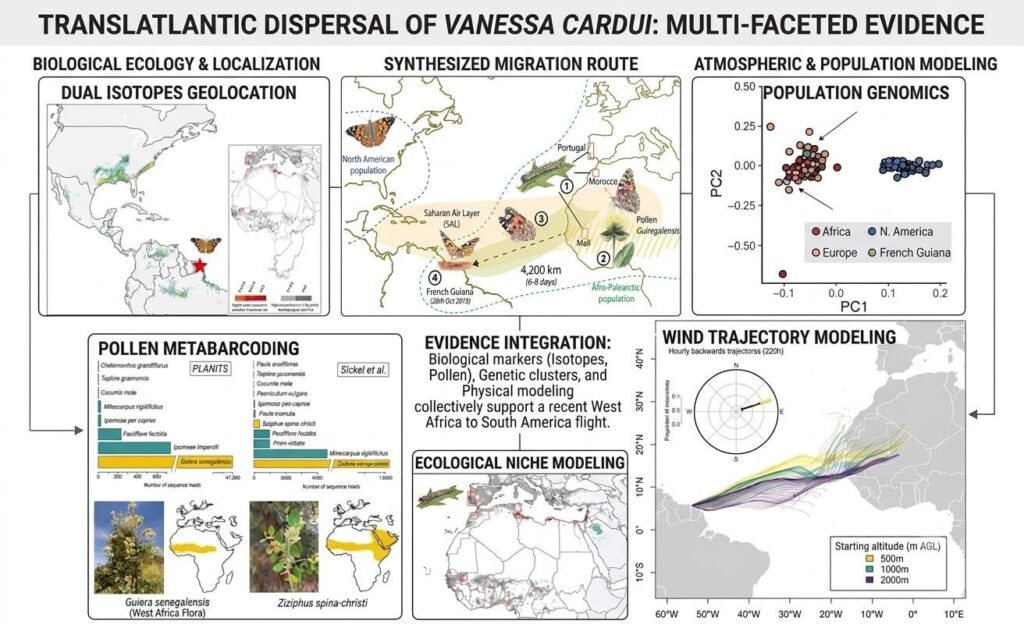
Multi-disciplinary evidence supporting the transatlantic dispersal of the Painted Lady butterfly (Vanessa cardui).
The schematic synthesizes four independent lines of evidence validating a direct migratory flight across the Atlantic Ocean from western Africa to South America.
- Dual Isotopes Geolocation & Ecological Niche Modeling (Top Left/Bottom Center): Isotopic tissue analysis combined with climate suitability mapping narrows down the natal breeding grounds of the captured individuals to specific regions in West Africa.
- Pollen Metabarcoding (Bottom Left): DNA sequencing of pollen carried by the butterflies identifies host plant species (Guiera senegalensis and Ziziphus spina-christi) exclusive to the African Sahel-Sudan region, proving recent geographical contact.
- Population Genomics (Top Right): Principal Component Analysis (PCA) of genomic data clusters the South American (French Guiana) specimens directly with African and European populations, separating them entirely from North American lineages.
- Wind Trajectory Modeling (Bottom Right): Atmospheric pressure and wind vector models recreate high-altitude, transatlantic air currents capable of carrying the butterflies from Africa to the South American coast within a viable physiological timeframe. Modified from: Suchan, T., Bataille, C. P., et al. (2024). Transatlantic dispersal of Vanessa cardui butterflies. Nature Communications.
Natural Resource Application
A critical bottleneck in predicting insect migration is accurately resolving where individuals originate and how populations are connected across landscapes. Stable isotope geolocation provides a uniquely powerful solution by encoding environmental signatures—such as precipitation and plant isotopic baselines—directly into insect tissues. This allows researchers to reconstruct natal origins and movement pathways even when tracking individuals directly is impossible. By anchoring connectivity models with empirically derived isotope assignments, we can move from inferred pathways to data-constrained migratory networks. This greatly improves the reliability of predicted connectivity and enables targeted interventions, such as protecting key source habitats or timing management actions to migratory pulses. In this framework, isotope geolocation acts as the bridge between observation and prediction, transforming disconnected datasets into actionable knowledge for conserving migratory insects at continental scales.
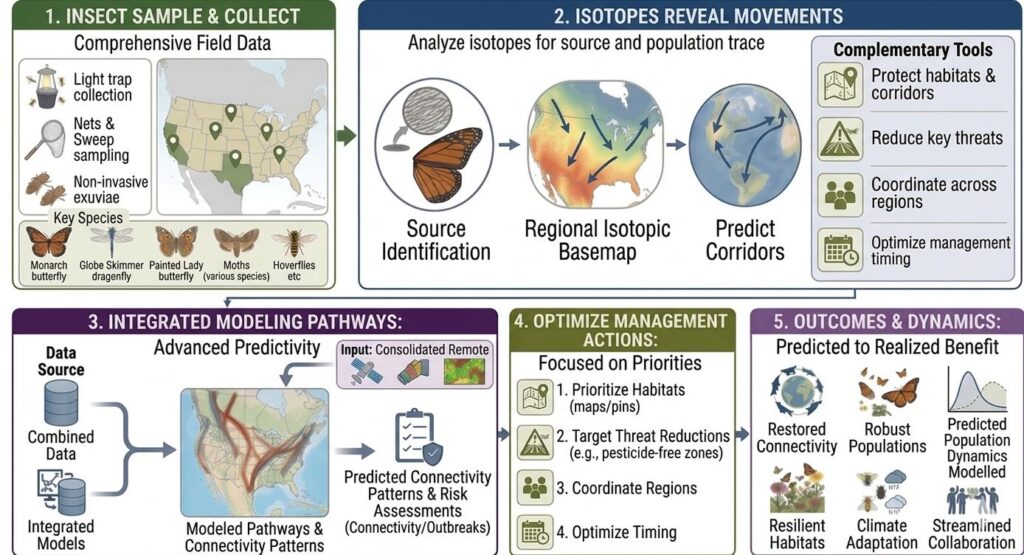
Integrated modeling framework linking insect movement pathways to management outcomes.
Multiple data streams are combined into predictive models of migratory connectivity and outbreak risk, which inform prioritized management actions (habitat protection, threat reduction, coordination, and timing). These interventions translate predicted connectivity into realized benefits, including restored ecological connectivity, resilient habitats, and robust insect populations under changing environmental conditions.