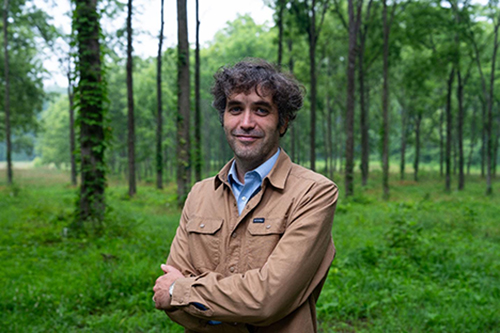
Professor Clement P. Bataille, Department of Forestry & Natural Resources
SAiVE Lab
Spatio-temporal Analytics of Isotope Variations in the Environment
about
The SAiVE Lab — Spatio-temporal Analytics of isotope Variations in the Environment — is an interdisciplinary research group founded by Clement P. Bataille in 2017 at the University of Ottawa and since 2025 is based in the Department of Forestry and Natural Resources at Purdue University, where Dr. Bataille holds the Belcher Chair of Environmental Sustainability. We bring together geochemistry, ecology, genomics, data science, and Earth observation to understand and manage how animals and materials move and change across space and time.
Our planet is facing accelerating environmental change that threatens biodiversity, natural resources, and sustainable development. Isotopes are ubiquitous markers of origin and process, and over the past decades the scientific community has generated millions of isotopic measurements from soils, water, plants, animals, and rocks worldwide. The SAiVE Lab works to unlock the potential of this data — through open, reproducible, FAIR-principled science — to build predictive tools that trace the movement and origin of life. Our vision is to harness isotope science as a tracer of life’s movements to pioneer and deploy solutions for sustainable natural resources management.
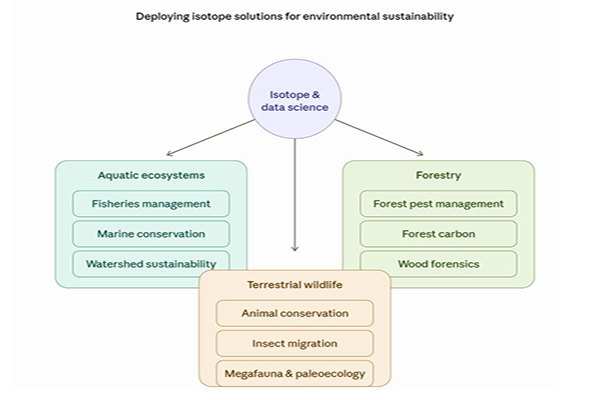
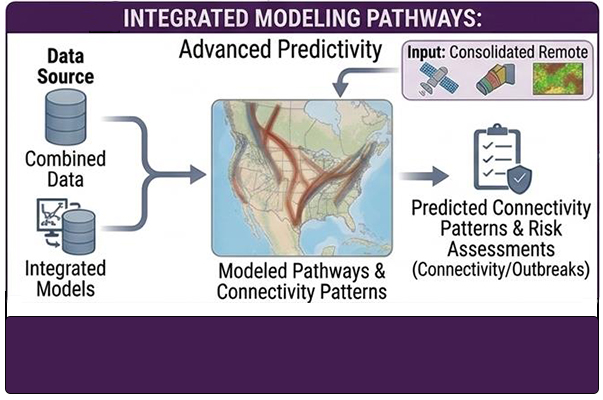
Our research spans an unusually broad range of systems, all unified by isotope geolocation and isotope data science. We forecast the migrations of invasive and native insects that threaten crops and forests to anticipate and manage their consequences, we reconstruct the journeys of ancient megafauna to understand the drivers of their extinction, we trace the origin of timber and food for supporting a sustainable bioeconomy, we follow aquatic animals between rivers, lakes and oceans to predict their population dynamics for fisheries and conservation, and we investigate the evolution of Arctic river weathering processes in a warming climate. All of those research directions are connected by the same core toolkit — multi-isotope measurement, spatial statistics, and predictive modeling.
A Note from Clement