
Aquatic Animal Migration and Management
We extend isotope geolocation to aquatic and marine systems, tracing how animals move between freshwater, coastal, and marine environments. Current projects include developing geolocation techniques to track migration between marine, lake and freshwater habitats, and quantifying the seasonal movements, trophic ecology, and land-sea or river-lake coupling of Arctic and sub-Arctic habitats for fishes and marine mammals including salmon, narwhal, beluga, and seals. This work supports fisheries science, marine conservation, and climate-change biology.
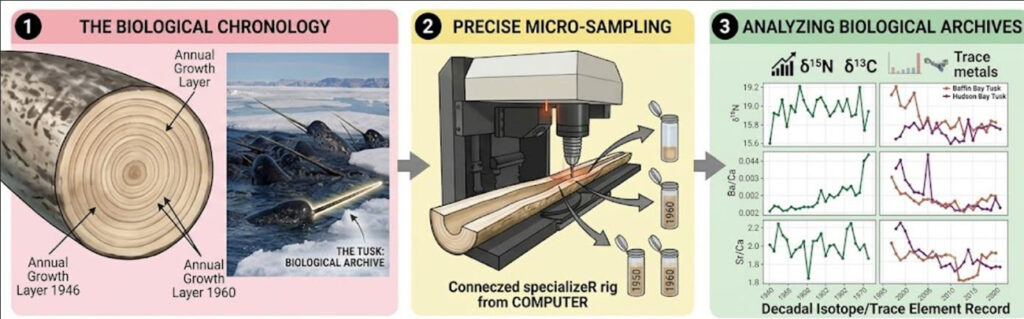
Workflow for reconstructing environmental histories from tusk biological archives.
(1) Annual growth layers within the tusk provide a chronological record of the organism’s life history.
(2) High-resolution micro-sampling along the growth axis is performed using a computer-controlled drill to extract sequential samples.
(3) Isotopic (δ¹⁵N, δ¹³C) and trace element analyses (e.g., Ba/Ca, Sr/Ca) generate time series that reveal ecological and environmental variability over decadal scales.