
Archaeology
Isotope geolocation is a powerful
lens on the human past.

We use multi-isotope analysis to reconstruct the mobility, origins, and trade networks of past peoples, animals, and artifacts — from the provenance of archaeological dogs in Maya Chiapas to mobility among Patagonian hunter-gatherers, prehistoric communities in the Alps, and the genomic and isotopic history of Iberian horses. These interdisciplinary collaborations bridge geochemistry with archaeology and ancient genomics to recover stories that would otherwise be invisible.
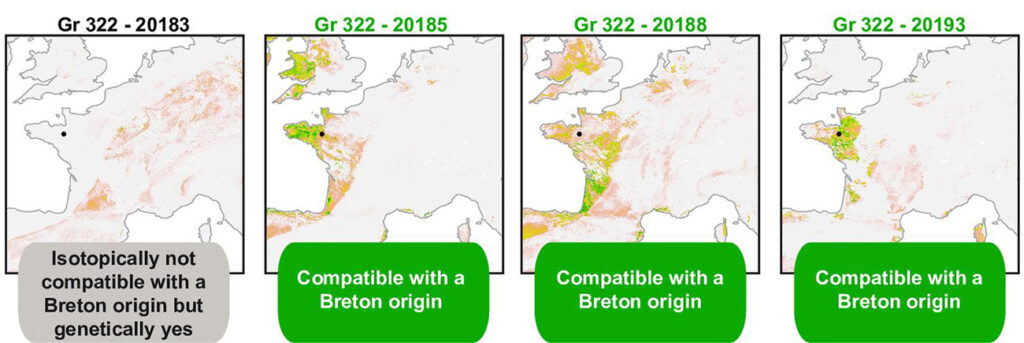
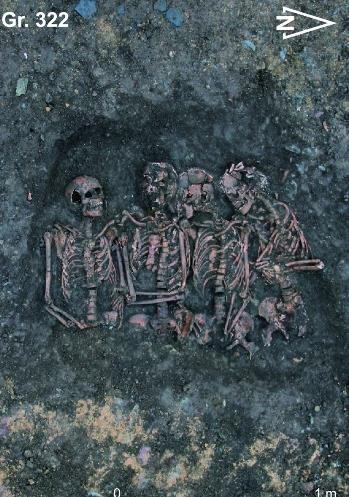
Isotope and genetic evidence of origin for individuals found in a mass grave dated of the 15th century in western France modified from Colleter et al., 2021.
Spatial probability maps derived from isotope show likely geographic origins for multiple individuals, revealing that most are isotopically consistent with a Breton origin suggesting that this mass grave gathers remains from one side of the conflict.
Natural Resource Application
Stable isotope geolocation transforms human remains into spatially explicit records of life history, allowing researchers to determine where individuals lived, how they moved, and how they were connected to broader communities. Because isotopic compositions reflect local environmental conditions—such as geology, climate, and food webs—different tissues record geographic information at distinct time scales. Teeth archive childhood origins, bones integrate signals over years to decades, and hair or nails capture short-term movements over weeks to months. By comparing these tissue-specific isotope signatures to regional and global isoscapes, it becomes possible to reconstruct individual mobility trajectories across the lifespan. This provides direct evidence for questions that are otherwise difficult to resolve, including migration patterns, population mixing, and long-distance connections. Importantly, isotope geolocation can distinguish between local and non-local individuals, identify migration events, and reveal how mobility varied by age, status, or social role. When combined with archaeological and historical data, isotope-based reconstructions illuminate the structure of past societies, including trade networks, kinship connections, and cultural interactions. In this framework, isotopes act as a bridge between biological remains and geographic space, enabling the reconstruction of human movement at scales ranging from individual life histories to continental migration systems.
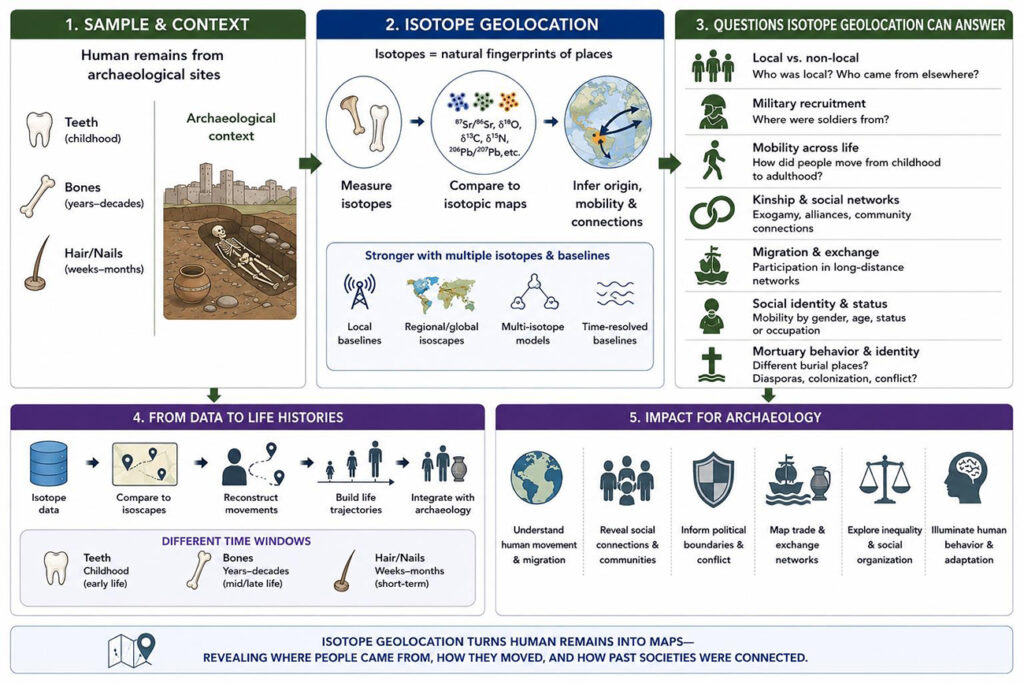
Isotope geolocation framework for reconstructing human mobility and social dynamics from archaeological remains.
Human tissues (teeth, bones, hair, nails) preserve time-resolved isotopic signatures that record environmental histories across the lifespan. By comparing these signatures to spatial isotope baselines (isoscapes), researchers can infer geographic origin, movement, and connectivity. Integrated with archaeological context, these data enable reconstruction of life histories and provide insight into migration, social networks, and past human behavior.