
Megafauna Extinction and Paleoecology
Fossils and ancient DNA archive millennia of ecological change that modern experiments are too short to capture. Because isotopes are preserved in fossil tissues, we analyze tusks, teeth, and bones of caribou, horses, bison, mammoths, wolves, and marine mammals — in collaboration with museums and First Nations — to reconstruct how past animals moved. By pairing high-resolution isotope profiles with movement models, we translate isotopic time series into spatially explicit mobility paths, illuminating how climate shifts and human activity shaped megafaunal survival and extinction. This work has earned two Science covers (as co-lead) and informs debates about rewilding, de-extinction, and conservation under climate change.
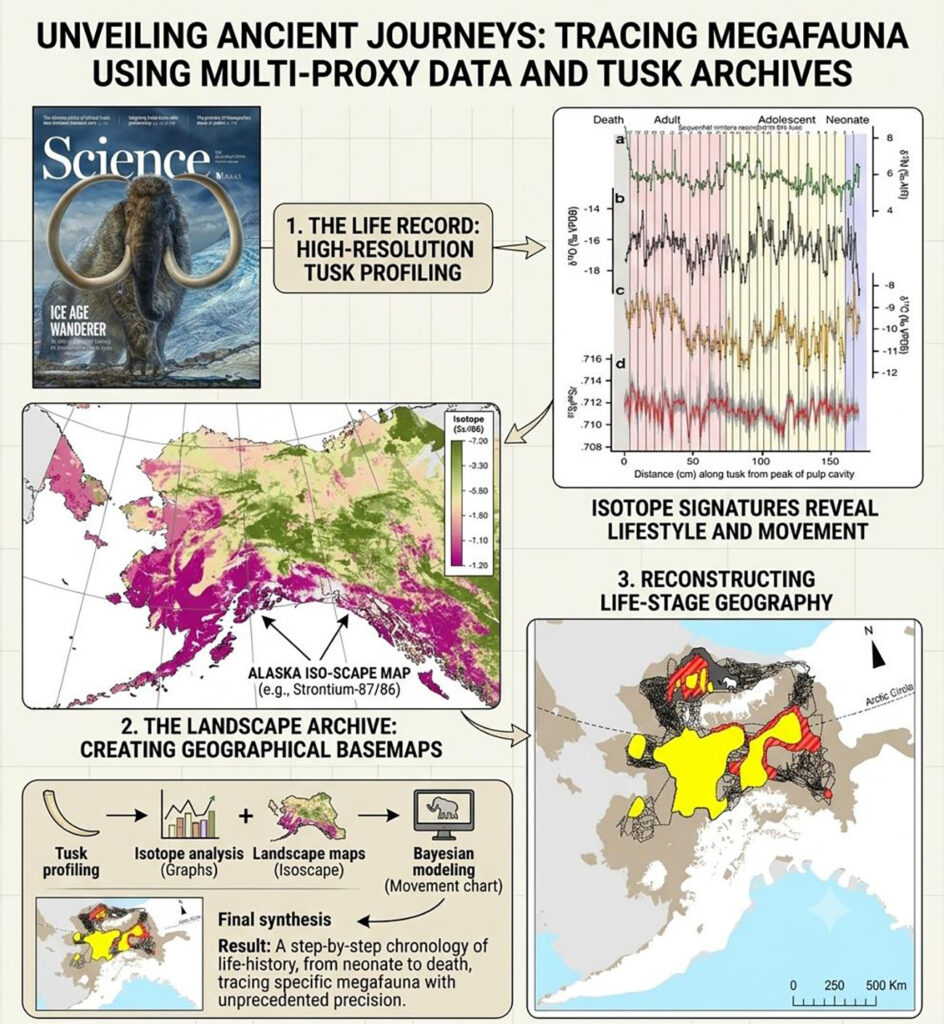
Reconstructing megafaunal life histories through isotope-enabled archive analysis.
High-resolution isotope profiling of serially sampled tusks, combined with geospatial isoscapes and multi-proxy modeling, enables reconstruction of individual life histories from birth to death. By linking isotopic signals to environmental baselines, this framework reveals movement pathways, habitat use, and life-stage geography, providing an unprecedented view of extinct megafaunal mobility across Ice Age landscapes. Figures are modified from Wooller et al. 2021.
Natural Resource Application
Stable isotope analysis provides a uniquely powerful window into the deep-time ecology of animal movement, allowing researchers to reconstruct life histories that span years to decades—even for extinct species. Incrementally growing tissues such as tusks, hair, and bone archive environmental isotope signatures over time, capturing changes in diet, habitat use, and migration pathways. These natural records enable the reconstruction of spatially explicit movement trajectories far beyond what is possible with direct observation or modern tracking methods. By linking these isotope profiles to geographically resolved baselines (isoscapes), researchers can infer where animals moved across landscapes and how their behavior responded to environmental variability. This approach makes it possible to establish pre-anthropogenic ecological baselines, providing a rare view into how large mammals structured ecosystems before modern pressures such as climate change, habitat fragmentation, and human exploitation. Crucially, isotope-informed reconstructions do more than describe the past—they provide a framework for the future. By comparing extinct and modern species, we can identify lost mobility patterns, altered migration corridors, and shifts in resource use, which can then inform predictive models of ecosystem resilience. In this way, isotope geolocation serves as the bridge between paleobiology and conservation, enabling the design of spatiotemporally targeted management strategies that restore connectivity, prioritize key habitats, and support the long-term persistence of migratory species.
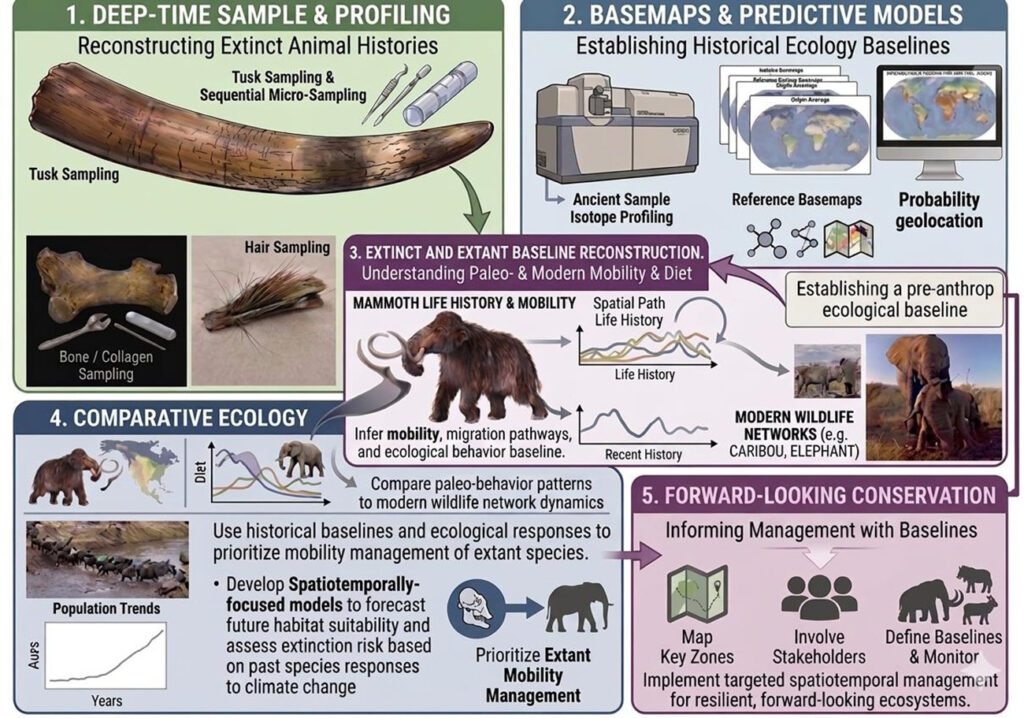
Isotope-enabled reconstruction of past animal movements to inform future conservation strategies.
Sequential sampling of archival tissues (tusks, hair, bone collagen) enables high-resolution isotope profiling across individual life histories. These data are integrated with isoscapes and predictive models to reconstruct mobility, diet, and ecological baselines for extinct and extant species. Comparative analyses link past and present movement patterns, providing a foundation for forward-looking conservation planning, targeted management, and resilience under environmental change.