


November 16, 2009
College of Education to unveil space images
WEST LAFAYETTE, Ind. - |
The images are from NASA's Hubble Space Telescope, Spitzer Space Telescope and Chandra X-ray Observatory.
They will be added to the college's current collection of nine large, limited-edition Hubble prints already on display in Beering Hall. This is the second time this year the College of Education has been selected to receive limited-edition prints in celebration of the International Year of Astronomy 2009.
The current collection was donated to the college by 1968 graduate Margaretha (Peggy) Motes McBride, a former teacher and director of the Muncie Community Schools Planetarium. Her connections with NASA and Hubble enabled the college to obtain the additional prints.
 |

As part of the Friday event, scheduled for 10:15 a.m. CST, McBride will give a presentation to 52 Lincoln Elementary fourth-graders before the images are unveiled.
The International Year of Astronomy 2009 celebrates the 400th anniversary of Galileo first turning a telescope to the heavens. From Galileo's first spyglass, telescopes have grown ever larger and more powerful and have moved to mountaintops and to space.
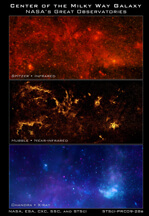
One image shows three full-color photos that showcase the galaxy's features in the infrared light observed by Spitzer, the visible light observed by Hubble and the X-ray light observed by Chandra. The other print, 6 feet by 3 feet, is a composite, multi-wavelength image that provides one of the most detailed views ever of our galaxy's core.
The images show the details of the spiral structure for which the galaxy is famous and the underlying giant clouds where stars are born, as well as the hidden locations of black holes and exploded stars.
Writer: Judith Barra Austin, 765-494-2432, jbaustin@purdue.edu
Source: Tonya Agnew, College of Education communications director, 765-494-0568, tragnew@purdue.edu
Purdue News Service: (765) 494-2096; purduenews@purdue.edu
PHOTO CAPTION:
This composite, multi-wavelength image provides one of the most detailed views ever of the Milky Way's core.
A publication-quality photo is available at https://www.purdue.edu/uns/images/+2009/milkyway.jpg
PHOTO CAPTION:
These views of the Milky Way are shown in infrared light from the Spitzer Space Telescope, in visible light from the Hubble Space Telescope and in X-ray light from the Chandra X-ray Observatory.
A publication-quality photo is available at https://www.purdue.edu/uns/images/+2009/milkyway-composite.jpg
To the News Service home page