
| VIDEO |
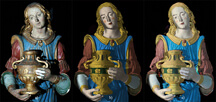 * Purdue computer science assistant professor Daniel Aliaga brings back an artifact's luster with computer-controlled projection of color lighting. (30 seconds) * Purdue computer science assistant professor Daniel Aliaga brings back an artifact's luster with computer-controlled projection of color lighting. (30 seconds) |
| RELATED WEB SITES |
| * Discoveries and Breakthroughs Inside Science |
| * Purdue Computer Graphics and Visualization Lab |
| * "Virtual Restoration of Cultural Heritage Artifacts" |
| PREVIOUS NEWS RELEASE |
| * New technique provides illusion of restoration without risk of damage to priceless artifacts |


November 3, 2009
Film puts spotlight on virtual artifact restoration process developed at Purdue
WEST LAFAYETTE, Ind. - A technique developed at Purdue University that virtually restores artifacts will be featured in a mini-documentary to be released this month.The 90-second segment summarizes how projecting millions of tiny lights onto deteriorated artifacts makes them look new again.
"We project the missing colors of the object, not just a new picture," said Daniel G. Aliaga, a Purdue assistant professor of computer science. "We can control precisely what we want the object to look like."
The researchers first demonstrated the process earlier this year at the Eiteljorg Museum of Native American Art and at the Indianapolis Museum of Art.
The documentary was filmed by Discoveries and Breakthroughs Inside Science (DBIS), a branch of the American Institute of Physics. DBIS will distribute the film to its subscribing TV newscasts nationwide.
During the film, Aliaga and graduate students Alvin Law and Yu Hong Yeung demonstrate how they use computer software and strategically placed projectors to give the illusion of restoration to historical objects without physically altering them. This allows for the study of artifacts without the risk of damaging the original objects.
"The new appearance of the objects is visible to the casual observer without the need for any special viewing goggles or screens," Aliaga said.
The next step for the Purdue researchers is to analyze how the technique can be used in archeological research and education and to enable future restoration efforts.
To learn more about the virtual restoration process and see videos of objects restored using the process, go to https://wiki.cs.purdue.edu/cgvlab/doku.php?id=projects:virtual_restoration
Writer: Kim Schoonmaker, 765-494-2081, kschoonmaker@purdue.edu
Source: Daniel G. Aliaga, 765-496-7943, Aliaga@purdue.edu
Purdue News Service: (765) 494-2096; purduenews@purdue.edu
To the News Service home page