


October 9, 2009
Gray and pink molds being found in Indiana cornfields
WEST LAFAYETTE, Ind. - |
There's a lot of Diplodia ear rot throughout Indiana, especially in the northeast and southeast, said Charles Woloshuk, a Purdue Extension pathologist who specializes in corn mycotoxins. Anywhere from a few percent to up to 30 percent of the ears are infected, he said.
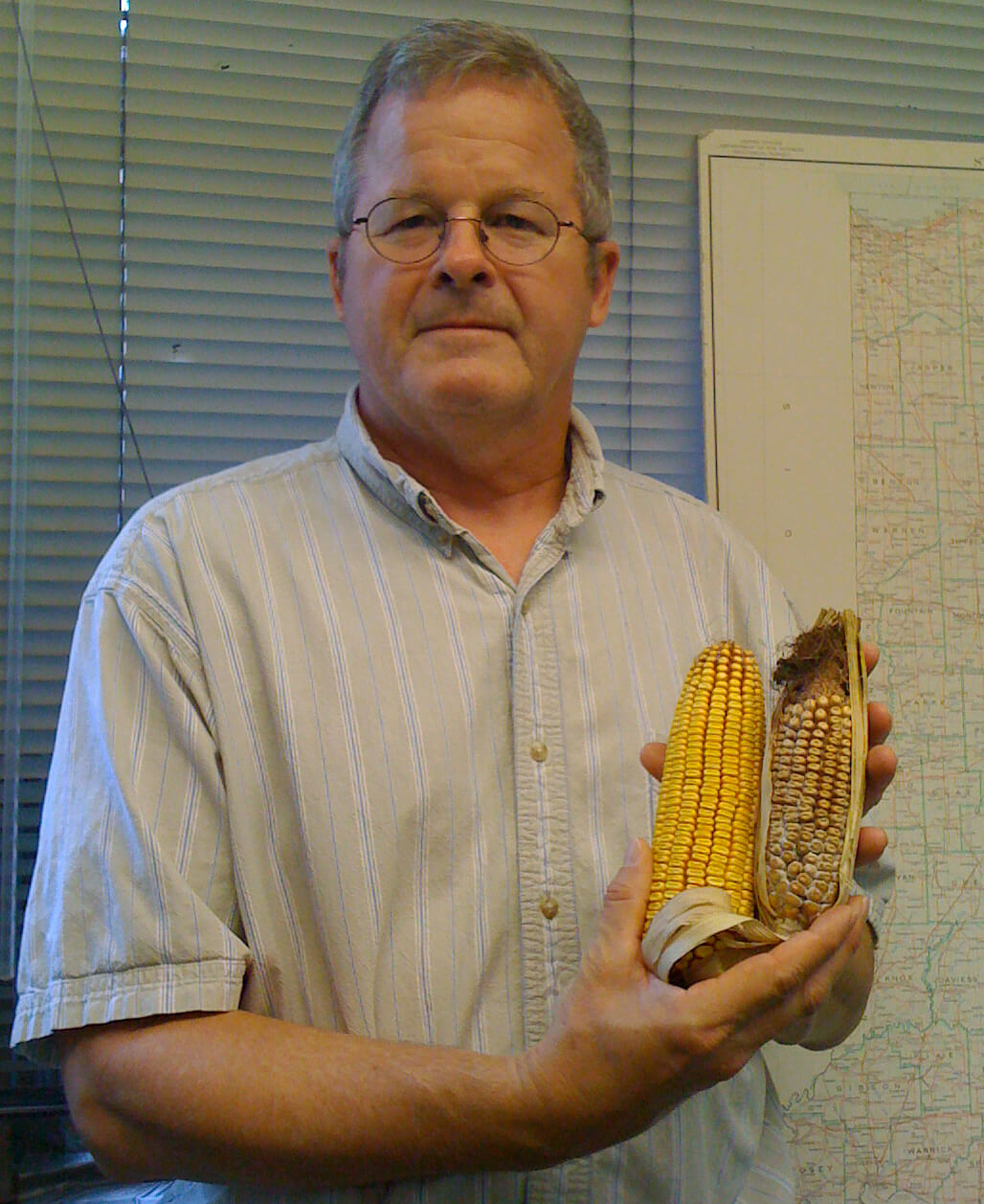
Diplodia ear rot is characterized by a grayish or grayish-brown mold on and between the kernels on part of the ear. Gibberella ear rot, also known as Gib, is characterized by a pink to reddish mold, which begins at the tip of the ear and develops toward the base. Gib is easy to identify in the field on intact ears, but is more difficult to spot once the grain has been shelled.
Woloshuk encouraged producers and elevators to know what's going on in their area. Producers need to walk their fields, pull 10 ears and determine if they have either Diplodia or Gibberella and the frequency, he said.
"If it's Gib ear rot, then there's concern about the mycotoxin deoxynivalenol, or DON, as well as zearalenone. If suspect, the grain should be tested, especially if it's to be fed to livestock," Woloshuk said.
Two grain inspectors in the central and north-central regions of Indiana who analyze grain for DON are East Indiana Grain Inspection Inc., located at 7020 N. Walnut St. in Muncie, and Titus Grain Inspection Inc., located at 1111 E. County Road 800 North in West Lafayette.
"If it's Diplodia, there is no need to be concerned about mycotoxins. However, if you are feeding a high percentage of moldy grain, that's still not good," Woloshuk said. "In either case, the grain needs to be harvested as soon as possible and dried for storage. This grain should not be stored through the summer months."
Farmers also are encouraged to adjust combines to reduce the amount of fine and small, shriveled or broken kernels.
Growers that have problems this year with either Gib or Diplodia can take steps to help prevent a reoccurrence.
Genetics are involved with Diplodia, Woloshuk said.
"If a producer had a problem this year with a specific hybrid, then I would not plant that hybrid again," he said.
With either of the diseases, the crop residue should be tilled under because that's where the pathogens can survive, Woloshuk said. He also recommended rotating to soybeans.
For questions and additional information about Diplodia or Gib, contact Woloshuk at 765-494-3450, woloshuk@purdue.edu
Writer: Julie Douglas, 765-496-1050, douglajk@purdue.edu
Source: Charles Woloshuk, 765-494-3450, woloshuk@purdue.edu
Ag Communications: (765) 494-8415;
Steve Leer, sleer@purdue.edu
Agriculture News Page
PHOTO CAPTION:
Purdue Extension pathologist Charles Woloshuk holds one good corn ear and one infected by Diplodia ear rot. (Purdue Agricultural Communication photo)
A publication-quality photo is available at https://www.purdue.edu/uns/images/+2009/woloshuk-diplodia.jpg
To the News Service home page