
| RELATED INFO |
| * Conference Web site |
| * James E. Braun |
| * Eckhard Groll |


May 1, 2008
Energy, environment key to air conditioning, refrigeration conferences
WEST LAFAYETTE, Ind. -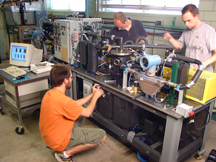 |
The conferences, held every two years, have drawn about 10 percent more technical abstracts this year, largely because of special sessions focusing on energy-conserving technologies. Engineers will present findings on technologies such as solar-assisted designs, more efficient heat pumps for space heating in buildings and domestic water heating, compressors that integrate devices to recover energy ordinarily lost, systems that use naturally occurring "green working fluids" such as air as a refrigerant, and designs that modify the conventional "vapor compression cycle" behind refrigeration.
About 500 people are expected to attend the 12th International Refrigeration and Air Conditioning Conference and the 19th International Compressor Engineering Conference. Researchers and industry executives from around the globe, including North America, Europe, Asia and South America, will present talks.
"Compressors, air conditioners and refrigerators are responsible for a huge portion of the world's total energy consumption," said general conference chair Eckhard Groll, a Purdue professor of mechanical engineering. "As energy prices increase, so too does interest in more efficient systems."
Sessions will include talks about automotive air conditioners that use carbon dioxide as a refrigerant, which has a much lower global warming potential than synthetic refrigerants now on the market. Other talks will cover compressors that make less noise than conventional designs; more accurate computational models to simulate the operation of refrigeration systems; and a type of compressor called a scroll compressor, which could be used in designs capable of using environmentally friendly refrigerants.
Registration will be in the east foyer of Purdue's Stewart Center from 8-10 a.m. on July 14. Most of the conference sessions will be held in Stewart Center.
"We're covering many areas critical to industry, commerce and domestic air conditioning and refrigeration," said James Braun, a Purdue professor of mechanical engineering and conference co-chair. "One session will focus entirely on industrial refrigeration. "
Talks also will detail work on "small-scale cooling," including miniature refrigeration systems to cool laptop and personal computers, led by Groll and Suresh Garimella, the R. Eugene and Susie E. Goodson Professor of Mechanical Engineering. The miniature compressors use tiny diaphragms to pump refrigerant.
Another session will focus on the Ericsson cycle, which uses an exotic concept called isothermal compression and expansion to induce cooling. Unlike conventional refrigerators, in which a refrigerant gas condenses into a liquid after absorbing heat, the refrigerant remains a gas in the Ericsson cycle. The gas is kept cool by adding a liquid to it as it is being compressed, and the system could replace synthetic refrigerants with natural materials such as air, nitrogen or carbon dioxide.
The conferences are organized by faculty from Purdue's Ray W. Herrick Laboratories, in cooperation with sponsoring and participating organizations, including the American Society of Heating, Air Conditioning, and Refrigerating Engineers and the International Institute of Refrigeration.
Conference highlights will include:
*A "paper room" to make research papers available to conference attendees in Stewart Center, Room 302, from 8 a.m. to 4 p.m. on July 14-16.
* A keynote speech by S. Forbes Pearson, CEO of Star Refrigeration Ltd. in Scotland, from 10-11:45 a.m. July 14 in Loeb Playhouse in Stewart Center. The topic is using natural refrigerants such as ammonia and carbon dioxide for industrial refrigeration instead of synthetic refrigerants that have a higher global warming potential.
* Sessions on using hydrogen as a refrigerant in "desiccant cooling" and compressors that use carbon dioxide, from1-3 p.m. on July 14 in Stewart Center.
* A talk by Peter Egolf from the University of Applied Sciences in Switzerland on "Magnetic Heating, Refrigeration and Power Conversion " from 8:30-9:30 a.m. July 15 in Stewart Center's Fowler Hall.
* Findings presented by Purdue engineers about miniature compressor research, from 9:45 - 11:45 a.m. on July 15 in Stewart Center.
* Sessions on several topics, including enhancing the conventional vapor compression cycle and scroll compressors, from 1-3:30 p.m. July 15 in Stewart Center.
* Sessions on subjects including control and diagnostics, work recovery, improving heat exchangers and new compressor concepts, from 4-6 p.m. July 15 in Stewart Center. Braun will present a talk about a method for sensing refrigerant "charge," or how much refrigerant is in the system, using a new "virtual refrigerant charge sensor." Another paper will focus on increasing the performance of air conditioning and refrigeration by using sensors and precisely controlling the flow of refrigerant using electronic "active-control" valves.
* Sessions on subjects including alternative cooling and heating technologies and designs that reduce the noise of air conditioners, from 9:45-11:45 a.m. on July 16. Three papers will be presented on the liquid-flooded Ericsson cycle in joint research by Braun, Groll and Galen B. King, a professor of mechanical engineering, along with students.
* Sessions on subjects including recovering heat to generate electricity and improve the efficiency of designs, from10 a.m. to noon on July 17.
* Sessions on subjects including solar-assisted systems, from1-3 p.m. July 17 in Stewart Center.
The conference organizing committee includes Herrick Laboratories faculty members Braun; Groll; Douglas Adams, an associate professor of mechanical engineering who is compressor conference program chair; Nasir Bilal, a graduate student and compressor engineering conference program chair; Hyeung Kim, a graduate student and the conference program chair; Ray Cohen, an emeritus professor of mechanical engineering; Patricia Davies, director of Herrick Labs and a professor of mechanical engineering; Werner Soedel, an emeritus professor of mechanical engineering; David Tree, a professor of mechanical engineering; and Virginia Freeman, the conference secretary.
Detailed information about the conferences and the approximately 325 technical abstracts that will be presented can be found at https://engineering.purdue.edu/Herrick/Events.
Registration fees are listed on the Web site. The fee for advanced registration before May 31 is $650, and full registration is $700. Short courses on compressors and natural-refrigerants will be on July 12-13in Rawls Hall. Each course costs $700.
Writer: Emil Venere, (765) 494-4709, venere@purdue.edu
Sources: James Braun, (765) 494-9157, jbraun@ecn.purdue.edu
Eckhard Groll, (765) 496-2201, groll@ecn.purdue.edu
Purdue News Service: (765) 494-2096; purduenews@purdue.edu
Note to Journalists: Electronic copies of papers being presented by Purdue researchers are available from Emil Venere, (765) 494-4709, venere@purdue.edu
PHOTO CAPTION:
Purdue mechanical engineering undergraduate student Robert Johns (far left) works with doctoral student Ian Bell (right) and visiting doctoral scholar Vincent Lemort on an Ericsson cycle air conditioning system at Purdue's Ray W. Herrick Laboratories. The Ericsson cycle uses an exotic concept called isothermal compression and expansion to induce cooling and can use environmentally friendly natural refrigerants instead of synthetics. Engineers will present findings about Ericsson cycle research during the 12th International Refrigeration and Air Conditioning Conference and the 19th International Compressor Engineering Conference at Purdue in July. (Purdue School of Mechanical Engineering photo/Michael Black)
A publication-quality photo is available: https://www.purdue.edu/uns/images/+2008/groll-refrigeration.jpg

To the News Service home page