


August 28, 2007
Purdue Research Park to feature new MRI center for patient care, research
WEST LAFAYETTE, Ind. -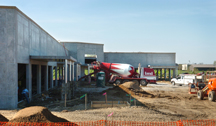 |
The 26,000-square-foot LakeView Technology Center, 3482 McClure Ave, is located in the Purdue Research Park's Phase II development on a 3.86-acre site just south of Kalberer Road. The 7,800-square-foot MRI center, called InnerVision West, is on the north end of the structure. The building also will house a restaurant, coffee shop and a growing high-tech company. A dedication of the new building is planned for Nov. 2.
"The MRI center is a partnership among Purdue University, Purdue Research Foundation, St. Elizabeth Regional Health, Unity Health Care and GE Healthcare," said Purdue President France A. Córdova. "The center will provide both a health-care service for the public and a valuable research tool for the university.
"It is an excellent example of how much can be accomplished through our university's collaborations with the community and business."
The new building will house:
* A 3-Tesla MRI scanner that offers enhanced resolution over conventional 1.5-Tesla MRI scanners. It is the first machine of this field strength in north central Indiana.
* A 5,500-square-foot restaurant aimed at the business lunch customer and a casual, yet upscale, dinner crowd.
* A 1,500-square-foot coffee shop that is separate from the restaurant.
* An 8,300-square-foot area for Simulex Inc., a Purdue Research Park-based firm currently located in the Purdue Technology Center.
"The Purdue Research Park is a prime location for new and growing high-tech companies, and office and laboratory space is now in short supply," said Stephen Shook, managing member of Lafayette, Ind.-based SRJ McClure Development I LLC, the organization that owns the facility. "The new one-story building will provide up to an additional 10,000 square feet of office or laboratory space for second-stage technology companies."
This is the second building to be developed at the Purdue Research Park by Shook, who expects this project to be completed in late October by the Indianapolis-based builder Duke Construction. The first building, which opened in 2006, was the International Technology Center, a 65,000-square-foot research park building that features a full-scale health club and six office tenants. The new building will have a similar design, utilizing tilt-up construction panels.
"It gratifies us that a Lafayette developer has had a significant role in bringing to the Purdue Research Park some of the amenities that will enhance its atmosphere as an attractive and convenient place for technology companies to do business," said Joseph B. Hornett, senior vice president, treasurer and chief operating officer of the Purdue Research Foundation, which owns and operates the research park.
Purdue University previously collaborated with GE Healthcare on developing safety studies for GE's fastscan magnetic resonance techniques. The university also has partnered with GE Healthcare on the company's CT systems.
"We have a long and important history of partnering with GE Healthcare," said George Wodicka, professor and head of Purdue's Weldon School of Biomedical Engineering. "We wanted something that could serve the community and provide additional resources for researchers. The MRI center provides both, as it will be used during the day for patients and used for research at night and on the weekends.
"This magnetic resonance imaging machine also will provide vast potential for clinically oriented research with St. Elizabeth Regional Health."
Howard Weiss, professor and head of the Department of Psychological Sciences in the College of Liberal Arts, said the new MRI machine will help researchers in many different fields of the social and behavioral sciences.
"This type of research is relevant to all disciplines related to human activity, from psychology to political science, from economics to speech and language sciences," Weiss said. "Our new functional MRI capabilities will allow us to map brain activity while individuals are engaged in various types of tasks.
"In that respect, it will help us understand how brain activity underlies human mental functioning, such as decision-making, attention, memory and emotions."
Magnetic resonance imaging is a non-invasive method that allows physicians to "see" internal tissues by using magnetic fields to interact with the protons in the patient's body. The magnetic field in an MRI system is rated using a unit of measure known as Tesla or "T." The unit of measure is named for Nikola Tesla, a Serbian-American physicist, inventor and electrical engineer who discovered magnetic inductivity, the process that makes magnetic resonance imaging possible. Three Tesla (3T) is equivalent to 60,000 times the Earth's magnetic field.
"This technology helps to maintain, and even enhance, our position as a leader and innovator in diagnostic imaging," said Stephen Matthews, M.D., director of the radiology for InnerVision Advanced Medical Imaging LLC. "It enables us to make diagnoses in many areas of medicine earlier and more accurately, which translates to better medical care for our patients.
"We are, therefore, extremely pleased to bring this new 3T technology to our community."
Some of the procedures that the 3T-MRI system will particularly benefit include magnetic resonance angiography; neurological/brain imaging; spine studies; orthopedic, including elbow, wrist, hip, knee, foot and ankle; prostate; pelvis; abdominal; spectroscopy; brain fiber tracking; and functional neuroimaging.
"The 3T-MRI captures images with a level of detail, clarity and speed never before possible outside of elite teaching hospitals and medical schools," said Terry Wilson, president and CEO of St. Elizabeth Regional Health (formerly Greater Lafayette Health Services). "The 3T strength can increase the imaging resolution by 16 times. We are very pleased to play a part in bringing this technology to our community."
The new machine is expected to scan approximately eight patients per day, with individual scan times of 30-60 minutes - similar to that of standard scanners. The center will be staffed by three to five people.
The south end of the building will feature a 5,500-square-foot restaurant. Shook said he is in negotiations with a restaurant operator and will disclose the name of the restaurant once contracts are signed.
Located off the 1,000-square-foot commons at the building's center, adjacent to the restaurant, will be a 1,500-square-foot coffee shop that will not be connected with the restaurant.
Simulex, a company established in 1999, will relocate into the remainder of the new facility's space. Simulex provides fully functioning synthetic environments that enable government and business customers to gain insights into complex situations. The technology, called Synthetic Environments for Analysis and Simulation (SEAS), was developed at Purdue and is the business analogue of military war gaming. It provides continuously running artificial theaters consisting of interlinked individuals, organizations, institutions, infrastructures and geographies. These theaters are populated with virtual entities with parameters established by real-world data. Within these theaters, customers can anticipate and shape competitive reactions to their actions and consequently predict and evaluate future courses of action.
The technology has been used by the U.S. Joint Forces Command, Naval Air Command, U.S. Army Recruiting Command and Fortune 500 companies for analysis, planning and training.
"We are expanding to this new location to support our growth plan," said Alok Chaturvedi, Purdue professor of management and chairman and CEO of Simulex. "We are in the process of reorganizing the company into two divisions – Simulex Government and Simulex Global. This move will give us the elbow room to grow both businesses."
Simulex currently has 35 employees and has offices in the Purdue Research Park, San Francisco, Atlanta and Norfolk, Va., as well as a subsidiary in India.
About Purdue Research Park
Purdue Research Park (https://www.purdueresearchpark.com) encompasses 591 acres in West Lafayette, Ind., and is home to the largest university-affiliated business incubator complex in the nation. Within the park, 140 businesses, of which more than 90 are high-tech, employ more than 2,900 people. The Association of University Research Parks recognized Purdue Research Park for Excellence in Technology Transfer in 2005, and the park received the organization's Research/Science Park Company of the Year Award of Excellence in 2004.
About Unity Healthcare
Unity Healthcare has about 75 general and specialty physicians operating from Unity's state-of-the-art medical facility and office in Lafayette's surrounding communities providing care for more than 200,000 patients per year. Unity Healthcare physicians independently offer allergy and asthma, anesthesiology, gastroenterology, general surgery, obstetrics and gynecology, occupational medicine, ophthalmology, orthopedics, orthopedic, spinal surgery, otolaryngology, pain management, pediatrics, physical therapy, plastic surgery, podiatry, primary care, psychology, radiology, radiation oncology, urology, venous medicine services and many others.
About St. Elizabeth Regional Health
St. Elizabeth Regional Health is a member of the Sisters of St. Francis Health Services system. The Sisters of St. Francis began its mission in the United States with the founding of St. Elizabeth Medical Center in Lafayette in 1875, and through the course of more than 130 years, the system has grown into a leading Midwest health-care system with 11 hospitals in Indiana and two hospitals in Illinois.
About InnerVision Advanced Medical Imaging
Unity Healthcare opened InnerVision Advanced Medical Imaging Center in the Unity Medical Center on Creasy Lane in October of 2000 and became a joint venture with the St. Elizabeth Regional Health in September of 2005. The center provides computed tomography, ultrasound, bone densitometry, X-ray, nuclear medicine and position emission tomography services to the residents and physicians of Tippecanoe County and the surrounding areas.Writers: Cynthia Sequin, (765) 494-4192, casequin@prf.org
Jeanine Phipps, (765) 494-0748, jsphipps@prf.org
Sources: Steve Shook, sshook@shook.com
Joseph Hornett, (765) 494-8645, jbhornett@prf.org
George Wodicka, (765) 494-2998, wodicka@purdue.edu
Howard Weiss, (765) 494-6061, weiss@psych.purdue.edu
Stephen Matthews, (765) 446-5399
Terry Wilson, (765) 423-6361
Alok Chaturvedi, (765) 494-9048, alok@purdue.edu
Purdue News Service: (765) 494-2096; purduenews@purdue.edu
PHOTO CAPTION:
Construction continues on the 26,000-square-foot LakeView Technology Center at the Purdue Research Park. The building, which will be completed by late October, includes a magnetic resonance imaging center, an upscale restaurant, a coffee shop and Simulex Inc., a high-tech company currently located in the Purdue Technology Center. SRJ McClure Development I LLC of West Lafayette, Ind., owns the structure. The MRI scanner is one of only two in the state with a 3 Tesla imaging ability, which is about twice the imaging strength of a traditional scanner. The center will be used for patient care, research and education, and is a partnership among Purdue Research Foundation, Purdue University, St. Elizabeth Regional Health, Unity Healthcare and General Electric Healthcare. (Purdue News Service photo/David Umberger)
A publication-quality photo is available at https://www.purdue.edu/uns/UNS/images/+2007/PRP-mcclure.jpg

To the News Service home page