
| RELATED INFO |
| * Center for Paralysis Research |
| * School of Veterinary Medicine |
| * Weldon School of Biomedical Engineering |


March 8, 2007
Purdue takes knowledge about spinal cord regeneration to China
WEST LAFAYETTE, Ind. - |
Richard Borgens, the Mari Hulman George Professor of Applied Neurology, and Riyi Shi (REE-yee SHEE), associate professor in the Department of Basic Medical Sciences, have been invited to give lectures in three cities over a two-week period. Borgens and Shi have joint appointments in Purdue's School of Veterinary Medicine and the Weldon School of Biomedical Engineering and conduct their research from the Center for Paralysis Research.
"This is an opportunity to present new therapies in human medicine developed in Indiana to the 'creme de la creme' of Chinese neuroscience and neurology," said Borgens, who is the center's director. "These scientists have the capability to take our technology to the nearly 100,000 people with spinal cord injuries in China each year. That rate compares to 11,000 people with similar injuries in the United States, so even taking into account the differences in population, it's big."
Borgens will lecture on the electrical control of spinal cord regeneration in humans. The groundbreaking device, the oscillating field stimulator, developed at the Center for Paralysis Research, is designed to regenerate nerve fibers. The Andara OFS (oscillating field stimulator) is currently being developed at Cyberkinetics Neurotechnology Systems Inc., where Borgens serves as a scientific adviser.
In February, Cyberkinetics submitted a humanitarian device exemption to the Food and Drug Administration to obtain market clearance for the implantable Andara OFS System. If approved, Cyberkinetics' Andara OFS System would be the first commercially available neurotechnology device designed to partially restore sensation and motor function in acute spinal cord injuries.
 |
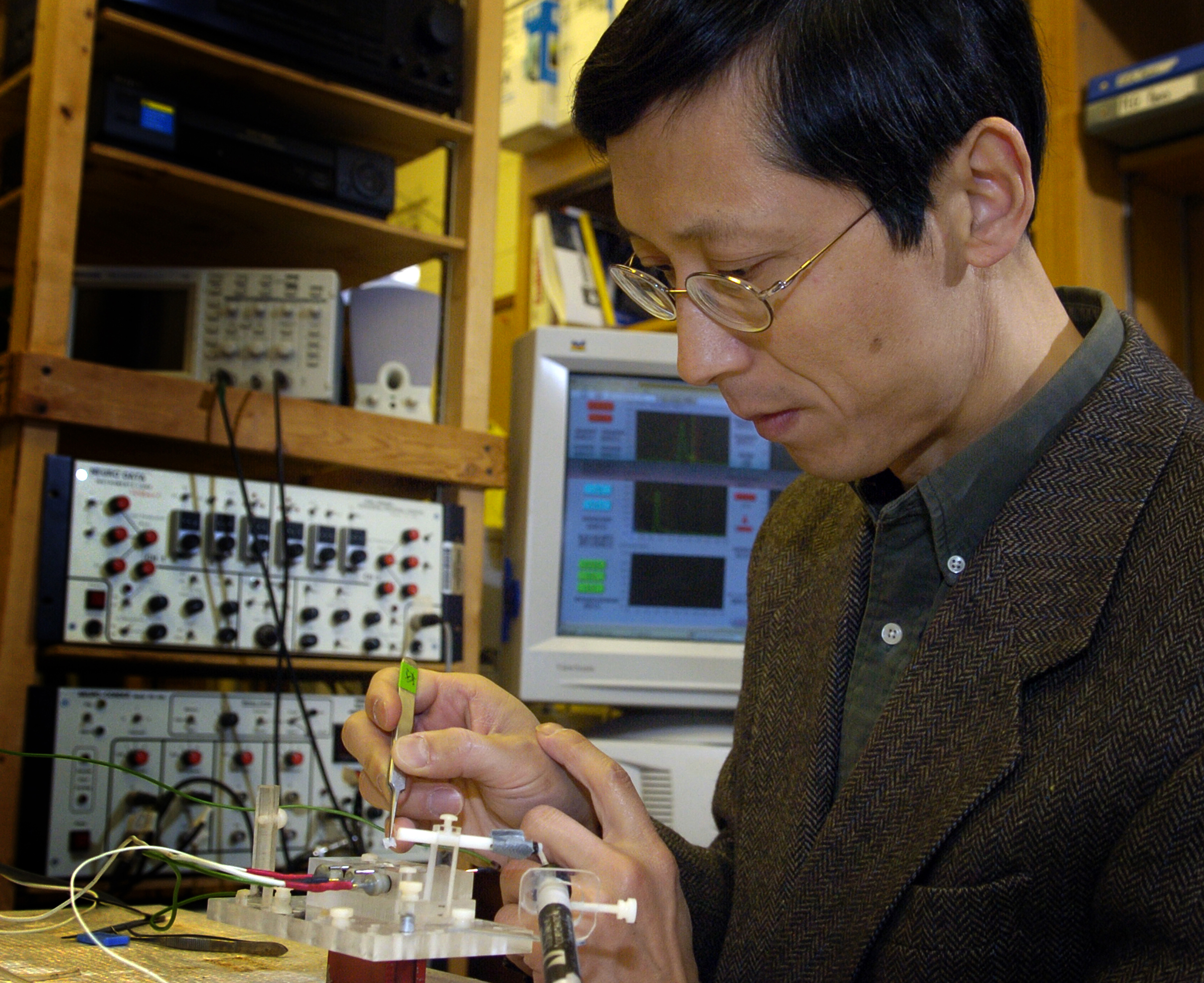
Shi will talk about the use of polymers and nanoparticles in the treatment of central nervous system injury. His work with Borgens at the center with injections of polyethylene glycol had clinical success in paraplegic dogs with acute spinal cord injuries.
The tour includes the three cities in China with the greatest number of universities: Beijing, Xian and Shanghai.
"We are going to Xian, which reflects ancient China, to Beijing, which is the China of today, and Shanghai, the China of the future," said Shi, who is originally from Shanghai and, as an orthopedic physician, practiced medicine there before coming to the United States for his doctorate in basic medical sciences at Purdue. "This helps us establish a scientific exchange while rekindling deep, old friendships."
The tour begins at the Capital Medical University in Beijing, where the host will be the scientist who initiated the invitation, Xiao-Min Wang. Wang is the university's vice president, as well as vice president of the Chinese Society for Neuroscience and the Chinese Association of Physiological Sciences. He also is president of the Beijing Society for Neuroscience and a longtime professional acquaintance of Shi.
"China has developed rapidly in the last 10 years, and research is well supported by their government," Shi said. "Dr. Wang is one of the most prominent neuroscientists in China and part of the inner circle, so he has access to the top students in China who might be interested in studying at Purdue. It's an honor that he has spent the time to arrange this tour for us."
The second stop is the historical city of Xian, where the host will be Shengxi Wu, director of the Leung Brain Research Center.
Finally, Borgens and Shi will visit Shanghai and give lectures at Shi's alma mater, JiaoTong University School of Medicine, and at the Chinese Academy of Sciences, where they will be guests of Mu-ming Poo, director of the Institute of Neuroscience. Poo has held two past endowed chairs, one at Yale and one at the University of California, San Diego. He now holds an endowed chair at the University of California, Berkeley. Borgens has known Poo for more than 30 years.
"Poo is a good example of someone who can help us take our technology to touch people worldwide," Borgens said. "We are hoping to bring back contacts and information that will be used not only immediately, but also in future research."Writer: Maggie Morris, (765) 494-2432, maggiemorris@purdue.edu
Sources: Richard Borgens, (765) 494-7600, cpr@purdue.edu
Riyi Shi, (765) 496-3018, riyi@purdue.edu
Purdue News Service: (765) 494-2096; purduenews@purdue.edu
PHOTO CAPTION:
Richard Borgens, the Mari Hulman George Professor of Applied Neurology, works on spinal cord regeneration in animals and humans in his laboratory at Purdue's Center for Paralysis Research where he is the director. Borgens, who has joint appointments in the School of Veterinary Medicine and Weldon School of Biomedical Engineering, has been invited to give lectures in China based on his research. (Purdue News Service photo/David Umberger)
A publication-quality photo is available at https://www.purdue.edu/uns/images/+2007/borgens-china.jpg
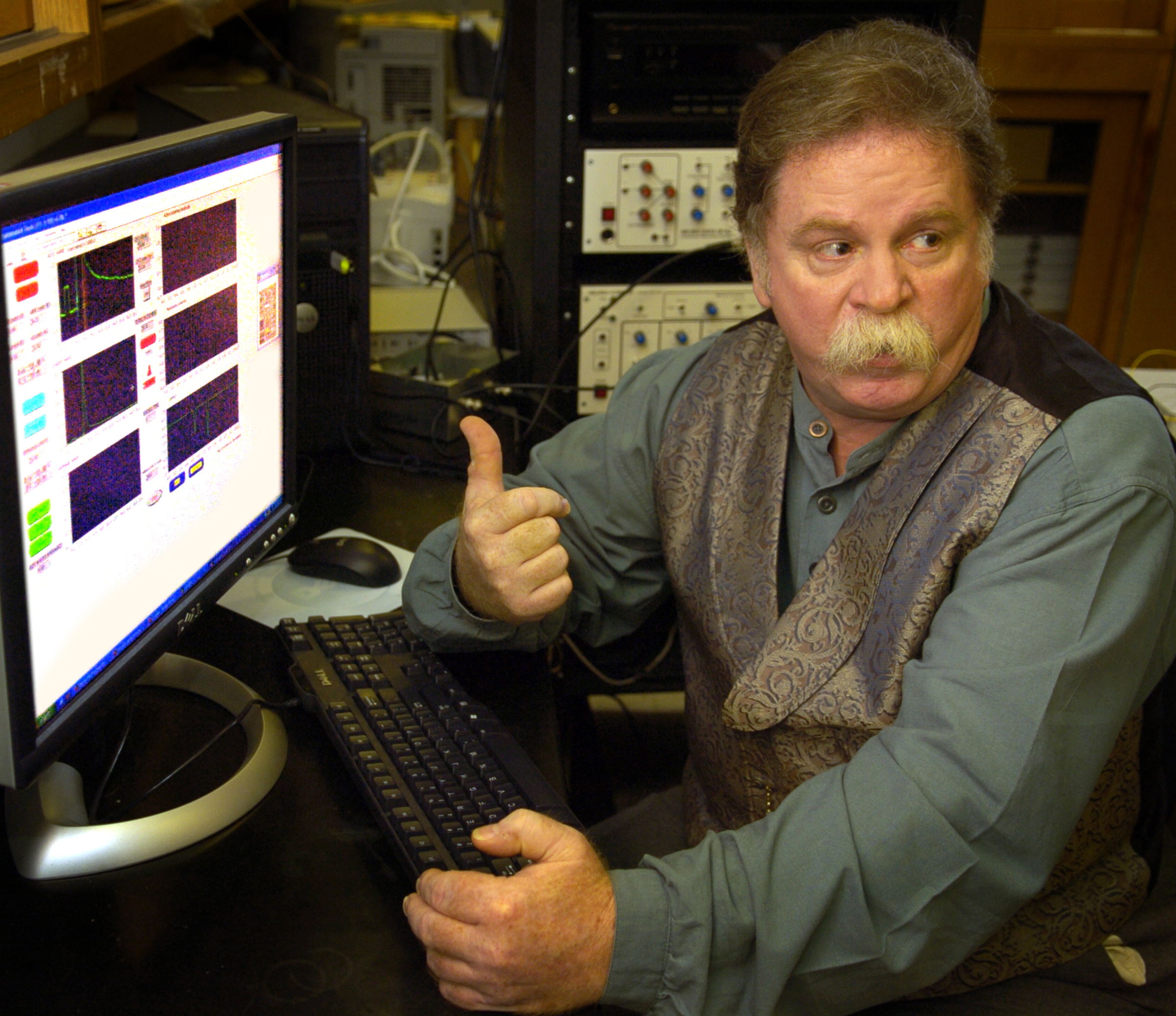
PHOTO CAPTION:
Riyi Shi, associate professor in basic medical sciences and biomedical engineering at Purdue, uses a recording chamber to test the loss of function in a spinal cord sample. Shi, who has joint appointments in the School of Veterinary Medicine and Weldon School of Biomedical Engineering, has been invited to give lectures in China based on his research at Purdue's Center for Paralysis Research. (Purdue News Service photo/David Umberger)
A publication-quality photo is available at https://www.purdue.edu/uns/images/+2007/shi-china.jpg
To the News Service home page