October
2006
CLA UPDATE FOR FACULTY & STAFF
|
Purdue Board of Trustees names John Contreni the first Justin S. Morrill Dean of the Liberal Arts
Appointment approved Sept. 29, 2006.
Trustees' news release.
|
John Contreni
 |
Dear Friends,
In just six pages and 11 paragraphs U.S. Congressman Justin S. Morrill (1810-1898) revolutionized university education.
A Vermonter, Morrill was forced by family circumstances at age 15 to leave school. Nevertheless, he continued to read and study on his own and became an accomplished entrepreneur, architect, horticulturalist, and, ultimately, politician.
In 1862 he authored and Abraham Lincoln signed the landmark Morrill Act which provided states not in a "condition of rebellion or insurrection against the government of the United States," with public lands they could sell to create and finance new educational institutions open to students of humble circumstances.
Most of the Morrill Act is devoted to describing the terms of the government's donation to the states – 30,000 acres for each senator and congressional representative in the state. The carefully prescribed sale of these lands provided states with the means to endow, support, and maintain "at least one college where the leading object shall be, without excluding other scientific and classical studies, and including military tactics, to teach such branches of learning as are related to agriculture and mechanic arts, in such manner as the legislatures of the State may respectively prescribe, in order to promote the liberal and practical education of the industrial classes in the several pursuits and professions in life."
I add emphasis in the Act's key clause to highlight a fundamental tenet of land-grant education: the new focus on agriculture and the mechanical arts was not intended to supplant scientific and classical studies or liberal learning. The new learning complemented the traditional culture.
And by extending educational opportunities to "the industrial classes," arguably, both cultures were enriched. This was what was so revolutionary about Morrill's insight – by broadening the curriculum and providing the opportunity of a college education to new people, he fundamentally altered a system of higher education that had changed very little since the university of Paris opened its doors in the twelfth century. Long the preserve of religious and social elites, thanks to Justin Morrill, universities became democratizing institutions. And while they continued to stress liberal education, they insisted that education also yield practical results.
In 1890, the benefits of the Morrill Act were extended to the states that had formerly been rebellious and in a state of insurrection during the Civil War. The nation's rich tradition of historically black colleges and universities, the 1890 land grant colleges and universities, extended the opportunity of higher education to new citizens whose participation in higher education was unimaginable a generation earlier.
Landgrant universities remain a work in progress. Women only gradually were welcomed into all the curricular programs offered in the new universities and only in the latter half of the twentieth century did the northern land grants welcome African-American students. Overall, the new universities were amazingly successful. Some 20 million students, from the United States and from all over the world, have earned degrees at land grant universities. Emulating their success, this country's most ancient universities – founded in colonial America in the seventeenth and eighteenth centuries to train clergy – broadened their missions to include professional programs and curricula in the "mechanic arts."
As the College's first Justin S. Morrill Dean of the Liberal Arts, I'm delighted and flattered by the honor. In concert with our faculty, staff, students, alumni, and the Purdue community, I look forward to building on the rich land grant tradition envisioned by Justin Morrill as we continue the work still in progress.
Sincerely,
John J. Contreni
Dean
NEWS AND RESEARCH
Trustees approve new Liberal Arts deanship
The Purdue board of trustees, meeting at Purdue Calumet, on Sept. 29 approved the appointment of the College of Liberal Arts' first named dean.
Contreni,
the Justin S. Morrill Dean of the Liberal Arts
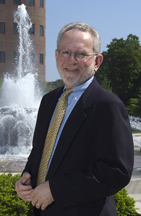 |
John J. Contreni was appointed the Justin S. Morrill Dean of the College of Liberal Arts.
Contreni was named the dean of the College of Liberal Arts in 2006 after serving as dean of the Graduate School from 2004-06 and interim dean from 2002-04. His appointment as dean of the College of Liberal Arts was originally announced June 2.
"Morrill was the great mind behind the College Land Grant Act, which created the foundation for universities such as Purdue," said Provost Sally Mason. "His dream was to open the doors of higher education to the American people, and he believed that land-grant universities should be engaged with Americans and become natural partners in our country's progress and development."
The act is now known as the Morrill Act in honor of the congressman's 1862 legislation.
"Liberal arts continues to create new ways to reflect Purdue's land-grant mission in endeavors that will advance society and solve a variety of technical and social problems," Mason said. "Justin Morrill's commitment to educational access and quality are well-characterized in the College of Liberal Arts' current programs."
Contreni was head of the Department of History from 1985-97 and interim head of the Department of Foreign Languages and Literatures from 1983-85. From 1981-85, he served as assistant dean for the School of Humanities, Social Sciences and Education, which is now the College of Liberal Arts. He has been at Purdue since 1971, and he earned his doctorate and master's degrees from Michigan State University in 1971 and 1968, respectively. He graduated with a bachelor's degree in history from St. Vincent College in Latrobe, Pa., in 1966. His specialty is the intellectual and cultural history of the age of Charlemagne.
More
Couple honored for sound support of speech, hearing
Ruth Steer was honored Sept. 18 for lifetime giving – donations totaling more than $1 million – made by her and her late husband to the College's Department of Speech, Language, and Hearing Sciences.
Ruth Steer
 |
Max (Mack) Steer, who died in 2003, founded the Purdue department. He served as the first department head from 1963 to 1970, when the program outgrew its home in the Department of English.
"Mack Steer's legacy is alive today through Purdue's world-class research and clinical operation," said Purdue President Martin C. Jischke. "This scholar's vision established a home for some of the nation's top researchers and students. It is a place where they can study topics such as how the brain processes sound and speech, the reasons for stuttering, and improved hearing aid devices. We thank Mrs. Steer for continuing support of a program that meant so much to her husband and means so much to Purdue."
Hearing aid fitting
 |
U.S.News and World Report most recently ranked the department's speech-language area in the nation's top three and the hearing area in the top eight.
"Purdue's speech, language and hearing sciences program is what it is today because of Mack Steer," said John Contreni, Dean of the College of Liberal Arts. "Purdue is a leader in many research areas, including the biological, psychological, physical, neurophysiological, and linguistic aspects of speech production, language, and hearing. The foundation he created for the interdisciplinary area of human communication sciences is still strong today."
More
Purdue breaks ground for Discovery Learning Center
Purdue officials on Sept. 21 announced that an anonymous gift of $2.5 million will help fund a new $10 million building to house the Discovery Learning Center, one of 10 interdisciplinary research centers in the university's Discovery Park.
Beverly Davenport Sypher
 |
"We have an opportunity to make a difference in what and how students learn at all ages," said Beverly Davenport Sypher, interim director of the Discovery Learning Center and an Associate Provost and professor of Communication. "And we can cover a wide range of areas by tapping into resources of Purdue faculty and other Discovery Park resources. It's a very deep mine of expertise."
The faculty in the Discovery Learning Center focus on designing innovative educational programs, developing new learning-related technologies, and enhancing understanding of the science of learning, especially as it relates to science, technology, engineering, and math.
More
Motorcycle campaign drives safety to 'involve you'
Motorcycle safety awareness for both motorcyclists and drivers of cars and trucks is the primary goal of a new health campaign designed by a Purdue professor and her students.
Motorcycle safety
 |
"Motorcycle safety really involves everyone – not just motorcyclists," says Marifran Mattson, an associate professor of Communication who studies health campaigns and was injured in a motorcycle accident in 2004. "Our campaign team is targeting riders about the importance of safety gear, proper licensing, training, and speed. But the team also is devoted to informing other motorists about what they can do to keep our roads safe and reduce the number of motorcycle accidents."
The campaign, Motorcycle Safety at Purdue, is working with American Bikers Aimed Toward Education, the Purdue football team, Greater Lafayette CityBus, Action Motor Sports, University Bookstore and Follett's Bookstore.
Motorcycle safety
 |
Motorcycle safety posters can be seen in the community, including the inside of CityBus buses. These posters were designed to remind motorists to watch for motorcycles and to encourage riders to wear the appropriate safety gear.
More
Program fuses collaboration in art, technology
Imagine watching a movie on DVD that changes its storyline each time it's played. Consider theater scenery rearranging automatically as the actors move from scene to scene.
A new art and design program at Purdue is offering an interdisciplinary program for students interested in exploring how digital technologies can interact like this with the world around them.
"Interactive Light" class
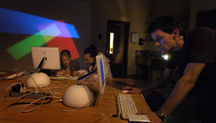 |
Fabian Winkler, an assistant professor in Art and Design, is establishing the electronic and time-based art area in the Patti and Rusty Rueff Department of Visual and Performing Arts.
"People can probably relate relatively easy to this emerging area of art because of the media culture around them, including video games, smart devices, and home computers," Winkler says. "However, the first thing students learn is to abandon the passive role of the media consumer and become a creator."
More
International events drive interest in Religious Studies
Purdue students realize that a better understanding of world religions can help them in the work force, meeting people, or just following current events, says a Philosophy expert.
"Given the political realities of the day – for instance, the current conflict in the Middle East as well as living in a smaller, globalized world – knowledge of other religions is imperative for success in business, politics, and international relations," says Jacqueline Mariña, associate professor of Philosophy and chair of the Religious Studies Program. "Religion plays an enormous role in shaping the way that people understand the world and its effect upon them, and many of our students are taking advantage of opportunities to learn more."
More Purdue college students are interested in learning about religions beyond their own faith, Mariña says. Students are especially interested in classes that compare religions and provide an introduction to the history and cultures associated with them.
Purdue's Religious Studies Program offers courses in religions of the east, medieval philosophy, Bible as literature, faith and superstition, religion in America, Native American religion, and Islamic civilization.
More
EVENTS
Purdue honors science journalists at inaugural program
Purdue will honor 10 international science journalists at the University's first Science Laureates Program Oct. 4-6.
The program is designed to give faculty and students from all colleges the opportunity to sit in on various sessions with the laureates, who also will have a chance to visit Purdue facilities and learn more about Purdue research.
At 10:30 a.m. on Oct. 5, the science laureates will participate in an open-to-the-public town hall meeting in the commons of the Lawson Computer Science Building to discuss the future of science research publication, both academic and mainstream.
At 3:30 p.m., the public is invited to a convocation in the Purdue Memorial Union Ballrooms to honor the laureates, who will address the audience and answer questions. After the ceremony, laureates will be available for one-on-one discussions at an informal reception.
More
OTHER EVENTS
– The College of Liberal Arts Honors Program's Open House for faculty and students is 5-6:30 p.m. on Oct. 5, in Beering Hall, Room 1114. Refreshments will be provided. Inquiries about the Honors Program can be directed to James Nairne, professor of Psychological Sciences.
– Michael Martone, the author of 13 books of fiction, nonfiction, and the craft of writing, will present a fiction reading at 7:30 p.m. on Oct. 5 in the Hicks Undergraduate Library Bookstall. There also will be a fiction discussion at 10 a.m. on Oct. 6 in Hicks Undergraduate Library Bookstall.
He is the author of The Blue Guide to Indiana, Unconventions, The Flatness and Other Landscapes, and Rules of Thumb. He has also edited four anthologies of essays and fiction, and he also teaches fiction at the University of Alabama. The events are sponsored by the Department of English and the Creative Writing Program as part of the 2006-07 Literary Reading Series.
– Cynthia G. Efird, United States ambassador to the Republic of Angola, will present "Oil, Democracy and Sovereignty – U.S. Policy and Angola" on Oct. 16. The talk is 2 p.m. in the Krannert Auditorium in the Krannert Building. Efird is a member of the United States Foreign Service and she has worked on public diplomacy, trade, conflict resolution and democracy development in Africa and Europe for more than 26 years. The Department of Political Science is sponsoring this event.
– Barbara B. Diefendorf, professor of History at Boston University, will present "Blood Wedding: The Saint Bartholomew's Massacre in History and Memory," from 3:30-5 p.m. on Oct. 18 in the Purdue Memorial Union, Room 118. Diefendorf is author of From Penitence to Charity: Pious Women and the Catholic Reformation in Paris. Her talk is part of the Department of History's colloquium. For more information, contact Stacy Holden, an assistant professor of History.
– Jean-Pierre Dormois, professor of History at Université Marc Bloch in Strasbourg, France, will present "The Americanization of French Society" at 7:30 p.m. on Oct. 25 in Stewart Center's Fowler Hall. Dormois is the author of Classical Trade Protectionism and The French Economy in the 20th Century. His talk is part of the Purdue History Forum, which is sponsored by the Department of History.
FACULTY & CLA HONORS
Mortar Board kicks off capital campaign
Purdue's chapter of Mortar Board, a national senior honor society, celebrated its 80th year during a banquet on Sept. 23.
The banquet was the official kickoff of a $50,000 capital campaign to benefit the Mortar Board Scholarships, Awards and Fellowships Endowment Fund, known as SAFE, which is used to support scholarships and fellowships for Purdue students. The organization is seeking donations from Mortar Board alumni and it will match each individual donation up to $50,000 total.
Rusty Rueff, a Purdue Mortar Board alumnus, made remarks on a DVD that was shown to the audience. The university's Department of Visual and Performing Arts is named after Rusty and his wife, Patti Rueff, in recognition of a $5 million gift to the College of Liberal Arts. Yue-Kong Pao Hall of Visual and Performing Arts also holds a gallery named for the couple.
More
MORE FACULTY NEWS
– Tom Templin, a professor of Health and Kinesiology, was inducted into the American Academy of Kinesiology and Physical Education on Sept. 16 in Tucson. The academy represents the top active, emeritus, and international scholars in the field, and only 480 individuals have been elected into the academy since 1926. Templin, who served as department head from 1996 to 2006, is an expert in the study of the lives and careers of teachers and the teacher education process.
– Barbara Solomon, a clinical professor in the Department of Speech, Language, and Hearing Sciences, was elected to the American Speech-Language-Hearing Association Legislative Council. The council is responsible for the association's focused initiatives, approval of the budget, and approval of all policy documents. The three-year appointment begins in January.
STUDENT NEWS
Homecoming queen is CLA major
JJ Camp of Grand Rapids, Mich., and Jillian Hmurovic of Munster Ind., were crowned Purdue University's Homecoming king and queen on Sept. 21 during the pep rally at Slayter Hill.
Camp is a senior majoring in Social Studies Education, and Hmurovic is a senior majoring in Psychology.
More
EXPERTS IN THE NEWS
Ambassador meets with CLA students
Lafayette Journal & Courier, Purdue Exponent, WBAA
Ambassador Donald Mahley, a Purdue alumnus who earned bachelor's degrees in Philosophy and Math in 1964, spoke to a group of Liberal Arts students on Sept. 11.
The group discussed America's international relations in the post-9/11 world.
|
Associated Press, Chicago Tribune, South Bend Tribune, Lafayette Journal and Courier, Indianapolis Star, London Times –
Obesity facing the faithful
(Ken Ferraro, Department of Sociology and Anthropology)
CNN.com, Associated Press, Sacramento Bee –
Spike Lee takes heart wrenching look at Katrina
(William "Joe" Palmer, Department of English)
Indianapolis Star, Cincinnati Enquirer –
Does booze bring out the truth?
(Julia Chester, Department of Psychological Sciences)
The Washington Times –
Historic event for C-SPAN
(Robert Browning, Department of Political Science)
Sacramento Bee –
Arena name game is a gamble
For arena, the name's a big-money game
(Josh Boyd, Department of Communication)
Baltimore Sun, Newsday, UPI, WBAA, WLFI TV –
TV revisits raw images of terror
(Glenn Sparks, Department of Communication)
Columbus Dispatch –
Futile effort, or worth a try? Group counseling seldom effective in stemming domestic violence
(Chris Eckhardt, Department of Psychological Sciences)
Independent Record, Helena, Montana –
Learning to see invisible people
(Kipling Williams, Department of Psychological Sciences)
Indianapolis Star –
Author advises aspiring writers
(Patricia Henley, Department of English)
The Hindu, India –
The power of women's organizing
(Mangala Subramaniam, Department of Sociology and Anthropology)
Lafayette Journal and Courier –
A festival of frights
(Emily Allen, Dino Felluga and Lance Duerfahrd, Department of English)
Lafayette Journal and Courier –
Purdue to break ground on teaching center
(Beverly Davenport Sypher, Department of Communication)
Lafayette Journal and Courier –
Netiquette: Do's and don'ts for e-mails
(Richard Johnson-Sheehan, Department of English)
Jewish Press –
Why Israel Must Not Allow Iran To Acquire Nuclear Weapons
(Louis Rene Beres, Department of Political Science)
Princeton Daily –
Pain and terror
(Louis Rene Beres, Department of Political Science)
AssociatedContent.com Spain –
Organ donation myths: How the TV media distorts organ donation
(Susan Morgan, Department of Communication)
Additional Stories:
Robert May, professor of History, appeared live as a guest on the KSIG, Crowley, Louisiana morning show. He spoke about William Walker, an American who invaded Nicaragua.
This edition of Liberal Arts eNews
is available online.
Previous editions of this newsletter can be found on the Liberal Arts eNews home page.
Any story ideas can be sent to Amy Patterson Neubert at the Purdue
News Service, 494-9723, apatterson@purdue.edu
Purdue News Service: 494-2096; purduenews@purdue.edu |


