
Senior in Movement Sciences, Mitchell Tillman, published his second journal article in the international journal Experimental Brain Research. The article can be found here.
The study discovered that when cued to execute a reaction-time task using the four fingers of the dominant hand, young adults reduce the total variability in the finger forces. They maintain the accuracy of performance of the current task, and simultaneously, the sharing of the total force between the individual fingers becomes more consistent. In contrast, older adults become more variable. The performance of the current task suffers, and their sharing of the total force between the individual fingers becomes more variable.
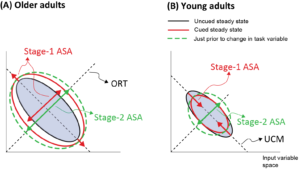
The change in finger behavior is quantified by computing the synergies in the finger forces. This is achieved using the uncontrolled manifold (UCM) method. The synergies are visualized as elliptical distributions in the finger-force space as shown here. The changes in the shape of the ellipse describe the changes in synergies that, in turn, may relate to changes in dexterity.
Mitchell graduated with his BS at HK@Purdue in Spring 2018. He is working toward his MS in Kinesiology with Dr. Ambike. He plans to complete his third study, and finish his MS within one year.