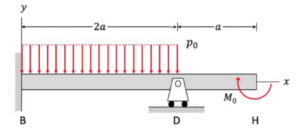
Hello, I was hoping to get some help on the direction in this problem. I understand we need to use the second order integration approach Log in to Reply
but Im not sure how to enforce the boundary conditions for this problem to solve for v(x) Log in to Reply
Hi, I believe that the boundaries should be v(0) = 0, v'(0) has no BC (deflection and slope at point B) v(2a) = 0, v'(2a)has no BC (deflection and slope at point D) The continuity conditions: v1 = v2 = 0 (deflection) v1’=v2′ (slopes) You should be able to plug these 4 boundary conditions into the 4 equations you found and solve Log in to Reply
Hello, I was hoping to get some help on the direction in this problem. I understand we need to use the second order integration approach
but Im not sure how to enforce the boundary conditions for this problem to solve for v(x)
Hi, I believe that the boundaries should be
v(0) = 0, v'(0) has no BC (deflection and slope at point B)
v(2a) = 0, v'(2a)has no BC (deflection and slope at point D)
The continuity conditions:
v1 = v2 = 0 (deflection)
v1’=v2′ (slopes)
You should be able to plug these 4 boundary conditions into the 4 equations you found and solve