
Ask your questions here. Or, answer questions of others here. Either way, you can learn.
DISCUSSION and HINTS
A horizontal force is applied to the center of mass of the thin bar, with the bar attached to a block that is constrained to have horizontal motion. Here want to know the resulting angular acceleration of the bar.
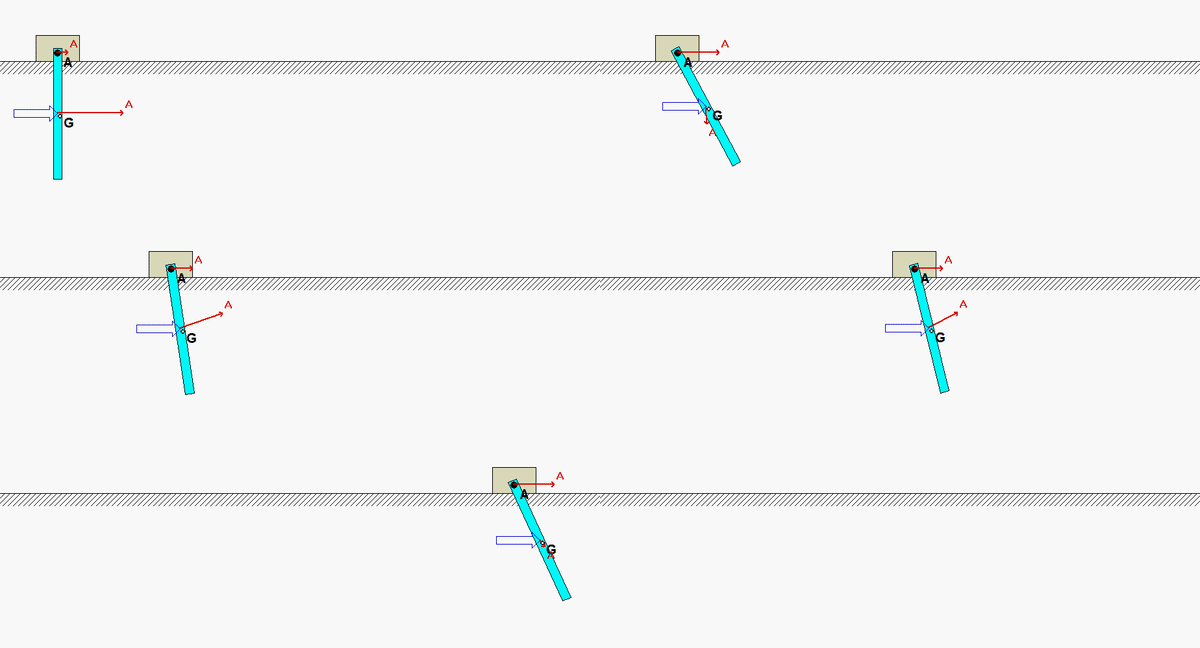
Recall the following four-step plan outline in the lecture book and discussed in lecture:
Step 1: FBDs
Draw individual free body diagrams (FBDs) of the bar and block.
Step 2: Kinetics (Newton/Euler)
Take care with your Euler (moment) equation. The point about which you write down the moment must be either the center of mass or a fixed point. For example, you can NOT write ΣMA = IAαAB because A is neither a fixed point nor is it the center of mass.
Step 3: Kinematics
End A of the bar is constrained to move only in the horizontal direction. Since the Newton equation for the bar requires the usage of the acceleration of the center of mass G, you will also need to use a kinematics equation relating the acceleration of A to the acceleration of G:
aG = aA + α x rG/A – ω2rG/A
Combining the above kinematics equations will provide you with the relationships among aGx, aGy, aA and α.
Step 4: Solve
From your equations in Steps 2 and 3, solve for the angular acceleration of the bar.