Climate Change on Forests
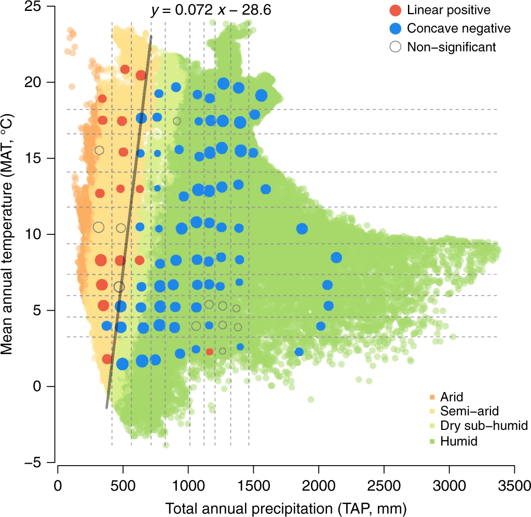
Climate change is reorganizing the geographic ranges of tree species across North America in ways that have profound consequences for forest composition, ecosystem function, and resource management. Using three decades of repeat forest inventory data spanning tens of thousands of plots across the eastern United States, our research tracks how the abundance of individual tree species is shifting across the landscape — and asks why different species respond differently.
One of our key findings is that species evolutionary history and functional traits explain the direction of range shifts: most deciduous trees have shifted westward, tracking changes in moisture, while most evergreen trees have shifted northward, following temperature gradients. This divergent response has implications for predicting future forest composition and for developing trait-informed adaptive management strategies. More recent work examines how the combined effects of climate change and major disturbance events — drought, pest outbreaks, and fire — are driving population-level declines in ecologically and economically important tree species at continental scales.
Indiana-Specific Work:
The lab has also contributed regional-scale risk assessments and management guidance for Indiana’s forests in response to projected climate change, working in collaboration with partners across the state.
Representative Publications — Climate Change on Forests
(Listed approximately by citation count / impact)
- Fei, S., Jo, I., Guo, Q., Wardle, D.A., Fang, J., Chen, A., Oswalt, C.M., & Brockerhoff, E.G. (2018). Impacts of climate on the biodiversity-productivity relationship in natural forests. Nature Communications, 9, 5436. https://doi.org/10.1038/s41467-018-07880-w
- Fei, S., Desprez, J.M., Potter, K.M., Jo, I., Knott, J.A., & Oswalt, C.M. (2017). Divergence of species responses to climate change. Science Advances, 3(5), e1603055. https://doi.org/10.1126/sciadv.1603055
- Feng, Y., Schmid, B., Loreau, M., Forrester, D.I., Fei, S., et al. (2022). Multispecies forest plantations outyield monocultures across a broad range of conditions. Science, 376(6594), 865–868. https://doi.org/10.1126/science.abm6363
- Fei, S., Guo, Q., & Potter, K. (2016). Macrosystems ecology: Novel methods and new understanding of multi-scale patterns and processes. Landscape Ecology, 31, 1–6. https://doi.org/10.1007/s10980-015-0310-3
- Knott, J.A., Jenkins, M., Oswalt, C., & Fei, S. (2020). Community-level responses to climate change in forests of the eastern United States. Global Ecology and Biogeography, 29(7), 1299–1314. https://doi.org/10.1111/geb.13102