


September 21, 2009
Alumnus and astronaut Feustel to speak at Purdue
WEST LAFAYETTE, Ind. -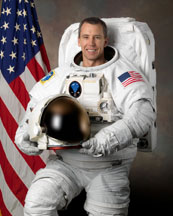 |
Feustel completed three spacewalks during a 13-day NASA mission in May to upgrade and repair the Hubble Space Telescope. He will speak from 5:30-6:15 p.m. in Stewart Center's Fowler Hall. The talk is free and open to the public, but due to limited seating people are asked to preregister by Wednesday (Sept. 23) by contacting the College of Science at 765-494-1857, scienceevents@purdue.edu
"Andrew played a major role in upgrading the Hubble telescope, and we are proud to call him one of our own," said Purdue President France A. Córdova, a former NASA chief scientist who has published papers on X-ray binary stars and pulsars using Hubble and contributed to the first Hubble advanced camera. "The space telescope has been central to remarkable discoveries regarding planets and other objects in our own solar system, more distant objects in our Milky Way galaxy and galaxies that are billions of years old."
The space shuttle Atlantis landed on May 24. It was the final servicing mission to the Hubble telescope, intended to extend and improve the orbiting observatory's capabilities for at least another five years of research.
Atlantis rendezvoused with Hubble, and then the crew used the shuttle's mechanical arm to place the telescope on a work platform in the cargo bay. Five spacewalks were needed for the mission. Feustel participated in the first, third and fifth EVAs, or extra-vehicular activities, repairing an imaging instrument and replacing a guidance instrument, two imaging instruments, and a battery.
Feustel also has been assigned to fly on space shuttle mission STS-134 to the International Space Station, scheduled for launch on Sept. 16, 2010. The flight will deliver an alpha magnetic spectrometer, a cosmic ray particle physics detector designed to examine fundamental issues about matter and the origin and structure of the universe.
Feustel, 44, earned a bachelor's degree in solid earth sciences in 1989 and a master's degree in geophysics in 1991, both from Purdue. He earned a doctoral degree in geological sciences from Queen's University in Kingston, Ontario, Canada, in 1995.
His visit was planned by Purdue's College of Science in conjunction with the Science Student Council's Science Week, when he will meet with fourth-graders from Glen Acres Elementary School and a fifth-grade challenge class from Edgelea Elementary School.
Feustel's wife, Indira, a Purdue liberal arts alumna, will meet with faculty and students in the College of Liberal Arts. The couple met while students at Purdue, and they have two children.
Córdova said Purdue has played a pivotal role in the U.S. space program. To date, 22 Purdue alumni have been chosen for space flight, including Neil Armstrong, the first person to walk on the moon, and Eugene Cernan, the most recent person to do so. Purdue alumnus Scott D. Tingle, 43, was chosen earlier this year as an astronaut candidate and began training at NASA's Johnson Space Center in Houston. He is a commander in the U.S. Navy and will become the 23rd Purdue graduate to become an astronaut.
Feustel said that his scientific background has been a good foundation for NASA training. Although his doctoral degree in geological sciences might seem unrelated to the Hubble repair mission, he said just the opposite proved true.
"Being a space shuttle or space station astronaut really relies more heavily on one's ability to learn new things and work in an operational environment than it does on specific academic training," he said. "That said, I hope that one day I will be able to directly apply my experiences and education as a geophysicist in lunar exploration and the establishment of a permanent base for operations. Like past missions to the moon, future missions will involve a significant amount of surface and subsurface characterization, and that is what geoscientists are trained to do."
Purdue alumni have flown on approximately 35 percent of all manned U.S. space flights, including missions from Project Mercury (Virgil "Gus" Grissom), the Gemini Program (Armstrong, Cernan and Grissom) and the Apollo Program (Armstrong and Cernan), and more than 40 space shuttle flights. Two of the six Americans who have flown on the Russian space station Mir - John Blaha and Dr. David Wolf, a medical doctor - are Purdue graduates.
More information about the Hubble mission is available at https://www.nasa.gov/mission_pages/shuttle/shuttlemissions/
hst_sm4/index.html
Information about the Hubble telescope is available at https://www.nasa.gov/hubble
Writer: Emil Venere, (765) 494-4709, venere@purdue.edu
Source: France A. Córdova, president@purdue.edu
Purdue News Service: (765) 494-2096; purduenews@purdue.edu
PHOTO CAPTION:
Andrew Feustel, a Purdue alumnus and NASA mission specialist, made three spacewalks during a mission to upgrade the Hubble Space Telescope. It was Feustel's first shuttle mission and the final telescope-servicing mission. (Photo courtesy of NASA)
A publication-quality photo is available at https://www.purdue.edu/uns/images/+2008/feustel.jpg

To the News Service home page