


June 25, 2009
Long-term apple scab resistance remains elusive, Purdue expert says
WEST LAFAYETTE, Ind. - |
After reviewing 33 years of data, Janna Beckerman, a Purdue assistant professor of botany and plant pathology, found that only five of 287 crabapple varieties had durable resistance to a serious disease of crabapple trees. The results of her study were published in the June issue of the journal HortScience.
Beckerman said data on crabapple trees and apple scab had only been done on a year-by-year basis until now. Looking over a prolonged period gives researchers a better idea of which trees have historically maintained or lost apple scab resistance.
"Whenever new plants are released, they are often touted as disease-resistant, but they have only been tested for a few years," Beckerman said. "That isn’t enough time. From this data, you could see that varieties that did well for the first few years after planting often developed scab within 10 years."
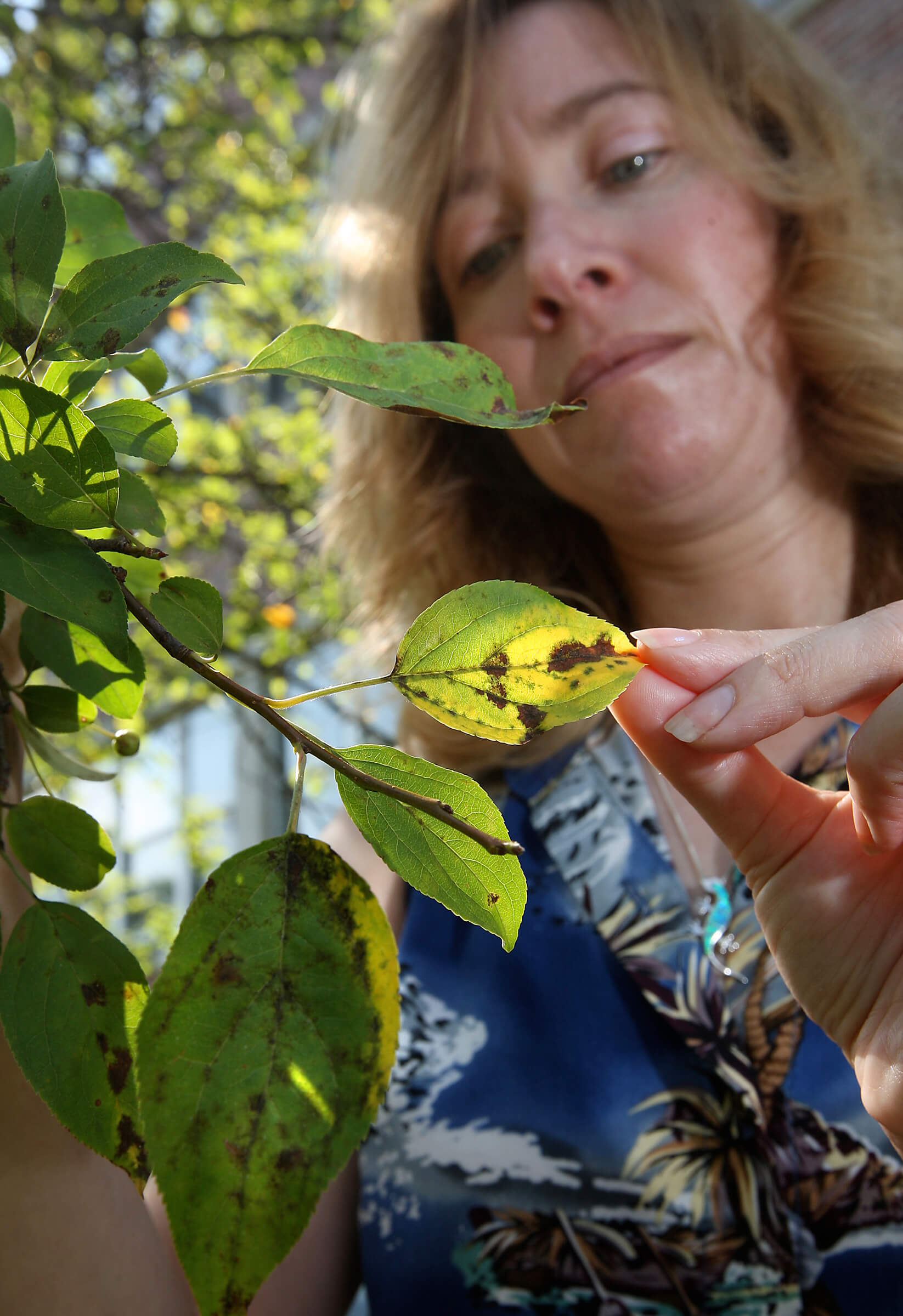
The Venturia inaequalis fungus produces black scab-like lesions on the fruit and leaves. Crabapple trees with scab tend to defoliate, or lose all their leaves, in early summer, a condition that can weaken and eventually kill the trees.
"When a tree loses all of its leaves, it will try to produce more leaves, using the energy reserves it needs to get through the winter," Beckerman said. "Over time, this repeated defoliation weakens the tree. A tree that is defoliated is under stress and can be susceptible to opportunistic insects and other diseases. The apple scab won't kill the tree, but the chronic weakening will."
The data, collected from observations at the Secrest Arboretum in Wooster, Ohio, showed that only 29 varieties of crabapple trees had resistance to scabbing for at least 10 years. Only 15 varieties lasted the entire 33 years, but 10 of those had problems with fire blight and other diseases.
The five that showed resistance to scabbing and other serious diseases were: Beverly, Sargentii, Jackii, White Angel and Silver Moon. A promising new variety, Adirondack, showed resistance for 12 years, but it was not considered enough time to count in the study.
Another major finding was that scab has infected the Japanese flowering crabapple, Malus floribunda. This variety was considered scab resistant in the early 1900s and provided the resistance gene bred into other crabapple trees to protect them from scabbing. But a trace of scab was found in Malus floribunda in 1997, and by 2003, the trees were defoliating, Beckerman said.
"You can actually see the pathogen evolving by looking at the data over time," Beckerman said. "Finding scab on this crabapple suggests that all commercial apple varieties with this resistant gene are at risk of scab."
Beckerman said even susceptible crabapples can be protected with about three well-timed fungicide treatments per year. Certified arborists have access to proper chemicals that the average homeowner wouldn't be able to obtain.
Beckerman said using information on scab resistance could minimize the need for those fungicides, though.
"What tree owners are doing is putting in an investment that could live in their yards for 100 years," Beckerman said. "A few minutes of research and choosing the right tree can pay out dividends over the course of decades."
Writer: Brian Wallheimer, (765) 496-2050, bwallhei@purdue.edu
Source: Janna Beckerman, (765) 494-4614, janna@purdue.edu
Ag Communications: (765) 494-8415;
Steve Leer, sleer@purdue.edu
Agriculture News Page
PHOTO CAPTION:
Janna Beckerman examines a Ralph Shay crabapple tree that is infected with apple scab. The fungus shows up as brown lesions on the leaves and fruit of crabapple trees, causing early defoliation. (Purdue Agricultural Communication photo/Tom Campbell)
A publication-quality photo is available at https://www.purdue.edu/uns/images/+2009/beckerman-crabapple.jpg
A 33-year Evaluation of Resistance and
Pathogenicity in the
Apple Scab-Crabapples Pathosystem
Janna Beckerman, James Chatfield, Erik Draper
Crabapples (Malusspp.) are popular ornamental trees in the commercial and residential landscape. Over a 33-year period at the Secrest Arboretum,Wooster, OH, 287 accessions of ornamental crabapple were evaluated for their resistance to apple scab caused by the fungus Venturia inaequalis. Of these 287 accessions, 31 had no symptoms of scab for longer than a 10-year period and were identi�?ed as resistant to the disease. Of these 31 resistant accessions, 14 eventually displayed symptoms, presumably as a result of infection by one or more newly present races of the pathogen in the trial plot. Notable resistance breakdowns in accessions previously classi�?ed as resistant include the development of scab on M. ‘Prairi�?re’, M. ‘BobWhite’, M. ‘RedJewel’, and M. floribunda. Corresponding to these changes of resistance is the putative development of new V. inaequalis races in North America: Race5, possessing virulence to the Vmgenein ‘Prairi�?re’; Race 3 that infects M. ‘Geneva’ but not M. baccata ‘Dolgo’; and the �?rst identi�?cation and report of scabona M. floribunda population that was reported as resistant even before the �?rst 25 years of the evaluation. The detection of scab on this species suggests the presence of Race7 in North America for the �?rst time. Five named accessions remained free from scab for the entire 33-year trial: M.sargentii ‘Sargent’, M. baccata ‘Jackii’, M. ‘Beverly’, M. ‘Silver Moon’, and M. ‘White Angel’ and may serve as sources of durable resistance in crabapple and commercial apple breeding in the Midwest.
To the News Service home page