


May 22, 2009
Purdue alumnus flies on NASA's challenging Hubble servicing mission
WEST LAFAYETTE, Ind. -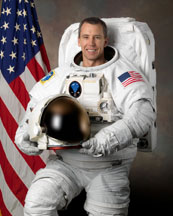 |
It was the final servicing mission to the Hubble telescope, intended to extend and improve the orbiting observatory's capabilites for at least another five years of research.
Feustel participated in three of the mission's five spacewalks.
"The mission is challenging due to the complexity of our repair work and limited time frame that we have to exact the repairs," said Feustel, who will be flying on his first mission. He was selected as a mission specialist by NASA in July 2000.
Atlantis will rendezvous with Hubble, and then the crew will use the shuttle's mechanical arm to place the telescope on a work platform in the cargo bay.
Purdue President France A. Córdova, a former NASA chief scientist who worked on projects that included Hubble, said the mission underscores the aging space telescope's value.
"The mission Andrew is flying is critical to the space science program," Córdova said. "The Hubble telescope has been central to remarkable discoveries regarding planets and other objects in our own solar system, more distant objects in our Milky Way galaxy, and galaxies that are billions of years old. Research using the Hubble telescope has been of enormous value to understanding the origin and evolution of cosmic matter and energy. The images produced by Hubble are inspiring to people everywhere."
As a mission specialist, Feustel will be in charge of stowing hardware and is responsible for the onboard computer network. He is scheduled to participate in the first, third and fifth EVAs, or extra-vehicular activities, repairing an imaging instrument and replacing a guidance instrument, two imaging instruments and a battery.
Astronaut and Purdue alumnus Gregory Harbaugh, a veteran of four space flights who flew on the second Hubble servicing mission in 1997 and logged more than 18 EVA hours, said spacewalks pose several challenges.
The sheer bulk and mass of the spacesuit makes it difficult to move, a problem that's addressed by using the shuttle robot arm as a platform for spacewalkers, he said.
"Another challenge relates to the dexterity and tactile feedback of the suit's gloves," said Harbaugh, who also was a backup EVA crewman working in mission control during the first Hubble servicing mission. "Doing EVA work on the Hubble is like doing brain surgery in ski gloves. Your ability to feel and grasp small objects is seriously limited. There are tools to enhance dexterity, but the key to success is careful planning, anticipating every last detail and every possible failure scenario and having fallback options. The mission will have five back-to-back spacewalks with, at most, one spare EVA to fall back on. This means that each EVA must be successful because there is little time to fix problems, thus very little margin for error."
He said a major concern is the potential for losing a tool, a screw or some other piece of debris that could be dangerous to astronauts, and also avoiding debris from the telescope itself.
"Hubble has been in orbit for many years and has some degradation of the exterior insulation as a result, meaning debris and contamination could be a problem," Harbaugh said.
Consequently, training for the spacewalks is especially demanding, he said.
Córdova said Purdue has played a pivotal role in the U.S. space program.
"Purdue is in an elite class of space explorers; only a handful of institutions have had more than 20 alumni selected by NASA to fly in space," she said. "It's a legacy Purdue is proud of."
To date, 22 Purdue alumni have been chosen for space flight, including Neil Armstrong, the first person to walk on the moon, and Eugene Cernan, the most recent person to do so.
Feustel, 43, earned a bachelor's degree in solid earth sciences in 1989 and a master's degree in geophysics in 1991, both from Purdue, and a doctoral degree in geological sciences from Queen's University in Kingston, Ontario, Canada, in 1995.
He said his scientific background has been a good foundation for NASA training. Although his doctoral degree in geological sciences might seem unrelated to the Hubble repair mission, he said just the opposite is true.
"Being a space shuttle or space station astronaut really relies more heavily on one's ability to learn new things and work in an operational environment than it does on specific academic training," he said. "That said, I hope that one day I will be able to directly apply my experiences and education as a geophysicist in lunar exploration and the establishment of a permanent base for operations. Like past missions to the moon, future missions will involve a significant amount of surface and subsurface characterization, and that is what geoscientists are trained to do."
Feustel is married to Indira Devi Bhatnagar, whom he met while both were graduate students at Purdue. They have two children.
"My wife is very supportive of my work and excited to participate in such a wonderful opportunity," Feustel said. "Without the support of her and our two boys, I would never have achieved the successes that I have. I really just feel lucky to have the opportunity to serve humankind in this capacity. With the opportunity comes the obligation to do my job to the best of my ability."
Feustel joins a crew of Scott D. Altman, Michael T. Good, John M. Grunsfeld, Gregory C. Johnson, Michael J. Massimino and K. Megan McArthur.
Two new instruments will be installed: the cosmic origins spectrograph, the most sensitive ultraviolet spectrograph ever flown on Hubble, and the wide field camera 3, which is sensitive across a wide range of wavelengths and will be used to study planets in the solar system and more distant objects.
Other planned work includes replacing one of three fine-guidance sensors needed to control the telescope's pointing system. The crew also will attempt to repair the space telescope imaging spectrograph, which was installed in 1997 and stopped working in 2004. The instrument is used for high-resolution studies in visible and ultraviolet light of both nearby star systems and distant galaxies, providing information about the motions and chemical makeup of stars, planetary atmospheres, and other galaxies.
Feustel said Purdue's reputation for preparing students for careers in space exploration has been strengthened by Córdova's appointment as president in 2007.
"I had an opportunity to speak with President Córdova at the Homecoming game last fall when many of Purdue's astronauts were in town for the Neil Armstrong Hall of Engineering dedication," Feustel said. "She has strong connections to NASA, and I believe her experiences will be instrumental in strengthening ties to the aerospace and aeronautics industry and also will be beneficial to raising awareness of what we do in the human space flight divisions of NASA."
Purdue alumni have flown on approximately 37 percent of all manned U.S. space flights, including missions from Project Mercury (Virgil "Gus" Grissom), the Gemini Program (Armstrong, Cernan and Grissom) and the Apollo Program (Armstrong and Cernan). Thirty-nine flights of the space shuttle have had Purdue alumni as part of the crews. Two of the six Americans who have flown on the Russian space station Mir - John Blaha and Dr. David Wolf, a medical doctor - are Purdue graduates.
The Hubble Space Telescope is an international cooperative project between NASA and the European Space Agency.
More information about the mission is available at https://www.nasa.gov/mission_pages/shuttle/
shuttlemissions/hst_sm4/index.html
Information about the Hubble telescope is available at https://www.nasa.gov/hubble
Writer: Emil Venere, (765) 494-4709, venere@purdue.edu
Sources: France A. Córdova, president@purdue.edu
Gayle Frere at NASA's Johnson Space Flight Center, 281-483-5111, Gayle.Frere-1@nasa.gov
Purdue News Service: (765) 494-2096; purduenews@purdue.edu
Note to Journalists: Andrew Feustel pronounces his name Foystal. Journalists may arrange interviews with astronauts by contacting Gayle Frere at NASA's Johnson Space Flight Center, 281-483-5111, Gayle.Frere-1@nasa.gov. Interviews with Andrew Feustel are available following the mission. NASA's Kyle Herring can connect reporters with an expert from the space shuttle program to discuss the complexities of the mission. Still images can be requested by contacting Mike Gentry, 281-483-8602, g.m.gentry@nasa.gov
PHOTO CAPTION:
Andrew Feustel, a Purdue alumnus and NASA mission specialist, is scheduled to make three spacewalks during a mission to upgrade the Hubble Space Telescope. It will be Feustel's first shuttle mission and the final telescope-servicing mission, which will be an 11-day operation designed to extend and improve the orbiting observatory's capabilities. (Photo courtesy of NASA)
A publication-quality photo is available at https://www.purdue.edu/uns/images/+2008/feustel.jpg

To the News Service home page