


March 26, 2009
Chip can make sure safe food products aren't unduly discarded
WEST LAFAYETTE, Ind. -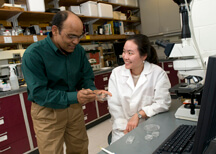 |
Arun Bhunia, Purdue professor of food science, found a way to use human cell receptors in biochips to detect the presence of Listeria monocytogenes, a bacterium common in deli meats and some unpasteurized cheeses. Listeria monocytogenes can cause sickness and death in people with weakened immune systems. Bhunia's findings were reported this week in the early online version of the journal Analytical Chemistry.
"If you want to modify this, you could use different receptors to detect salmonella, E.coli or any other pathogenic bacteria," Bhunia said. "There are many potential uses."
Bacteria in a fluid are passed over the biochip and attach to the cell receptors, changing the conductivity of the solution. The chip senses the conductivity change and signals to a computer that bacteria are present.
Researchers, including Bhunia, had previously developed a chip that used antibodies instead of cell receptors. The antibody chips also detected benign forms of bacteria, however. Without being able to tell whether the bacteria were harmful, food producers were forced to discard products that were suitable for consumption.
"Companies could be wasting resources because current testing methods don't show whether the bacteria is pathogenic," said Ok Kyung Koo, a Purdue graduate student working with Bhunia.
When bacteria come into contact with the specific human cell receptor, the bacteria attach to that cell, causing sickness. Benign versions of those bacteria do not bond with receptors, making them better for bacteria detection in food products.
"Most of the tests you have now may not be specific. There's a chance it could give you a false positive," Bhunia said. "The test we have set up would only detect pathogenic listeria."
Bhunia said current tests for listeria and other pathogens take between one day and 10 to obtain results. His biochips take less than 12 hours, and he believes that time can be shaved to less than eight hours.
Since the chips are so small — about the size of a postage stamp — they require only a small sample. And Bhunia said that since the chips can be hooked up to a computer, tests could be done on-site, eliminating the need to send samples to outside labs.
The U.S. Department of Agriculture funded Bhunia's research. The biochips worked with samples of bacteria in a fluid that was passed over the chips. The next step is to test the chips using samples taken from food products.
Writer: Brian Wallheimer, (765) 496-2050, bwallhei@purdue.edu
Sources: Arun Bhunia, (765) 494-5443, bhunia@purdue.edu
Ok Kyung Koo, (765) 496-7356, okoo@purdue.edu
Ag Communications: (765) 494-8415;
Steve Leer, sleer@purdue.edu
Agriculture News Page
PHOTO CAPTION:
Arun Bhunia (left) and his graduate student, Ok Kyung Koo, developed an advancement in biochips using human cell receptors to detect harmful bacteria in food. The tiny chips send a signal to a computer when harmful bacteria are present. (Purdue Marketing and Media photo/Mark Simons)
Targeted Capture of Pathogenic Bacteria Using a Mammalian Cell Receptor Coupled with Dielectrophoresis on a Biochip
Ok Kyung Koo, YiShao Liu, Salamat Shuaib, Shantanu Battachayra, Michael R. Ladisch, Rashid Bashir, and Arun K. Bhunia
Efficient capture of target analyte on biosensor platforms is a prerequisite for reliable and specific detection of pathogenic microorganisms in a microfluidic chip. Anti- bodies have been widely used as ligands; however, because of their occasional unsatisfactory performance, a search for alternative receptors is underway. Heat shock protein 60 (Hsp60), a eukaryotic mitochondrial chaperon protein is a receptor for Listeria adhesion protein (LAP) during Listeria monocytogenes infection. This paper reports application of biotinylated Hsp60 as a capture molecule for living (viable) L. monocytogenes in a microfluidic environment. Hsp60, immobilized on the surface of streptavidin-coated silicon dioxide exhibited speci�?c capture of pathogenic Listeria against a background of other Listeria species, Salmonella, Escherichia, Bacillus, Pseudomonas, Serratia, Hafnia, Enterobacter, Citrobacter, and Lactobacillus. The capture efficiency of L. monocytogenes was 83 times greater than another Listeria receptor, the monoclonal antibody, mAb-C11E9. Additionally, the capture rate was further increased on a Hsp60-coated biochip by 60% when a dielectrophoresis force was applied for 5 min at the beginning of the final 1 h incubation step. Our data show that Hsp60 could be used for specific detection of L. monocytogenes on a biochip sensor platform.
To the News Service home page