
| RELATED INFO |
| * Purdue School of Mechanical Engineering |
| * Purdue Research Foundation Office of Technology Commercialization |


February 11, 2009
Purdue researchers increase innovation and economic development activities
WEST LAFAYETTE, Ind. - The number of technology commercialization activities by researchers throughout Purdue University increased more than 40 percent during the past four years, according to university officials.In the 2007-2008 fiscal year, there were 237 invention disclosures across all disciplines at the university, compared to 167 in the 2003-2004 fiscal year. An invention disclosure is a process undertaken when researchers file a discovery with the Purdue Research Foundation's Office of Technology Commercialization that is patentable and has market potential.
 |
Purdue's School of Mechanical Engineering researchers experienced a three-fold increase in delivering technology from the laboratory to the market during the same time period. According to the Office of Technology Commercialization, invention disclosures from School of Mechanical Engineering faculty increased from 10 in 2003 to 31 in 2008. Technology transfer managers in the Office of Technology Commercialization directly assist faculty entrepreneurs with this process.
Purdue's mechanical engineering faculty also increased the number of applications for provisional U.S. patents from four in 2003 to 17 in 2008. The application is the first step for researchers to be issued a patent, which awards the sole right to make, use and sell the invention for a set period of time, usually 20 years, according to the U.S. Patent and Trademark Office. Patents issued to the school's faculty also have increased over the past five years from a total of four in the 2003-2004 fiscal year compared to eight in the 2007-2008 fiscal year.
E. Dan Hirleman, the William E. and Florence E. Perry Head of the School of Mechanical Engineering, suggested the increases can be attributed to changes in faculty mindset and the Purdue environment.
"Service to society via economic development is increasingly a mainstream mission for the faculty," Hirleman said. "Innovation and entrepreneurship have become more pervasive, and our recent faculty hires are especially aggressive in developing their research discoveries."
The increase also may be attributed to interdisciplinary research conducted by faculty throughout Purdue. Among the School of Mechanical Engineering researchers who have disclosed inventions, applied for provisional U.S. patents and whose inventions are being used commercially, some have appointments in other schools at Purdue and most are involved in interdisciplinary projects.
The School of Mechanical Engineering faculty and Office of Technology Commercialization officials also have increased the number of innovations with actively licensed patent rights. A license allows a third party to develop or use an invention for a period of time in exchange for royalty income for Purdue. Twenty-seven inventions created or co-created by mechanical engineering researchers have active licenses as of January 2009; 18 of those were initially licensed between 2003 and 2008.
"In Purdue's new strategic plan this is known as 'Discovery with Delivery,'" Hirleman said. "Many of our inventions have been licensed or transferred to Indiana companies based in the Purdue Research Park. This completes a cycle of society investing in research that ends up generating new jobs and new products."
Purdue's other engineering schools reported the following number of their faculty, including those with dual appointments, who were issued patents in the 2007-2008 fiscal year:
* Department of Agricultural and Biological Engineering: 1
* Division of Environmental and Ecological Engineering: 1
* School of Aeronautics and Astronautics: 3
* School of Chemical Engineering: 2, compared to 1 in the 2004-2005 fiscal year.
* School of Civil Engineering: 1
* School of Electrical and Computer Engineering: 11, compared to 4 in the 2004-2005 fiscal year.
* School of Industrial Engineering: 2
* School of Materials Engineering: 2
* Weldon School of Biomedical Engineering: 8, compared to 2 in the 2004-2005 fiscal year.
Other Purdue colleges and schools reported the following number of their faculty, including those with dual appointments, who were issued patents in the 2007-2008 fiscal year:
* College of Agriculture: 3
* College of Pharmacy, Nursing and Health Sciences: 7, compared to 4 in the 2004-2005 fiscal year.
* College of Science: 9, compared to 4 in the 2004-2005 fiscal year.
* School of Veterinary Medicine: 3
About Purdue Research Foundation
Purdue Research Foundation is a private, nonprofit foundation created to advance the mission of Purdue University. The foundation accepts gifts; administers trusts; funds research, scholarships and grants; acquires property; and negotiates research contracts on behalf of Purdue. In the 1990s, the foundation was charged with helping the university in the realm of economic development. The Purdue Research Foundation oversees the Purdue Research Park, which is the largest university-affiliated business incubator in the country.
Purdue Research Foundation contact: Steve Martin, (765) 494-6872, sgmartin@prf.org
Source: E. Dan Hirleman, (765) 494-5688, hirleman@purdue.edu
Purdue News Service: (765) 494-2096; purduenews@purdue.edu
PHOTO CAPTION:
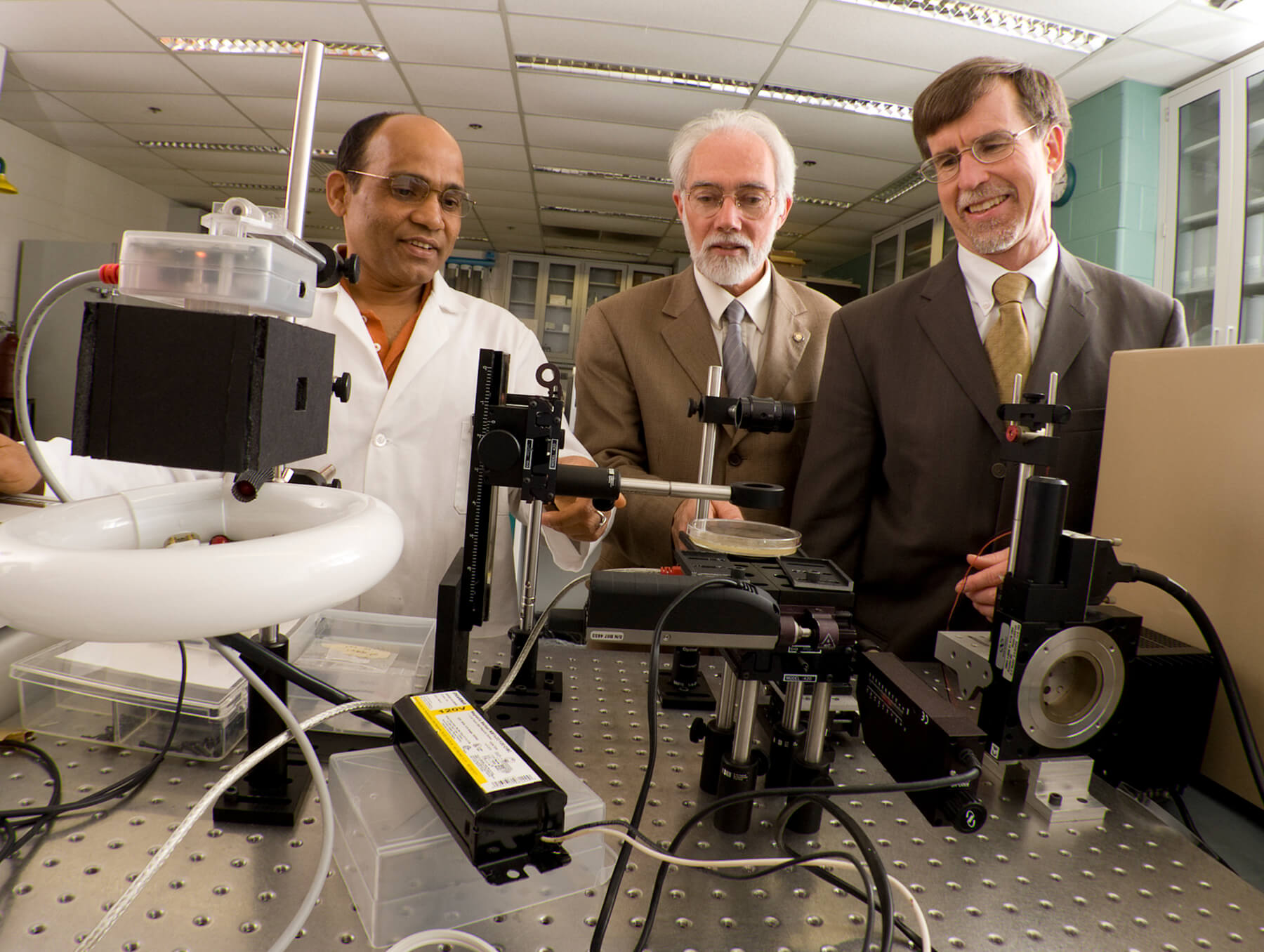
Three Purdue faculty look at a food pathogen identification instrument, known as BARDOT, that resulted from their collaborative research. The faculty are Arun Bhunia, a microbiologist in Food Science; Paul Robinson, the School of Veterinary Medicine Professor of Cytomics and a professor in the Weldon School of Biomedical Engineering; and E. Dan Hirleman, the William E. and Florence E. Perry Head of the School of Mechanical Engineering. The research project was funded by the USDA Center for Food Safety Engineering at Purdue. The technology has been patented through the U.S. Office of Patent and Trademark Office and licensed by Purdue’s Office of Technology Commercialization.
(Purdue Research Foundation photo)
To the News Service home page