
| RELATED INFO |
| * Vasc-Alert |
| * Purdue Research Park |
| * National Kidney Foundation |

October 13, 2008
Purdue Research Park-based company helps dialysis centers meet new governmental regulations and aids in identifying patients' health problems
WEST LAFAYETTE, Ind. -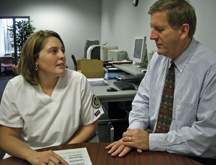 |
The new Medicare regulations for end-stage renal disease providers, which take effect Tuesday (Oct. 14), require that dialysis clinics provide both monitoring and surveillance of dialysis patients' vascular access sites. An access site is the connection between the patient and the machine that acts as an artificial kidney to filter impurities, waste and excess fluid from the blood and returns the blood to the patient's body.
Vasc-Alert's surveillance service enables dialysis providers to test the patient's access with every dialysis treatment. Patients on dialysis receive therapy three times each week. Vasc-Alert analyzes data taken during regularly scheduled dialysis treatments to check for "trends" or patterns outside the normal range. When data appears outside the normal range, Vasc-Alert makes a recommendation to health-care providers for further testing. Conventional monitoring and surveillance testing of dialysis patients currently are performed monthly using an ultrasound device to track access sites and blood flow. The conventional testing is done separately from the dialysis treatment.
"Vasc-Alert provides clinical staff with testing and trending analysis of the access site for every dialysis treatment rather than just once a month as with other surveillance methods. We collect and analyze data from every treatment," said Doug Curry, vice president of Vasc-Alert. "This frequency provides greater trending analysis that can assist clinics in meeting the new regulations which require 'timely referrals for intervention when indications of significant stenosis, a narrowing, are present.' Development of a stenosis is a common dysfunction of access sites. If left untreated, a stenosis can decrease the effectiveness of the treatment and put the patient at risk to lose the access."
Using Vasc-Alert's Web-based technology to analyze the access during each dialysis treatment benefits both patients and dialysis centers, said DeLynn Huff, Vasc-Alert's clinical coordinator.
"An access site can progress from looking fine to having a clotting incident in less than a month. We've seen that happen with patients," Huff said. "The more frequent the surveillance, the better care the patient receives. By meeting new Medicare regulations, dialysis centers ensure at-risk patients are identified and timely referrals for intervention will occur.
"In the long-term, Vasc-Alert surveillance of patients' accesses will likely decrease access-related costs to Medicare and provide those patients better outcomes and quality of care."
The U.S. Renal Data System's 2008 annual report states that in 2006 there were more than 500,000 Americans diagnosed with kidney disease who currently receive artificial kidney dialysis therapy. The Centers for Disease Control and Prevention projects the number of patients with kidney failure will increase to 650,000 by 2010.
About Vasc-Alert
Vasc-Alert LLC, is a privately held informatics company that uses computer technology to cost-effectively identify access dysfunction or stenosis in an effort to decrease vascular access-related hospitalization rates and associated costs of emergent access care due to clotting incidences. Vasc-Alert's patented technology, originally developed by a team of physicians and engineers at Henry Ford Hospital, provides a sophisticated data-evaluation process that measures and automatically trends a patient's intra-access pressures.
About Purdue Research Park
The 725-acre Purdue Research Park (https://www.purdueresearchpark.com) has the largest university-affiliated business incubation complex in the country. The park is home to more than 140 companies. About 90 of these firms are technology-related and another 39 are incubator businesses. The park was ranked No. 1 in 2004 for university-affiliated research parks and received the 2005 Outstanding Commercialization Award, both from the Association of University Research Parks. The park's companies also have received numerous recognitions, including a 2006 MIRA Award: Innovation of the Year for Purdue Research Park/Quadraspec Inc. and a 2005 CoreNet Global Innovators Award finalist. The Purdue Research Park is part of the Purdue Research Foundation, a private, nonprofit foundation created to assist Purdue University in the area of economic development. In addition to the Purdue Research Park in West Lafayette, the foundation has established or is currently constructing technology parks in other locations around Indiana including Merrillville, New Albany and Indianapolis.
To the Purdue Research Park, https://www.purdueresearchpark.com
PHOTO CAPTION:
Vasc-Alert LLC, a Purdue Research Park-based company, is poised to help dialysis centers meet new governmental regulations. Vasc-Alert's Vice President Doug Curry, at right, and company medical informatic specialist Jami Rice discuss a dialysis patient's report. (Purdue Research Foundation photo/Steve Martin)
A publication-quality photo is available at https://www.purdue.edu/uns/images/+2008/vascalert.jpg
Purdue Research Park contact:
Steve Martin, (765) 494-46872, sgmartin@prf.org
Sources:
Doug Curry, (765) 775-2525, dcurry@vasc-alert.com
DeLynn Huff, (765) 775-2525, dhuff@vasc-alert.com