


October 1, 2008
First genomics breeding program to benefit poultry industry
WEST LAFAYETTE, Ind. - |
Purdue University animal sciences professor Bill Muir is project co-director for the multimillion dollar research effort to determine the viability of using whole genome DNA selection to improve the accuracy and efficiency of breeding methods.
The project will test a novel way to select poultry for traits that are difficult or costly to measure or are not highly hereditary. Traits of interest include bone density, productivity, animal well-being, feed efficiency, yield, egg quality, growth, robustness and disease resistance.
"Finding individual genes responsible for these traits is terribly difficult," Muir said. "Our solution is to use a genomics strategy that is effective because it gets us simultaneously close to all genes and for all possible traits."
This new strategy is called whole genome selection.
Muir is partnering with Hans Cheng of the U.S. Department of Agriculture and the poultry breeding companies Hendrix Genetics in the Netherlands and Cobb-Vantress Inc. of Siloam Springs Ark.
Using blood to extract DNA from a chick, the breeding value of a particular bird is calculated based on a panel of 60,000 genetic markers, called single nucleotide polymorphisms or SNPs. These SNPs are evenly spaced throughout the chicken's genome.
"Using SNPs automates the process, thus making selection fast and cheap," he said. "The animals for breeding can be selected as early as one day of age based on analysis of the genetic markers, which could save vast amounts of money."
This technique could be used on other species, but is being tested first on poultry due to their short gestation period. Every 23 weeks scientists will have data on new offspring to determine the effectiveness of the method.
"Poultry has the shortest generation interval of the major agricultural species, and improvements in poultry breeding have tremendous economic potential," Muir said.
The participating companies represent about half of the world's poultry industry. Cobb-Vantress supplies about 50 percent of the broilers internationally and Hendrix Genetics about the same for chickens used for egg production.
The USDA is providing $2.5 million for the research, with another $2.5 million match from the companies. The corporations also are supplying additional research resources, such as birds, facilities and labor to collect trait measures, making the true value of the effort in excess of $10 million.
Findings of the study will be published and, if the technique proves successful, the method may be adopted by other poultry breeders and breeders of livestock in general.
In the last 40 years, poultry production has grown more than fivefold, making it the primary meat consumed in the United States. U.S. poultry producers are the largest exporters of poultry meat in the world.
"Because of the size of this industry, even small improvements in the breeding stock can provide a big competitive edge," Muir said. "This project is an example of the promise of biotechnology for producers."
Writer: Beth Forbes, (765) 494-2722, forbes@purdue.edu
Sources: Bill Muir, (765) 494-8032, bmuir@purdue.edu
Hans Cheng, supervisory research geneticist, hans.cheng@ars.usda.gov
Albert Paszek, Cobb-Vantress director of biotechnology, Albert.Paszek@cobb-vantress.com
Gerard Albers, Hendrix Genetics director of Research and Technology Centre, Gerard.Albers@hendrix-genetics.com
Ag Communications: (765) 494-2722;
Beth Forbes, forbes@purdue.edu
Agriculture News Page
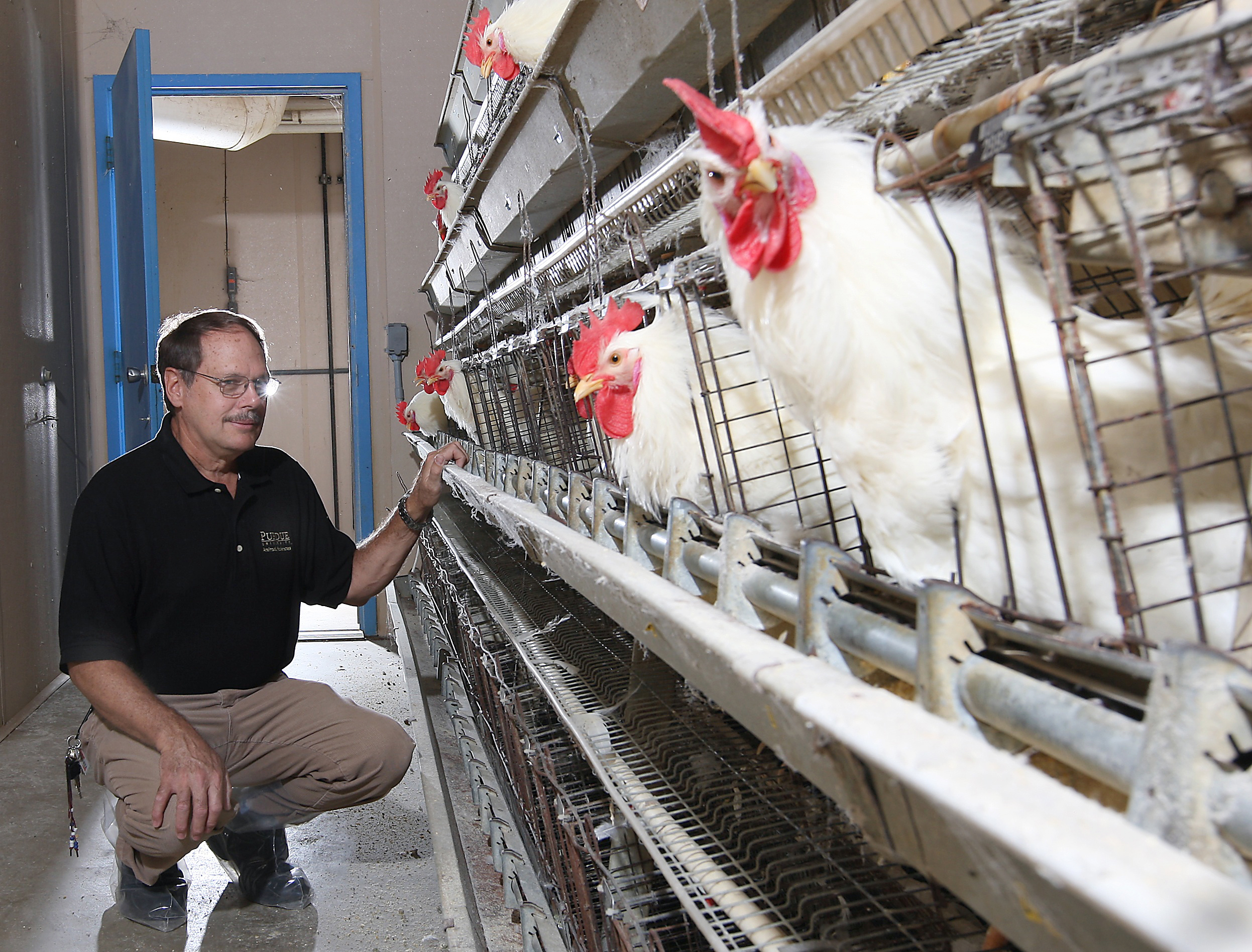
PHOTO CAPTION:
Bill Muir is co-project director for the world's first breeding program to use an animal genome. The multimillion dollar industry and university partnership will test a more efficient method for selecting chickens for breeding based genetic markers. (Purdue Agricultural Communication photo/Tom Campbell)
A publication-quality photo is available at https://www.purdue.edu/uns/images/+2008/muir-genomics.jpg
To the News Service home page