
| VIDEO |
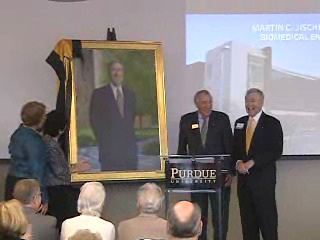 * Martin C. Jischke hailed at formal dedication of engineering building bearing his name. (2 minutes, 21 seconds) * Martin C. Jischke hailed at formal dedication of engineering building bearing his name. (2 minutes, 21 seconds) |


September 30, 2008
Jischke lauded, portrait unveiled in Purdue biomedical engineering building
WEST LAFAYETTE, Ind. - |
The Jischke ceremony also marked the 10th anniversary of the biomedical engineering program at Purdue.
"Dr. Jischke was pivotal in the creation of the Weldon School of Biomedical Engineering and the construction of this flagship facility," Purdue President France A. Córdova said. "Purdue will forever be in his debt for his contributions to the growth of biomedical engineering at the university."
The portrait of Jischke was unveiled during a ceremony at the building, located on the east side of Martin C. Jischke Drive, south of State Street.
"Innovative educational and research programs require an equally innovative set of classrooms and laboratories," said Jischke, who stepped down in 2007 after seven years as Purdue's 10th president. "Now Purdue biomedical engineering has a world-class facility to go with its top faculty and students."
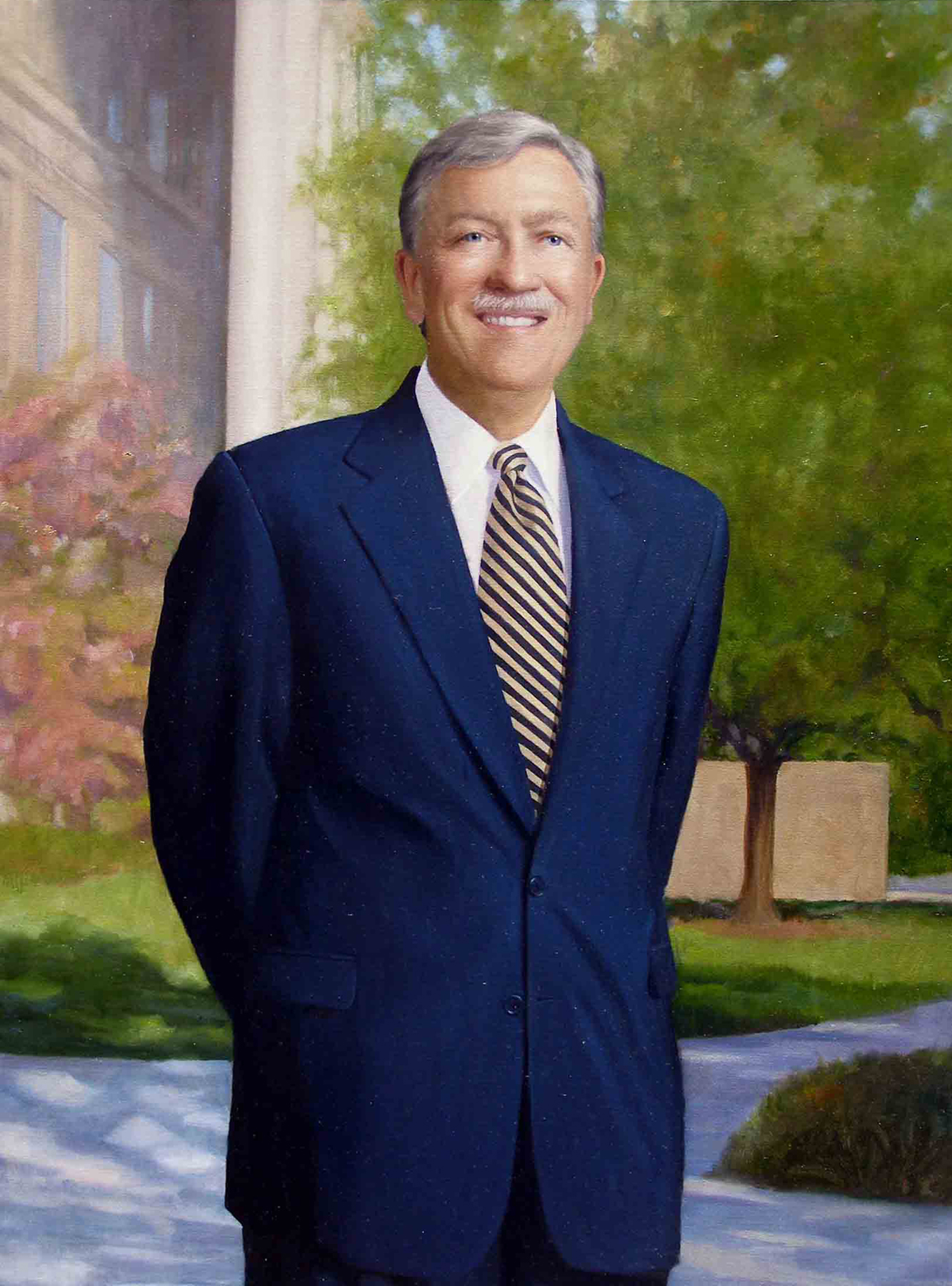
The oil painting measures 50 inches by 37 inches and shows a smiling Jischke dressed in a blue suit with an
 |
The $25 million facility – the first of its kind in Indiana – opened in the fall of 2006 and enabled Purdue to expand its then department of biomedical engineering into a full-fledged school. In so doing, Purdue created an undergraduate program in biomedical engineering that graduated its inaugural class last year.
"Dr. Jischke was instrumental in establishing a vision and obtaining support not only for the facility, but also for educational programs," said George Wodicka, head of biomedical engineering and a professor of both electrical and computer engineering and biomedical engineering. "We have hundreds of students now working on all sorts of projects - course projects, design projects, research projects. These projects ensure hands-on learning through intense laboratory activities and involvement in real-world problem solving."
A biomedical engineering program officially began at Purdue in 1998 with the formation of a department that built on a legacy that began in 1974 when the Hillenbrand Biomedical Engineering Center was formed by Leslie Geddes, Showalter Distinguished Professor Emeritus of Biomedical Engineering and recent recipient of the National Medal of Technology.
The Weldon School of Biomedical Engineering is now the fastest growing academic unit at Purdue, Wodicka said.
Since 2000 the program has expanded from four to 20 core faculty, 23 to 107 graduate students and zero to 168 undergrads.
"We want to emphasize the appropriateness of naming our building in Dr. Jischke's honor given how much biomedical engineering at Purdue has accomplished due to his vision and leadership," Wodicka said.
These accomplishments include the creation of the Purdue Imaging Center in partnership with GE Healthcare and Innervision West; the development of a graduate concentration in biomedical entrepreneurship, supported by the Guidant and C.R. Bard foundations; the establishment of a nanomedicine alliance with the Korean Institute of Science and Technology; and the formation of a collaborative graduate education program with the University of Puerto Rico at Mayaguez.
Biomedical engineering recently was recognized by U.S.News and World Report as a top-20 graduate program in the nation.
During Jischke's presidency, Purdue completed the Campaign for Purdue, which has brought in more than $1.7 billion in private gifts to the university.
"Purdue students on all campuses are benefiting greatly from the construction of more than $1 billion in new and renovated facilities completed or initiated during his tenure and made possible by his vision and leadership," said Leah Jamieson, the John A. Edwardson Dean of Engineering and Ransburg Distinguished Professor of Electrical and Computer Engineering.
The biomedical engineering building was officially named for Jischke last summer by the university's board of trustees.
The 91,000-square-foot building houses specialized laboratories and integrated educational facilities. Many projects in the labs involve partnerships with Indiana medical device and biotechnology companies that manufacture orthopedic, cardiovascular and tissue engineering technologies.
Indiana has grown into a globally recognized center for medical devices, including orthopedic and vascular implants, as well as clinical diagnostics, and the industry needs a steady supply of highly skilled and innovative employees, Wodicka said.
Purdue worked with architects to create a facility geared specifically for biomedical engineering and incorporate advanced features to enhance teaching and research.
Optics laboratories in the building's basement level are constructed on individual concrete slabs to improve the accuracy of instruments making measurements on the scale of nanometers, or billionths of a meter. The slabs isolate the instruments from vibrations that could affect measurements. In another lab, multiple chemical hoods are separated in alcoves to prevent possible cross-contamination.
"We had unparalleled collaboration among the architects and the faculty, staff and students to optimize the design," Wodicka said.
The Indianapolis office of BSA LifeStructures Inc., an architecture and engineering firm, designed the building, with Maregatti Interiors providing interior design. The facility's wings extend from a central area - a three-story space that promotes interactions among students, staff and faculty.
"The challenge for architects and engineers was not only to create a building to house new programs, but to do it alongside the development of a new undergraduate curriculum," said Kalevi Huotilainen, the BSA LifeStructures design leader for the project. "The creation of curriculum was interwoven with the creation of the building."
Primary teaching areas needed to be located in neighborhoods connected by a streetscape -diverse spaces that are extensions of the labs and classrooms, Huotilainen said. The goal was to remove barriers and help students, faculty and researchers connect.
"We also created a building that is tunable," he said. "Its labs and teaching spaces can be adjusted to meet changing needs."
One example of adaptability is the "flex lab" for engineering design courses, which uses a "dance floor" approach that easily allows benches and other mobile equipment to be quickly changed for the varied aspects of prototype design and testing.
The building was funded with $13 million from the state, $5 million from the Whitaker Foundation and $7 million from alumni and other private donors. The state also provided $7.5 million for 2003-05 to launch the new undergraduate program and expand the graduate program.
Biomedical engineering researchers have made discoveries that have resulted in more than 100 U.S. patents, the majority of which have been licensed to Indiana companies, and bringing in royalties that exceed those from all other Purdue royalty sources combined.
The work has included research to develop:
* Commercially successful, energy efficient cardiac defibrillators.
* Synthetic and natural "biomaterials" used in surgery to repair and regenerate diseased or damaged tissues, such as bladders, blood vessels, ligaments, skin and eyes.
* Modeling and experimental techniques to design, evaluate and improve artificial joints.
* New devices that monitor the vital signs of premature babies.
* Materials used to create controlled-release pills and implantable devices designed to automatically deliver therapeutic drugs to the body.
* New imaging techniques to detect and help treat cancer.
* Systems that monitor subtle seismic waves traveling through bones to detect and prevent fractures and injuries in humans and animals.
* Therapies for spinal cord damage that encourage the body to self-heal.
The Weldon School of Biomedical Engineering is the first named school in the history of Purdue engineering. It is named in recognition of a critical $10 million gift from the Weldon family of Evergreen, Colo., and Atlanta, and their longstanding association with biomedical engineering at Purdue.
Jischke came to Purdue in 2000 from Iowa State University, where he was president for nine years. He had been chancellor at the University of Missouri-Rolla and a faculty member, director, dean and interim president at the University of Oklahoma. He received a bachelor's degree in physics from the Illinois Institute of Technology and a doctorate in aeronautics and astronautics from the Massachusetts Institute of Technology.
Writer: Emil Venere, (765) 494-4709, venere@purdue.edu
Sources: France A. Córdova, (765) 494-9708, president@purdue.edu
Leah H. Jamieson, (765) 494-5346, lhj@purdue.edu
George Wodicka, (765) 494-2998, wodicka@purdue.edu
Kalevi Huotilainen, (317) 819.2123, bsalifestructures.com
Purdue News Service: (765) 494-2096; purduenews@purdue.edu
Note to Journalists: Biographical information about artist Laurel Stern Boeck is available from Emil Venere, (765) 494-4709, venere@purdue.edu. Publication-quality photographs of the portrait and of biomedical engineering researchers also are available.
PHOTO CAPTION:
With the newly unveiled portrait behind him, former Purdue President Martin C. Jischke speaks at the dedication of the Martin C. Jischke Hall of Biomedical Engineering on Tuesday (Sept. 30). The $25 million facility enabled Purdue to expand its department of biomedical engineering into a full-fledged school and to create an undergraduate program in biomedical engineering. (Purdue News Service photo/Andrew Hancock)
A publication-quality photo is available at https://www.purdue.edu/uns/images/+2008/jischkehall.jpg

PHOTO CAPTION:
This portrait of former Purdue president Martin C. Jischke was painted by New York artist Laurel Stern Boeck. The oil painting will hang the southwest entrance of the Martin C. Jischke Hall of Biomedical Engineering. Jischke will be formally recognized for his influence on the biomedical engineering program during a ceremony that also will mark the program's 10th anniversary. (Photo courtesy of Portraits Inc.)
A publication-quality photo is available at https://www.purdue.edu/uns/images/+2008/jischkepainting.jpg
To the News Service home page