


August 19, 2008
Goss' bacterial wilt confirmed for first time in Indiana
WEST LAFAYETTE, Ind. -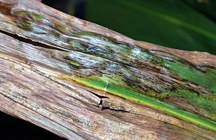 |
The confirmed samples were from popcorn and hybrid corn fields in Pulaski County. The disease is common throughout the Midwest in limited areas and years and is currently only confirmed in the one Indiana county. Purdue Extension field crops disease specialist Kiersten Wise and other specialists believe that early hailstorms and recent heavy rains and windstorms likely contributed to the infection and dispersal of Goss' wilt in Indiana fields.
This is not a concern for consumers and has no impact on food safety, but it is more of a concern for producers, Wise said. There also may be implications for infected grain that's scheduled to be exported.
Philip Marshall, director of Indiana Department of Natural Resources' Entomology and Plant Pathology Division, said his staff is reviewing the phytosanitary requirements for certificates required for export.
"We don't know how much impact the bacteria will have on the corn crop in this area because we don't know what kind of resistance hybrids grown in Indiana have," Wise said. "Additional hail storms and wind-driven rain could spread Goss' bacterial wilt locally; however, it's a very manageable disease."
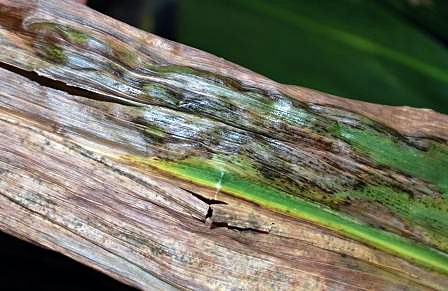
The disease, first discovered in Nebraska and caused by a subspecies of the bacterium Clavibacter michiganensis, is characterized by distinct light tan to gray lesions filled with dark specks.
"Lesions will often appear shiny due to bacteria oozing on the leaf surface," Wise said. "Blighted areas are common in susceptible varieties and can be confused with drought stress.
"The dark flecking and shiny areas within lesions distinguish Goss' wilt from other bacterial diseases."
The disease infects the plant's vascular tissue, causing a systemic infection that can lead to wilting and stalk degradation. The infected tissue appears orange to brown in color.
Wise said unlike Stewart's wilt, Goss' wilt does not rely on insects for disease transmission, but is both seedborne and seed transmitted. The plant has to have wounds for dispersal, she said.
"Once seed to seedling transmission occurs, disease spreads in areas that have experienced hail damage or wind-driven rain," Wise said. "It's important that farmers recognize and identify this disease as a bacterial disease because fungicides will not control it."
Because the disease can live in infected corn residues on the soil surface, farmers with infected fields need to use tillage to break down the residue and incorporate it into the soil, she said. The affected field also should be rotated to a different crop from this year's.
Purdue Extension, in collaboration with Indiana's Department of Natural Resources, will host a meeting on Tuesday (Aug. 26) in Francesville to give farmers more information about the disease and grain transportation implications. More information on the meeting will be announced as details are finalized.
In an effort to see if there are other affected areas, Purdue Extension and the Department of Natural Resources will increase survey efforts. Suspect samples may be sent to the Purdue Plant and Pest Diagnostic Laboratory for diagnosis. There is an $11 handling fee and a $25 testing fee for serological confirmation of the bacteria. For more information about sample submission, go online to https://www.ppdl.purdue.edu/PPDL/physical.html
More information on Goss' bacterial wilt is available online at https://www.ianrpubs.unl.edu/epublic/live/g1675/
build/g1675.pdf. For questions and additional information, contact Wise at (765) 496-2170, kawise@purdue.edu.
Writer: Julie Douglas, (765) 496-1050, douglajk@purdue.edu
Sources: Kiersten Wise, (765) 496-2170, kawise@purdue.edu .
Gail Ruhl, Purdue Plant and Pest Diagnostic Laboratory senior plant disease diagnostician, (765) 494-4641, ruhlg@purdue.edu
Tom Creswell, director of the Purdue Plant and Pest Diagnostic Laboratory, (765) 430-4392, creswell@purdue.edu
Philip Marshall, (317) 232-4120, PMarshall@dnr.IN.gov.
Ag Communications: (765) 494-2722;
Beth Forbes, forbes@purdue.edu
Agriculture News Page
PHOTO CAPTION:
Corn leaf infected by Goss' bacterial wilt. (Purdue University photo/Kiersten Wise)
A publication-quality photo is available at https://www.purdue.edu/uns/images/+2008/wise-gosswilt.jpg
To the News Service home page