
Discovery Lecture puts spotlight on science, technology, engineering, math learning
|
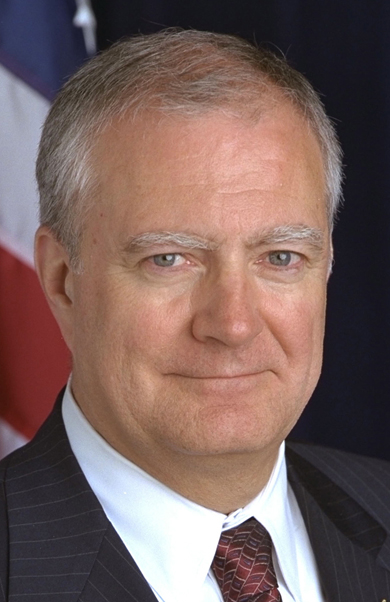
John Marburger III, director of the White House Office of Science and Technology Policy, at 1:30 p.m. will deliver the keynote address for the latest Discovery Lecture Series event. He will outline President Bush's initiative to bolster the federal government's efforts in science and technology learning and research.
Marburger's talk, titled "The American Competitive Initiative: Leading the World in Innovation," is sponsored by Purdue's Discovery Park and the Lilly Endowment. Because of growing interest, Marburger's lecture has been moved to Stewart Center's Loeb Playhouse.
Several Indiana K-12 teachers plan to bring their students to hear Marburger's discussion and participate in the day's activities.
|
"The high school curriculum in chemistry and physics establishes a fundamental exposure to these areas of science," said Cheryl McLean, who teaches chemistry and physics at McCutcheon High School in Tippecanoe County. "But this study can be a bit limited in scope and depth, so students are not necessarily excited about pursuing the latest research topics. Through the Discovery Lecture and Dr. Marburger's visit to Purdue, we will have the opportunity to peek into this research firsthand."
Several recent reports, including "Rising Above the Gathering Storm: Energizing and Employing America for a Brighter Economic Future" by the National Academies, stress the need to boost basic scientific research in this nation's physical sciences and engineering and to train more math and science teachers. In response, President Bush has pledged to double funding for the most critical research in those areas, an investment of $50 billion over the next decade.
Addressing these challenges will take a concentrated effort by scientists, educators, entrepreneurs and political leaders, McLean said. Discussions that bring together our current and next generation of scientists and educators can only help to bridge that next big step.
"We forget that the leaders within the scientific community were once high school chemistry and physics students," McLean said. "The challenges of our world will not be eliminated in the near future, so bright, young minds must continue to be directed toward problem-solving whether the topic is eliminating our dependency on oil or curing disease."
Laura Slocum, who teaches science at University High School of Indiana in Carmel, Ind., will bring junior and senior students who are members of the school's Science National Honor Society to the lecture. She hopes the daylong event will help them decide which careers to pursue.
"These students are very interested in exploring different opportunities and career paths that may be open to those with a science degree," said Slocum, who has taught chemistry for 15 years, including the last six at University High.
Purdue senior Benjamin Pruden said his desire to become an occupational health physician was sparked during his high school science classes. On Friday, Pruden will be among several Purdue students talking about their campus research during a poster session at the Birck Nanotechnology Center. Pruden will discuss an "Idea-to-Product" project his team developed through the Engineering Products in Community Service program.
"My excitement and passion for the sciences, health and medicine stem from my many teachers, family members and others who encouraged me at an early age to study this in college and carry that love into a career," said Pruden, a Noblesville, Ind., native who is studying health sciences.
Research presentations also will be given about the Network for Computational Nanotechnology at Birck, the Interns for Indiana and Discovery Park Undergraduate Research Internship programs, and research projects within the Center for Advanced Manufacturing and the Discovery Learning Center.
"Discovery Park is working with industry, educators and policy-makers to ensure our future U.S. work force has the necessary science and technology skills to compete," said Steve Shade, managing director of the Center for Advanced Manufacturing. "We are discovering tools that will help advance the national agenda on how U.S. manufacturers will compete globally."
Marburger will meet with Purdue President Martin C. Jischke and hear presentations about Discovery Park's research in energy, nanotechnology, health care and homeland security. Tours of Discovery Park and Purdue Research Park labs and facilities also are planned.
Before his appointment to the White House post in 2000, Marburger was director of Brookhaven National Laboratory since 1998. He had served as president of the State University of New York at Stony Brook on Long Island and as dean of the College of Letters, Arts and Sciences at the University of Southern California.
Marburger attended Princeton University, earning a bachelor's degree in physics and then received a doctoral degree in applied physics from Stanford University.
Discovery Park, which is located on the southwestern edge of Purdue's West Lafayette campus, is a $330 million hub for interdisciplinary research and is home to 10 primary centers focusing on everything from biosciences, nanotechnology and manufacturing to cancer care, homeland security and health-care engineering.
Writer: Phillip Fiorini, (765) 496-3133, pfiorini@purdue.edu
Sources: Cheryl McLean, (765) 474-1488, ext. 4063, cmclean@tsc.k12.in.us
Laura Slocum, (317) 733-4475, ext. 203, lslocum@universityhighschool.org
Benjamin Pruden, (317) 776-2216, bpruden@purdue.edu
Steve Shade, (765) 494-1279, sashade@purdue.edu
John Marburger III, (202)-456-6098
Purdue News Service: (765) 494-2096; purduenews@purdue.edu
Note to Journalists: White House adviser John Marburger III and Purdue President Martin C. Jischke will be available to talk to journalists from 11-11:30 a.m. Friday (Oct. 27) in the Birck Nanotechnology Center. Marburger and Jischke also will tour Discovery Park facilities from 9-9:30 a.m. After the 1:30 p.m. lecture, Marburger will tour Purdue Research Park from 3-4 p.m. For more information, including parking details, contact Phillip Fiorini, Purdue News Service, at (765) 596-3133, pfiorini@purdue.edu.
PHOTO CAPTION:
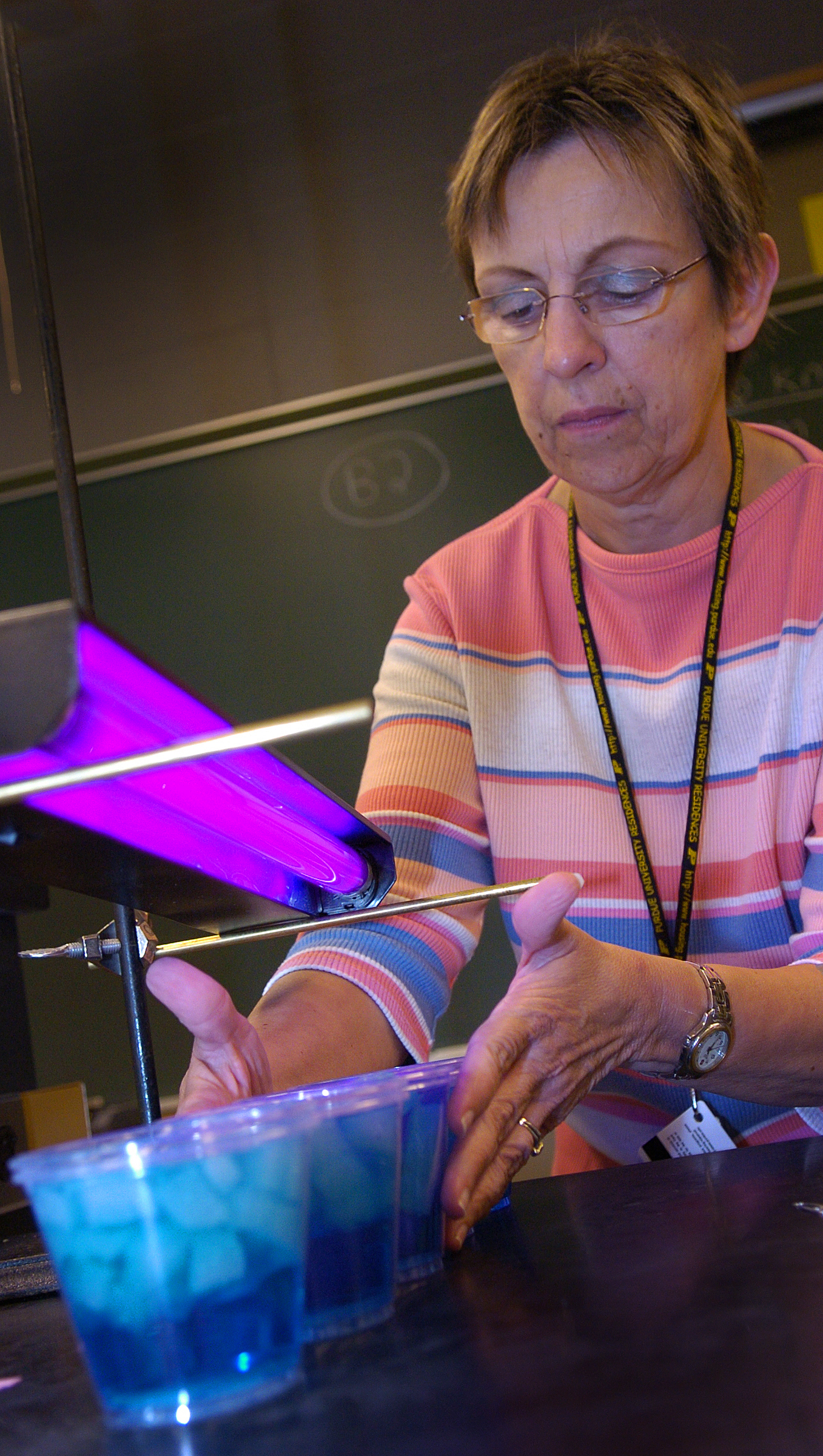
Diane McKnight, a chemistry teacher at Danville High School from Plainfield, Ind., conducts an experiment as part of a summer workshop in the National Center for Learning and Teaching in Nanoscale Science and Engineering. Indiana high school science teachers participated in the two-week workshop taught by physics professor Nicholas Giordano. Offered through Purdue's Discovery Learning Center, the National Center for Learning and Teaching in Nanoscale Science and Engineering offers expertise in science education, learning tools, visualization and simulation, nanoscience, engineering and evaluation. McKnight's experiment looked at titanium as an additive in sunscreens to block ultraviolet rays. White House science adviser John Marburger III is speaking at Purdue on Friday to discuss what can be done to improve U.S. teaching and learning in science and technology. (Purdue News Service photo/David Umberger)
A publication-quality photo is available at https://www.purdue.edu/uns/images/+2006/marburger-DLCnano.jpg
To the News Service home page